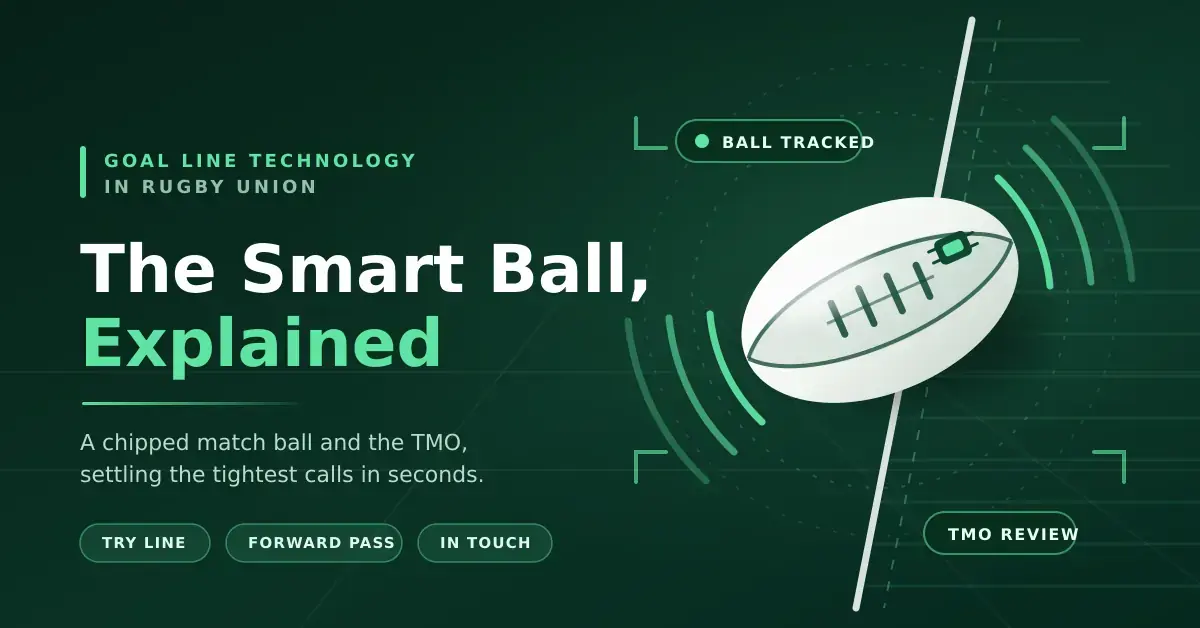
Technology is steadily reshaping the sports we love, and rugby union is no exception. Much of the recent conversation centres on the smart ball — an electronically tracked match ball that can tell officials, almost instantly, exactly where the ball is on the field. It is often described in shorthand as “goal line technology”, borrowing a phrase from football, but in rugby it is really a broader officiating tool aimed at settling try-line, forward-pass and touch decisions quickly. This guide explains what the technology is, how it works, where it has already been used and how rugby’s cautious approach compares with other sports.
Key Points
- What it is: a smart ball with built-in electronics, plus the Television Match Official (TMO), used to judge tries and other tight calls.
- Who built it: developed by Sportable with Gilbert, World Rugby’s official ball supplier.
- What it decides: try-line grounding, forward passes, in-flight touches, where the ball found touch, and lineout throws.
- How it works: radio signals to around ten stadium beacons, locating the ball in 3D to within a few centimetres up to 20 times a second.
- Where it has been used: Six Nations broadcast data from 2023, a live officiating trial at the June 2023 U20 Championship, and “Touchfinder” at the 2025 Men’s Six Nations.
What “goal line technology” means in rugby
In football, goal line technology confirms one thing: whether the whole of the ball has crossed the goal line for a goal. Rugby union has no goal in that sense. The equivalent match-defining moment is a try, which is awarded when a player grounds the ball on or beyond the opposition’s try line. So when people talk about “goal line technology” in rugby, they usually mean tools that help officials judge whether the ball was legally grounded over the line — and, increasingly, other tight calls too.
The two pieces that do this work are the Television Match Official (TMO) — a video referee who reviews broadcast footage and advises the on-field referee — and, more recently, the smart ball, which adds precise positional data on top of the video. If you are new to the sport, our guide on how to play rugby explains tries, the try line and the basic laws these tools are built around.
How the smart ball works
The smart ball was developed by sports-technology company Sportable together with Gilbert, World Rugby’s official ball supplier. From the outside it looks and plays like a normal match ball: the electronics are built in without changing its weight or balance in any noticeable way.
Inside, a lightweight microchip, battery and sensors sit just below the valve, including a gyroscope that measures spin and orientation. The ball communicates by radio frequency up to 20 times per second with a set of beacons — typically around ten — placed around the stadium. By triangulating those signals, the system can pinpoint the ball’s position in three dimensions to within a few centimetres, in real time. You can read the manufacturer’s own explanation of the smart ball technology for the finer detail.
Crucially, the goal is not only accuracy but speed. Because the data is available almost instantly, officials can reach a decision without long stoppages — a common criticism of video review in other sports.
What decisions the technology can help with
During its officiating trials the smart ball has fed data directly to the TMO to support several tight calls:
- Try-line decisions: whether the ball reached or crossed the try line.
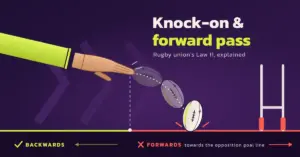
- Forward passes: tracking the ball’s movement to help judge whether a pass travelled forward.
- In-flight touches: detecting whether a ball was touched, for example off a charge-down or knock-on.
- Finding touch: identifying exactly where the ball crossed the touchline from a kick.
- Lineout throws: checking whether a throw was straight.
Several of these overlap with the game’s discipline laws — our explainer on the offside and forward-pass rules shows why forward-pass calls in particular are so hard to judge with the naked eye.
Where and when it has been used
The technology has moved from concept to match use over several seasons:
- 2022: Sportable publicly demonstrated a smart ball that could detect forward passes.
- 2023 (Six Nations): the smart ball began supplying live performance and broadcast insights, such as kick distance and pass speed, to television coverage.
- June 2023 (U20 Championship, South Africa): World Rugby ran the first live trial of the smart ball in a match-officiating capacity, feeding data to the TMO. Our overview of U20 rugby covers the tournament where that milestone happened.
- 2025 (Men’s Six Nations): a feature called “Touchfinder” debuted, using the smart ball to help assistant referees pinpoint where kicks went into touch.
In other words, the answer to whether rugby should “embrace” this technology is partly that it already has: the smart ball is established in broadcast data and has taken its first steps into senior officiating, even if it is not yet used for every decision at the top level.
How rugby compares with other sports
Rugby union has actually leaned on video officiating for a long time. Television replays were first used to help a decision in Pretoria in 1995, SANZAR brought a TMO into Super 12 from 2000, and rugby union adopted the TMO more widely from 2001. That is well ahead of football, which only introduced Video Assistant Referees (VAR) at senior international level around the 2018 World Cup, and added goal line technology from 2012.
Rugby league went down the video-referee road early too, experimenting with television officials as far back as 1996 — though that is a separate code from rugby union and should not be confused with union’s own timeline. The table below sets the main systems side by side.
Officiating Technology Compared
| Sport | Main technology | What it helps decide | In use since |
|---|---|---|---|
| Rugby union | Smart ball + TMO (World Rugby) | Try line, forward pass, touch, lineout | TMO from ~2001; smart ball trials from 2023 |
| Football | Goal line technology & VAR (Hawk-Eye) | Whole ball over goal line; key incidents | Goal line tech from 2012; VAR from ~2018 |
| Rugby league | Video referee | Grounding, obstruction | Mid-1990s |
| Cricket | DRS / ball tracking | LBW, edges, boundaries | 2000s |
| Tennis | Electronic line calling | In or out line calls | 2006 |
The benefits and the concerns
Supporters point to clear advantages. Decisions can be more accurate and consistent, contentious try-line and forward-pass calls are easier to resolve, and quick data can actually speed play up rather than slow it down. It also takes pressure off referees by giving them objective evidence to lean on.
There are genuine concerns as well. Some fans feel constant review interrupts the flow and dampens the instant celebration of a try. There is a risk of over-reliance on data for calls that still need human judgement. And there is a practical cost: the beacon infrastructure and balls are not yet available at every ground, which raises questions about consistency between elite and community rugby. The technology sits within the wider trend covered in our look at rugby’s evolution from past to present.
Rugby, technology and the fan experience
Officiating is only one place technology touches the game. Broadcast graphics, player-tracking data and second-screen apps have all changed how supporters follow matches, a shift explored in our piece on enhancing the Kiwi fan experience through digital innovation. The sport’s profile also reaches into entertainment, from console and PC rugby titles to themed online slot games such as the latest arrivals in slot gaming. Those are commercial gambling products aimed at adults and are unrelated to how the game is officiated — the note below has more on that.
Disclaimer
This article is for general information about rugby and its technology, not gambling advice. Online gambling in New Zealand is restricted to adults aged 18 and over, involves financial risk, and outcomes are based on chance — no game or offer improves your odds. If gambling is affecting you or someone you know, free confidential support is available from the Gambling Helpline NZ and the Choice Not Chance service.
Sources
- World Rugby – Rugby’s smart ball to support officiating at the U20 Championship
- Gilbert Rugby – Inside the smart rugby ball
- Six Nations Rugby – Smart ball delivers Touchfinder
- Sky Sports – Rugby’s smart ball and new data at the 2023 Six Nations
- CNN – A smart rugby ball that can detect forward passes
- Rugby365 – History of the TMO
Frequently Asked Questions (FAQ)
Does rugby union use goal line technology like football?
Not in the same form. Football’s goal line technology confirms whether the whole ball crossed the goal line. Rugby’s equivalent is deciding whether a try was grounded over the try line, which is handled by the Television Match Official reviewing footage, now supported by data from the smart ball.
What is the smart ball and who makes it?
The smart ball is a standard-looking match ball with built-in electronics that track its exact position on the field. It was developed by the technology company Sportable together with Gilbert, World Rugby’s official ball supplier.
Has the smart ball been used in top-level rugby yet?
Yes, in stages. It supplied broadcast data during the 2023 Six Nations, was trialled for live officiating at the June 2023 World Rugby U20 Championship in South Africa, and its “Touchfinder” feature debuted at the 2025 Men’s Six Nations.
How accurate is the smart ball?
The system communicates with beacons around the stadium up to 20 times per second and can locate the ball in three dimensions to within a few centimetres in real time, which is why it can help judge tight try-line, touch and forward-pass calls.
Will technology slow rugby down?
That is the main worry, and one reason the smart ball is being introduced gradually. Because its data is almost instant, the aim is to speed up decisions rather than create long stoppages, but the balance between accuracy and game flow is still being tested.