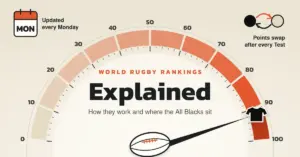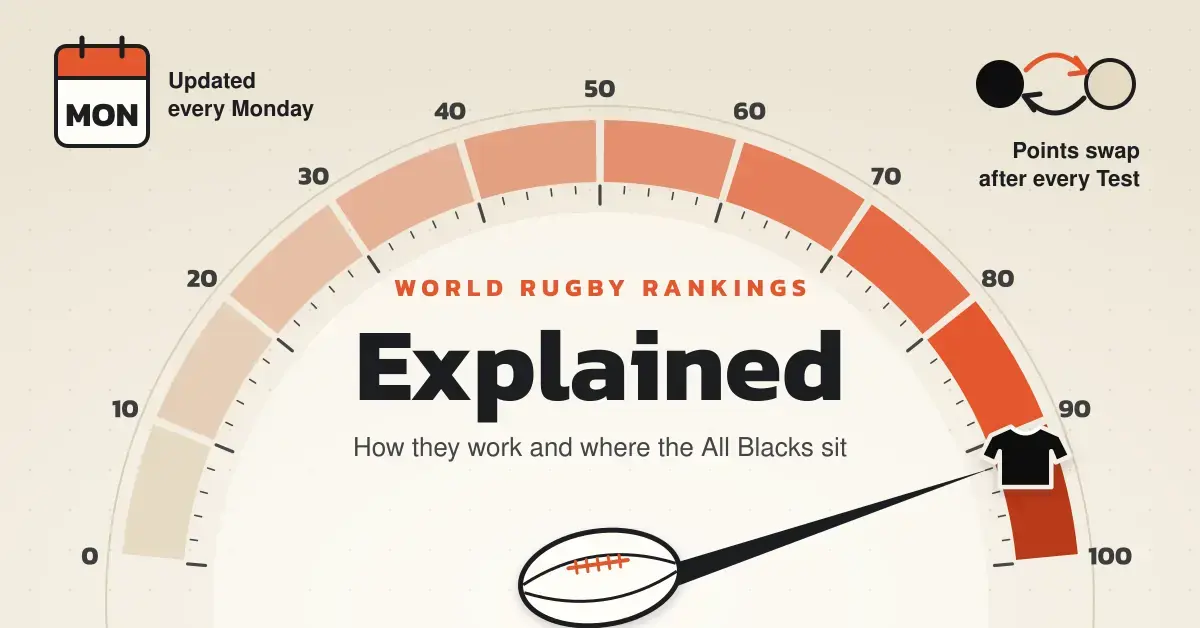
The World Rugby Rankings are the official scoreboard of international rugby union — a single table that sorts every national men’s team from best to worst, with a separate table for the women’s game. They are run by World Rugby, the sport’s global governing body, and refreshed every Monday during the international season. For New Zealand supporters, the rankings answer the question that comes up after every Test: are the All Blacks still near the summit, and who is ahead of them? This guide explains, in plain English, how the numbers are worked out, what moves a team up or down, and exactly where New Zealand currently sits.
What the world rugby rankings measure
The rankings are a rolling rating of international form rather than a one-off opinion poll. Every full member nation carries a single rating — a number that typically falls between 0 and 100, with the world’s leading side usually sitting somewhere above 90. The gaps between those numbers matter just as much as the order itself, because they show how close (or how far apart) two teams really are.
The system was introduced in October 2003, in the month before that year’s Rugby World Cup, and the first list was published on 6 October 2003. Back then the sport’s governing body was called the International Rugby Board, so the table was known as the IRB World Rankings. When the IRB rebranded as World Rugby in 2014, the rankings took on their current name. A separate women’s ranking runs on the same principles, which we cover further down.
Key Facts
- Run by: World Rugby (the sport’s global governing body)
- System: Points Exchange — a zero-sum trade of points after each Test
- Introduced: October 2003 (originally the IRB World Rankings)
- Scale: ratings run from 0 to 100; the world leader is usually above 90
- New members start on: 30 points (men) and 40 points (women)
- Big wins: a victory by more than 15 points is multiplied by 1.5
- World Cup matches: points exchanges are doubled
- Home-advantage bonus: removed from 1 July 2026
- Current men’s No. 1: South Africa; the All Blacks sit second
- Updated: every Monday during the international season
How the points exchange system works
At the heart of the rankings is a method World Rugby calls the Points Exchange. It is best thought of as a zero-sum trade: after every eligible Test, points are moved from one team to the other, so whatever the winner gains, the loser gives up by exactly the same amount. The total number of rating points in the system never changes — it is simply redistributed match by match.
Two rules keep the system fair and intuitive:
- A win never costs points, and a loss never adds them. You cannot climb by losing well, and you cannot fall by winning ugly.
- Narrow defeats to stronger teams earn nothing. Running a top side close is admirable, but only the result changes the ratings.
The factors that decide the swing
How many points change hands depends on three things:
- The ratings before kick-off. The calculation starts from each side’s current rating and the gap between them. Beating a team rated far below you earns only a small reward; causing an upset against a much higher-rated side brings a far bigger gain.
- The result. A match can only end in one of three ways for ratings purposes — a home-or-away win, a draw, or a loss — and the result is the single most important input.
- The winning margin. The scoreline nudges the figure, but World Rugby is clear that the result matters more than the margin.
So if a top-five nation beats a team ranked 20th, it might gain only a fraction of a point, because it was expected to win. If that same lower-ranked team pulls off the upset, it could jump several places in one afternoon. This is why the biggest ranking shifts almost always follow a shock result rather than a routine one, and why the smallest margins between two closely matched giants — think New Zealand and South Africa — can take several Tests to open up.
Margin, the World Cup and the 2026 home-advantage change
A few multipliers sit on top of the core calculation:
- Big wins count for more. If a team wins by more than 15 points, the core rating change is multiplied by 1.5. A tighter win still scores, just by a smaller amount.
- World Cup matches are doubled. During the Rugby World Cup finals, every points exchange is worth twice as much, to reflect the importance of the tournament.
- Home advantage has been removed. For most of the system’s history the home side was treated as three rating points stronger than its actual figure, to offset the benefit of playing at home. From 1 July 2026, World Rugby scrapped that home weighting. The reason given was the growing number of Tests played at neutral or centralised venues, where a home bonus made little sense. In short, where a match is played no longer changes the sums.
Every full international outside the World Cup — whether a one-off friendly or a title decider — is treated the same way.
How teams enter and climb the rankings
Only full internationals between two World Rugby full member unions count towards the ratings. A match against a team that is not a full member, or any game that is not a recognised Test, simply does not move the needle.
New member nations do not start from zero. Since December 2012, a new men’s full member joins on a rating of 30 points and is treated as provisional until it has played ten Tests; in the women’s game, newer members begin on 40 points. From there, a side rises or falls purely on results against other ranked nations. Because the exchange is proportional, a run of wins over strong opponents lifts a team quickly, while a losing streak against lower-rated sides drains points fast.
The system also builds in some common sense for unusual situations. There is a limit on how much a single result can move a rating, so one freak scoreline cannot send a team rocketing up or crashing down overnight. Nations that stop playing for several years can become “dormant” and drop off the current list, then return at their previous rating when they play again. And when unions merge or split, the new entity inherits a rating based on its predecessors rather than starting afresh. These details rarely affect the top teams, but they keep the full list — well over 100 ranked nations — stable and meaningful.
Where the all blacks sit
As of late September 2026, New Zealand are ranked second in the men’s world rankings on roughly 91 points, behind South Africa in top spot on around 93. The Springboks moved clear after taking the 2026 “Greatest Rivalry” series against the All Blacks 3–1, a run of results that opened up the gap between the two great southern-hemisphere rivals. Because the table is recalculated every Monday, the exact decimals shift week to week — the official figures always live on World Rugby’s site.
Even sitting second, New Zealand’s long-term record in these rankings is unmatched. The All Blacks have spent more weeks at number one than any other nation — around 750 in total — and hold the longest unbroken run at the top, roughly 509 weeks from November 2009 to August 2019. Their highest rating of 96.57 was reached on 10 October 2016. For more on the current side and its results, see our guides to the All Blacks’ 2026 games and the history of New Zealand versus South Africa.
Men's Rankings Top 10
| Rank | Team | Rating points |
|---|---|---|
| 1 | South Africa | 93.09 |
| 2 | New Zealand | 91.15 |
| 3 | Ireland | 88.08 |
| 4 | France | 87.43 |
| 5 | England | 85.68 |
| 6 | Australia | 85.55 |
| 7 | Scotland | 84.78 |
| 8 | Argentina | 82.24 |
| 9 | Japan | 77.28 |
| 10 | Fiji | 76.81 |
Men’s world rankings as of late September 2026. Figures update every Monday — check World Rugby for the latest.
Why the rankings matter beyond bragging rights
The table is more than a talking point. Its most important job is seeding major draws. The pools for the Rugby World Cup 2027 were built using ranking bands, so a team’s position at the cut-off date decides whether it is a top seed or risks landing in a tough group. A slip of one or two places months earlier can shape a whole tournament.
Rankings also frame the storylines around marquee competitions such as the 2026 Nations Championship, where every meeting between top-eight sides can reorder the leaderboard. And for players and unions, holding a high ranking carries real prestige and, often, commercial value.
The women’s rankings and the Black Ferns
World Rugby publishes a separate women’s ranking that uses the same points exchange. England’s Red Roses sit at number one after winning the 2025 Women’s Rugby World Cup, with New Zealand’s Black Ferns close behind near the top of the table — the first time in the rankings’ history that New Zealand’s women have been outside the top two for a spell. As with the men, the women’s list is official and updated regularly, so the current order is best checked on World Rugby’s site.
Common misunderstandings
A few myths cling to the rankings. Clearing them up makes the table far easier to read:
- They are not a prediction. The rankings describe past results, not a forecast of who will win on the day.
- You cannot farm points by losing narrowly. Only wins and draws add to a rating; a brave defeat changes nothing.
- Margins matter less than you think. A 50-point thrashing and a one-point win against the same team are close in value; the bonus for a 15-plus-point win is modest.
- Friendlies count too. Every full Test outside the World Cup carries equal weight, so a “warm-up” can still shift the table.
Understanding those points turns the weekly update from a mystery into a clear read on international form. For a wider sense of how the Test game reached this level, our overview of the history and evolution of rugby union adds useful context.
Sources
Frequently Asked Questions
Who is number one in the world rugby rankings right now?
As of late September 2026, South Africa lead the men’s rankings on about 93 points, with New Zealand second on roughly 91. The table is recalculated every Monday during the season, so the exact numbers and order can change after each round of Tests. The live figures are published on World Rugby’s official rankings page.
How are world rugby ranking points calculated?
Each Test moves points from one team to the other through a “points exchange”. The size of the swing depends on the two sides’ ratings before kick-off, the result, and the margin of victory. Beating a much weaker team earns little, while an upset win earns a lot. Wins by more than 15 points are boosted by half again, and World Cup matches are worth double.
Did world rugby change the rankings in 2026?
Yes. From 1 July 2026, World Rugby removed the home-advantage weighting that had treated the home side as three rating points stronger. The change was made because so many Tests are now played at neutral or centralised venues, where a home bonus no longer made sense. Venue no longer affects the calculation.
Why do the All Blacks matter so much in the rankings?
New Zealand have spent more total weeks at number one than any other nation — around 750 — and hold the longest unbroken run at the top, from 2009 to 2019. Their peak rating of 96.57 came in October 2016. Even when they are ranked second, that record makes every move the All Blacks make a major talking point.
What is the difference between the rankings and a competition table?
A competition table, such as the Rugby Championship standings, only counts matches within that single tournament and resets each year. The world rankings are continuous: they carry over from season to season and include every eligible Test a nation plays, which is why a team can top a tournament yet still sit below a rival in the world rankings.