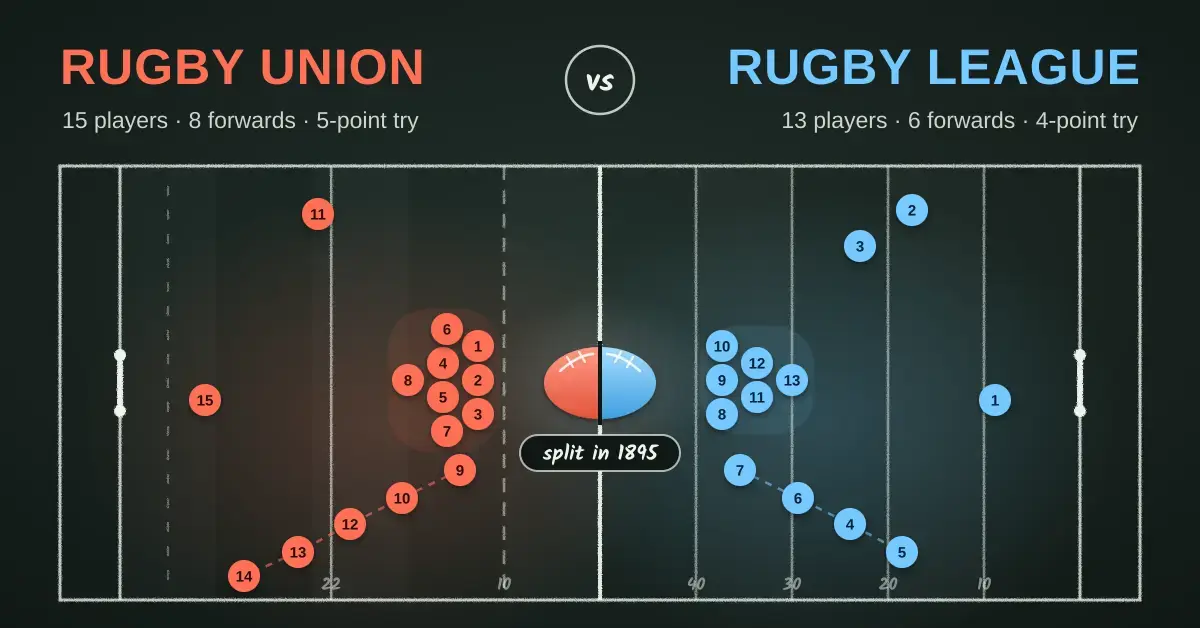
To someone new to the game, rugby union and rugby league can look almost identical: two teams, an oval ball, hard tackles and players driving over a try line. Yet they are two distinct sports with separate rulebooks, different team sizes, different scoring and very different rhythms of play. They grew from the same root in 19th-century England before splitting apart in 1895, and today each has its own competitions, governing bodies and following in New Zealand. This guide explains what sets them apart — the rules, the positions and the key differences — in plain language, so you can follow either code with confidence.
One game, then two: the 1895 split
Both codes descend from the handling game codified at English public schools and later organised by the Rugby Football Union (RFU), formed in 1871. The division came down to money. Many clubs in the industrial north of England had working-class players who lost wages when they took time off work to play or travel to matches. These clubs wanted to pay “broken-time” compensation for those lost earnings; the RFU, committed to strict amateurism, refused.
The dispute came to a head in 1895, when a group of northern clubs met at the George Hotel in Huddersfield and broke away to form the Northern Rugby Football Union. This breakaway body allowed broken-time payments and, over the following years, changed its rules to make the game faster and more open. It was renamed the Rugby Football League in 1922, and the new code became known simply as rugby league. The original code kept the name rugby union and held on to its amateur rules until 1995, when it finally turned professional after that year’s Rugby World Cup. If you want the longer story of the older code, see our guide to the history and evolution of rugby union.
How many players are on each team
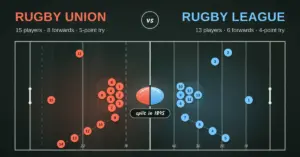
The clearest difference you will see at kick-off is the number of players on the field.
- Rugby union: 15 players per side — usually eight forwards and seven backs. Match-day squads name up to eight replacements on the bench, for a 23-player match-day squad. Most substitutions are permanent once made, with specific exceptions for front-row cover, blood injuries and head-injury assessments.
- Rugby league: 13 players per side — typically six forwards and seven backs. Teams carry a small interchange bench and are allowed a set number of interchanges during a match (eight in the NRL), so players can be rotated on and off more freely than in union.
Fewer players on a league field means more open space, which is one reason the game often looks faster and more spread out. For a full breakdown of who does what in the 15-a-side game, our guide to rugby positions and player roles covers every jersey number.
Keeping the ball moving: tackles, rucks and the play-the-ball
This is the single biggest difference in how the two games actually play out.
In rugby union there is no limit on how long a team can keep the ball. When a player is tackled and brought to ground, play continues through a ruck — players from both sides bind over the ball and try to win it with their feet. A standing contest over a held ball is a maul. Crucially, the defending side can legally compete for the ball at the tackle (the “jackal”), so possession is never guaranteed. This contest for the ball after every tackle is central to union’s tactics.
In rugby league there is no ruck or maul. After a tackle, the tackled player is allowed to stand up and restart play with a play-the-ball: they place the ball on the ground and roll it backwards with a foot to a teammate standing behind them, known as the dummy half or acting half-back. Only two defenders (the “markers”) may stand in front. The catch is the six-tackle rule: the attacking team gets a set of six tackles to make progress. After the sixth tackle, possession hands over to the other side, so teams almost always kick on the fifth tackle to gain ground or force an error. (A ruck-infringement “six again” call can reset the count in some competitions.) This six-tackle structure gives league its distinctive, repetitive rhythm of carry, play-the-ball, carry.
Set pieces: scrums, lineouts and restarts
Both codes use scrums, but they are very different in size and importance.
- Union scrum: eight players per team bind together and contest the ball with a strong push. It is a genuine physical battle and a key attacking platform. Learn how it works in our technical guide to the scrum.
- League scrum: six players per team (three front row, two second row, one loose forward). It is largely uncontested and mostly used to restart play, for example after the ball goes into touch, rather than as a real contest for possession.
The lineout — where players are lifted to catch a ball thrown in from the sideline — exists only in rugby union. League has no lineout; when the ball goes out of play, the game restarts with a scrum or a tap, depending on how it went out.
Each code also has a signature kicking law. League has the 40/20: a kick from inside a team’s own 40-metre zone that bounces and goes into touch beyond the opponent’s 20-metre line wins the kicking team the restart. Union borrowed the idea in 2021 with its 50:22 law, rewarding a kick from inside the kicker’s own half that finds touch inside the opponent’s 22.
Scoring: why the points differ
Both games are won by scoring more points, and both reward a try most, but the exact values differ. A try in either code means grounding the ball over the opponent’s goal line. The comparison element below sets the two systems side by side.
Key Differences at a Glance
| Feature | Rugby Union | Rugby League |
|---|---|---|
| Players per team | 15 | 13 |
| Scrum size | 8 players, contested | 6 players, largely uncontested |
| Lineout | Yes | No |
| After a tackle | Ruck or maul (ball contested) | Play-the-ball (ball retained) |
| Possession limit | None | Six tackles, then handover |
| Try | 5 points | 4 points |
| Conversion | 2 points | 2 points |
| Penalty goal | 3 points | 2 points |
| Drop / field goal | 3 points | 1 point (2 from 40m+ in AU domestic) |
| Governing body (world) | World Rugby | International Rugby League |
The practical effect is that a converted try is worth seven points in union but six in league, and penalties and drop goals are worth less in league. Because a league penalty goal is only two points and a field goal just one, teams rarely kick for goal from distance — the four-point try is almost always the better option. In union, by contrast, a reliable goal-kicker can keep the scoreboard ticking with three-point penalties, which shapes how teams play for territory.
Positions compared
Both codes split the team into forwards (generally bigger players who do the heavy contact work) and backs (generally faster players who create and finish attacks), but the specific roles differ.
Rugby union has specialist set-piece roles that league does not need, because league has no lineout and an uncontested scrum. Union forwards include props, a hooker, locks (second row) and a back row of flankers and a number 8; the backs run from scrum-half and fly-half out to the centres, wings and fullback.
Rugby league positions are built around the play-the-ball and the six-tackle set. The forwards — props, hooker and second-rowers, plus a loose forward (often called the lock) — carry the ball up and tackle. The backs include the halfback and five-eighth (the main playmakers), the hooker who often acts as dummy half, centres, wingers and a fullback. Because every player must attack and defend across the whole field within a set of six, league positions tend to be less rigidly specialised than union’s. If you are completely new to the oval ball, our beginner guide on how to play rugby explains the union positions and basic skills from scratch.
How each game feels to watch
Put simply, the contest for possession is what separates the viewing experience. Union is a continuous battle for the ball — at the tackle, in the scrum and in the lineout — so momentum can swing on a single turnover, and phases can build for minutes at a time. League guarantees each team its six tackles, so the game flows in structured, fast sets with frequent kicks and a strong emphasis on line-speed in defence.
Neither is “better”; they simply reward different things. Union fans tend to enjoy the tactical chess of the breakdown and set piece, while league fans enjoy the relentless pace and the clarity of the six-tackle structure. The 15-a-side game is also the one played at the Rugby World Cup and by the All Blacks; league runs its own separate international and club competitions.
Rugby union and rugby league in New Zealand
New Zealand follows both codes, but they sit very differently in the sporting landscape. Rugby union is governed by New Zealand Rugby and is the country’s traditional national game, fronted by the All Blacks and Black Ferns and supported by provincial and Super Rugby competitions. Union has long had higher participation: census-era figures compiled by Te Ara put union participation well ahead of league in the mid-2000s.
Rugby league is governed by the New Zealand Rugby League. The national men’s team is the Kiwis and the women’s side the Kiwi Ferns, while the country’s flagship club, the New Zealand Warriors, competes in Australia’s National Rugby League (NRL) — the sport’s premier club competition in the region. The Warriors’ large and loyal following, especially among younger and Pacific communities, has kept league prominent despite New Zealand having just one NRL side. You can follow the club game through our coverage of the NRL ladder and standings.
New Zealand Snapshot
- Union governing body: New Zealand Rugby (NZR).
- Union national teams: All Blacks (men), Black Ferns (women).
- League governing body: New Zealand Rugby League (NZRL).
- League national teams: Kiwis (men), Kiwi Ferns (women).
- Top NZ club in league: New Zealand Warriors, who play in Australia’s NRL.
- Traditional national game: rugby union, historically with higher participation than league.
Players do sometimes move between the codes — switching usually means relearning the tackle laws, the set-piece roles and, in league, the discipline of the six-tackle set. High-profile cross-code moves happen in both directions, though they remain the exception rather than the rule.
Sources
- Rugby league gameplay — six-tackle rule, play-the-ball, 40/20 and scoring
- Laws of rugby union — scoring values and match structure
- History of rugby league — the 1895 split and broken-time payments
- World Rugby — beginner’s guide to points and scoring
- National Rugby League (NRL) — official competition and rules
- Te Ara, the Encyclopedia of New Zealand — rugby league participation
Frequently Asked Questions (FAQ)
What is the main difference between rugby union and rugby league?
The biggest difference is what happens after a tackle. In union, both teams contest the ball at a ruck, so possession can change hands at any time and there is no limit on how long a team keeps the ball. In league, the tackled player restarts play with a play-the-ball, and each team gets only six tackles before possession hands over. Union also fields 15 players to league’s 13, and the two codes score points differently.
How many players are on each team?
Rugby union has 15 players on the field per team, usually eight forwards and seven backs. Rugby league has 13 players per team, typically six forwards and seven backs. Both carry replacements on the bench, but league allows players to be interchanged more freely during a match.
How does scoring differ between the two codes?
In union a try is worth five points, a conversion two, and both a penalty goal and a drop goal three. In league a try is worth four points, a conversion and a penalty goal two each, and a field (drop) goal one — with two points for a field goal from beyond 40 metres in Australian domestic matches. So a converted try is seven points in union and six in league.
Which code is more popular in New Zealand?
Rugby union is the traditional national game, led by the All Blacks and historically played by more New Zealanders. Rugby league has a strong and growing following, built largely around the New Zealand Warriors in the Australian NRL and the national Kiwis team, but it remains the second of the two codes in overall participation.
Can a player switch between rugby union and rugby league?
Yes. Because the two games share the same core skills — running, passing, kicking and tackling — players do move between them, in both directions. A switch means adapting to different laws, especially the tackle and set-piece rules, the different team size and, for anyone moving to league, the structure of the six-tackle set.