A rugby scrum cap is the soft, padded headgear you see forwards and plenty of backs pulling on before kick-off. It is light, washable and sits close to the skull, and its real job is narrower than most people assume: it guards against cuts, grazes and cauliflower ear, not against concussion. This guide explains what a scrum cap does, what World Rugby’s rules allow, and how to choose the right one for your position and level of play in Aotearoa New Zealand.
Key Facts
- What it protects: cuts, grazes and cauliflower ear — not concussion.
- Compulsory? No — you can play with or without a cap.
- Standard to look for: the World Rugby Approved mark (Law 4 / Regulation 12).
- Padding limit: no more than 12 mm thick, soft foam, no hard buckles.
- NZ innovation: the University of Canterbury “Ruru” junior headgear cut head-impact forces by up to 40% in lab tests and is awaiting World Rugby testing.
What a scrum cap actually is
A scrum cap — also called a headguard — is a close-fitting cloth cap with thin foam padding stitched inside and a strap or soft fastening under the chin. “Scrum cap” and “headguard” are both everyday terms in New Zealand, while “headgear” is the wording World Rugby uses in its specification, defined simply as “padding worn on the head.”
Despite the name, you do not need to pack down to wear one — plenty of backs wear them too. If you are new to the set piece and want to understand what a scrum actually involves, it is a separate topic from the gear — the cap is simply the padding many players choose to wear.
What a scrum cap actually protects against
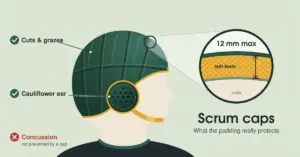
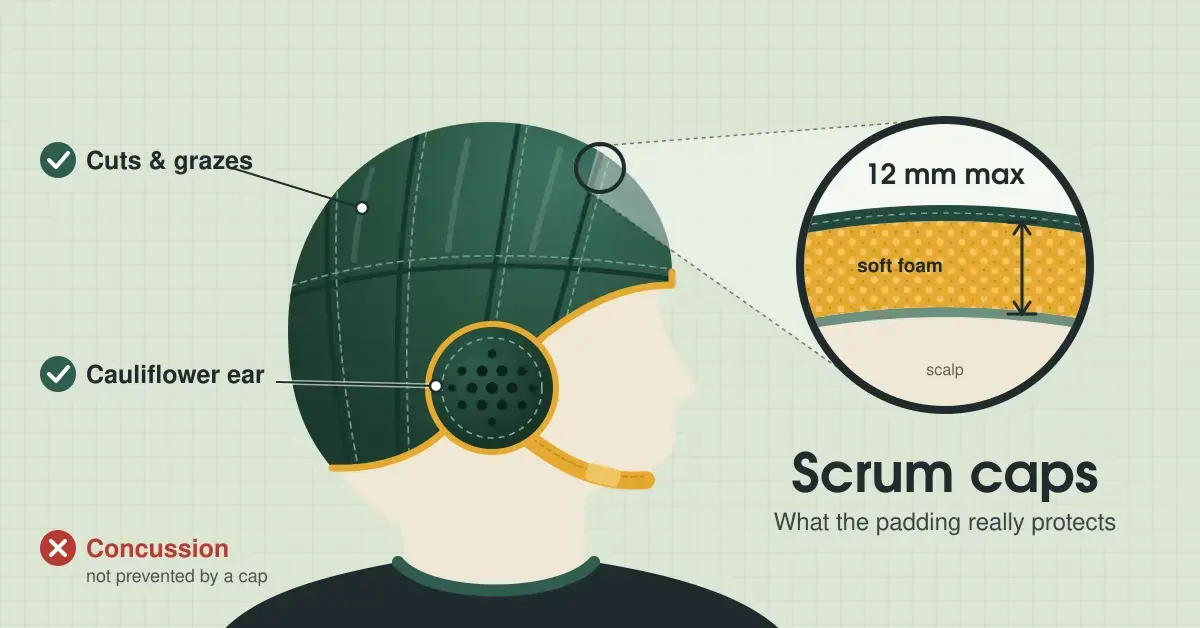
According to World Rugby’s Headgear Performance Specification, “the only injuries that headgear compliant with this specification are intended to protect against are cuts and abrasions.” In other words, a legal scrum cap is designed to stop the skin splitting and the ears tearing — the superficial damage that comes from repeated friction in rucks, mauls and scrums.
The clearest everyday benefit is reducing cauliflower ear, the permanent swelling and deformity caused by repeated knocks and rubbing to the outer ear. That is why front-row forwards and loose forwards are the most common wearers.
What a scrum cap is not built to do is cushion heavy blows. The specification is blunt that compliant headgear “is not intended nor expected to protect against any form of mild traumatic brain injury or skull fractures.” World Rugby even requires the packaging to carry a line telling buyers the gear reduces the risk of cuts and abrasions only, and that any impact reduction is a secondary effect.
Do scrum caps prevent concussion?
No. A standard scrum cap does not prevent concussion, and no headgear is approved by World Rugby on that basis. World Rugby’s own Headgear Performance Specification is explicit that compliant headgear “is not intended nor expected to protect against any form of mild traumatic brain injury or skull fractures.”
Research is, however, moving on from the simple yes/no question. Writing in The Conversation in July 2025, University of Canterbury professor Nick Draper argued that while headgear is unlikely to prevent concussion, newer foams could reduce the total impact “burden” a player absorbs over a season or career. In laboratory testing his team recorded an estimated 30% reduction in peak linear acceleration with headgear compared with none, using instrumented “smart” mouthguards to measure head acceleration events. Those events varied enormously between players across a single season — from around 300g to nearly 14,000g of cumulative exposure.
There is a direct New Zealand angle here. A University of Canterbury team has developed a softshell junior headgear called “Ruru” (after the native owl) that, in lab testing, reduced head impact forces by up to 40%. The design draws on more than a decade of research involving over 300 players from Year 8 to First XV level. As of late 2026 it is being prepared for submission to World Rugby testing and is not yet approved — and the researchers are careful to stress that no headgear can prevent concussion entirely.
The practical takeaway: wear a cap for comfort and skin protection if you like, but never treat it as a licence to tackle harder or play through a knock. Good technique, strength and conditioning do far more for your safety — our guide to injury prevention for rugby players covers the habits that actually lower your risk. If a head knock is suspected, the only safe response is to come off and be assessed.
World Rugby’s rules for headgear
Headgear is governed by Law 4 and World Rugby Regulation 12. A few points matter when you are buying:
- It is not compulsory. Headgear is permitted rather than required, so you can play with or without a cap.
- Look for the World Rugby Approved mark. Compliant headgear is independently tested by an accredited test house and carries the Approved mark on the back of the device. The mark confirms it passed the cuts-and-abrasions standard — it is not an endorsement of brain protection.
- Padding is capped. The foam must be no more than 12 mm thick uncompressed, so approved caps are thin by design.
- No hard parts. Buckles and other hard fixings are banned; soft rubber buttons or Velcro-type fastenings are allowed, and any chin strap must be at least 15 mm wide with smooth, rounded edges.
There is one exception to the standard specification. Under the separate Law 4 headgear trial, World Rugby relaxes the usual limits on impact attenuation, foam density and sandwich construction, so trial devices may use denser, sandwich-construction or higher-attenuation materials than a normal approved cap — the kind of design that tends to carry a medical claim. Trial devices carry a distinct Trial Approved logo. Crucially, World Rugby states it “makes no claim as to the ability of the headgear devices to achieve the claims made by the manufacturers”; any medical claim is the manufacturer’s alone. So if you see padded headgear marketed as concussion-reducing, understand that it is being trialled, not endorsed.
How to choose a scrum cap
Fit and size
Measure around your head just above the eyebrows and match it to the maker’s size chart (caps usually run S–XL, with junior sizing too). It should feel snug without pressing hard or sliding forward when you jog. A loose cap twists in contact and a tight one gives you a headache — neither protects your ears properly.
Coverage and padding
Traditional soft-shell caps keep the padding thin and focus on the ears, which suits scrummagers and anyone who wants minimal weight. Full-coverage headguards spread a little more foam across the skull and are popular with juniors and nervous first-timers. Both are still capped at 12 mm if they are World Rugby Approved, so the real difference is coverage area and ventilation, not raw cushioning.
Ventilation and comfort
Rugby is hot, sweaty work, so look for moulded vent holes and a moisture-friendly lining. A cap you can rinse and air-dry between games will last longer and smell a lot better.
The approved mark and where to buy
For any serious match play, buy a cap carrying the World Rugby Approved mark from a reputable sports retailer. Prices vary with coverage and ongoing sales, so a basic adult or junior cap costs far less than a premium full-coverage model — check what your retailer currently stocks. If you are already kitting out for the season, the same thinking about fit, ground and purpose applies to the rest of your gear: see our guides to choosing the right rugby boots, a parent’s guide to kids’ rugby boots, and buying an official rugby jersey.
Headgear Types Compared
| Type | Padding & coverage | Who tends to wear it | Key point |
|---|---|---|---|
| Traditional soft-shell scrum cap | Thin foam, ear-focused | Front-row and loose forwards | Lightweight; World Rugby Approved models available |
| Full-coverage headguard | Thin foam spread across the skull and ears | Juniors and first-time wearers | Still capped at 12 mm; more area covered, not more cushioning |
| Law 4 trial / softshell headgear | Denser, sandwich-construction or higher-attenuation foams allowed under the trial | Players in approved trials | Legal only through World Rugby’s Law 4 trial; not standard-approved |
| Fashion or supporter caps | None | Fans off the field | Not match-legal headgear — for show, not play |
Caring for and replacing your headgear
Rinse your cap in cool water after games, let it air-dry out of direct sun, and avoid hot machine washes that break down the foam and stitching. Replace it when the padding stays compressed, the stitching opens, the strap frays or the fit goes loose — a flattened cap no longer meets the standard it was sold under, however good it looks.
Sources
Frequently Asked Questions
How is a scrum cap different from an American football or boxing helmet?
Those are hard-shell or heavily padded helmets built to absorb big impacts. A rugby scrum cap is deliberately thin and soft — padding is limited to 12 mm — because the rules aim to protect the skin, not create a hard surface that could injure other players.
What size scrum cap does a junior player need?
Measure around the child’s head just above the eyebrows and match the number to the brand’s junior size chart rather than guessing by age. The cap should sit snug without sliding forward when they run. Because children grow quickly, re-check the fit each season instead of buying a size up and hoping it lasts — a loose cap twists in contact and stops protecting the ears.
Do referees check for the World Rugby Approved mark?
Under Law 4 the referee is entitled to inspect a player’s clothing and headgear before kick-off and can require any non-compliant item to be removed before play. Buying a cap that carries the World Rugby Approved mark on the back is the simplest way to be sure it passes that check.