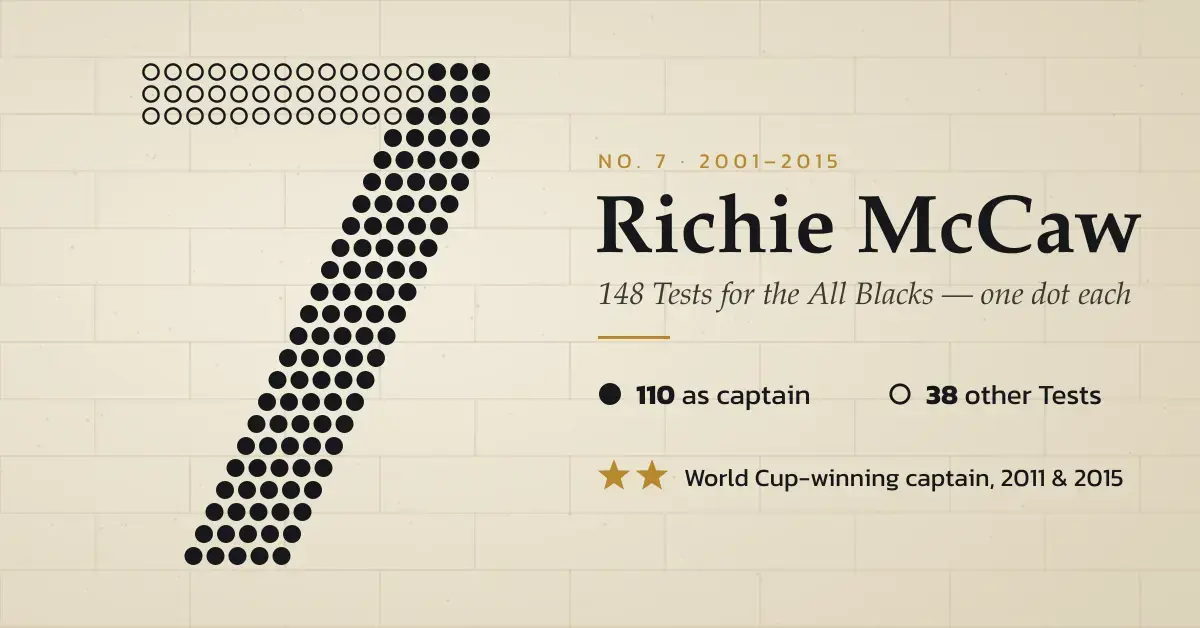
Few players have shaped modern rugby the way Richie McCaw did. Over a 14-year professional career the Oamaru-born flanker captained the All Blacks to back-to-back Rugby World Cup titles, finished as the most-capped player in the game’s history, and was voted the world’s best player three times.
Key Facts
| Full name | Richard Hugh McCaw ONZ |
|---|---|
| Born | 31 December 1980, Oamaru, New Zealand |
| Height | 187 cm |
| Position | Openside flanker (number 7) |
| Teams | Canterbury, Crusaders, All Blacks |
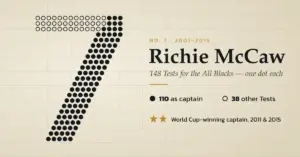
| Test caps | 148 (world record at retirement) |
| Test wins | 131 (world record) |
| Tests as captain | 110 (world record) |
| Rugby World Cups | Two as captain (2011, 2015) |
| World Rugby Player of the Year | 2006, 2009, 2010 |
| Highest honour | Order of New Zealand (2016) |
| Retired | 2015 |
From Oamaru to Canterbury
Richard Hugh McCaw was born on 31 December 1980 in Oamaru, in New Zealand’s South Island. Standing 187 cm, he played as a flanker — the forward who links the set piece with open play — and became one of the most physically relentless players of his generation.
He broke through with Canterbury in the provincial championship, playing for the union between 2000 and 2009. That grounding in the demanding Canterbury environment set him up for the step into Super Rugby and, soon after, the All Blacks.
Crusaders and Super Rugby success
McCaw made his Super Rugby debut for the Crusaders in 2001 and stayed with the Christchurch franchise for his entire club career, making 145 appearances up to 2015. The Crusaders won the Super Rugby competition four times during his years with the team, confirming them as the dominant side of the era and McCaw as the engine of their forward pack.
All Blacks career: a record-breaking 148 Tests
McCaw wore the black jersey for 15 seasons and left it holding records that still stand out in the Test game.
Test debut and breakthrough
He made his All Blacks debut against Ireland at Lansdowne Road in Dublin on 17 November 2001, aged just 20, and was named man of the match. He went on to become one of the first names on the team sheet almost immediately, quickly establishing himself as the world’s leading specialist in his position.
Captaincy and back-to-back World Cups
McCaw first captained the All Blacks against Wales on 20 November 2004, becoming the 60th man to lead the side. He would go on to captain New Zealand in 110 Tests — a world record for any international captain. (The New Zealand Rugby Players Association records the figure as 111.)
The defining achievements came at the game’s biggest tournament. McCaw led the All Blacks to the 2011 Rugby World Cup title on home soil, a tense 8-7 win over France, and then to the 2015 title with a 34-17 victory over Australia in the final at Twickenham in London. That made him one of only two men to captain a Rugby World Cup-winning side twice, and the 2015 final was the last match of his career. He shared the field with a golden generation of All Blacks, including lock Sam Whitelock and playmaker Beauden Barrett.
Playing style: master of the breakdown
McCaw played predominantly at openside flanker, the number 7 jersey. The openside’s job is to compete for the ball at the breakdown — the contest on the ground immediately after a tackle — and to be first to the next ruck, over and over, for 80 minutes. If you are new to the roles on the field, our guide to rugby positions explains how each number fits together.
His edge was timing and work-rate at that breakdown: he was famous for slowing opposition ball and winning turnovers right at the point where a team’s momentum is made or broken. Referees and rivals spent years trying to work out where the line was between his legal poaching and a penalty, which is itself a measure of how finely he played the laws.
Leadership and the standards he set
McCaw is regarded by his peers as one of the greatest leaders the game has known. Across his career he captained Canterbury, the Crusaders and the All Blacks, and his calm, standards-driven approach became part of the modern All Blacks culture. Away from the field he co-founded the youth sport initiative iSPORT in 2009 alongside fellow All Black Dan Carter and Ali Williams.
His leadership also shaped the next generation of back-row forwards and captains, including openside flanker Sam Cane.
Honours, awards and the knighthood he turned down
McCaw was named World Rugby Player of the Year a record three times — in 2006, 2009 and 2010 — a mark he shares with Dan Carter, and he was nominated for the award eight times in total, also a record.
His most-discussed decision off the field was turning down a knighthood. After the 2011 World Cup win, Prime Minister John Key revealed McCaw had decided that accepting the honour was not right while he was still playing. Rather than a knighthood, McCaw was later appointed to the Order of New Zealand (ONZ) in the 2016 New Year Honours. The ONZ is the country’s highest civic honour, limited to just 20 living members at any time, and he became the youngest person to hold it. Because the ONZ carries no title, he remained simply “Richie” rather than “Sir Richie”.
Life after rugby: flying and family
Since hanging up his boots, McCaw has largely stepped out of the spotlight. He learned to fly helicopters and joined Christchurch Helicopters, where he is now one of the chief pilots — turning a long-held passion for aviation and adventure into a second career.
He married former New Zealand hockey international Gemma Flynn — a Black Sticks player — in January 2017 at a ceremony overlooking Lake Wanaka. His final season was documented in the 2016 feature film Chasing Great, which followed his pursuit of back-to-back World Cups. He has also lent his name to charitable causes, including as a patron of the CatWalk Spinal Cord Injury Trust.
Is Richie McCaw the greatest rugby player ever?
Whether McCaw is the single greatest player in history is a debate without a definitive answer, but the case for him is built on measurable facts rather than opinion. At his retirement he held the records for most Test appearances and most Tests as captain, was on the winning side more often than any other player, won the global player award a record three times, and captained two World Cup-winning teams. No other forward has combined individual dominance and team success on that scale. For many in the game he is the benchmark openside flanker, and for New Zealand supporters he ranks among the greatest All Blacks of all time.
Sources
- Wikipedia — Richie McCaw
- World Rugby Hall of Fame — Richie McCaw
- Planet Rugby — “McCaw’s superb career: key facts”
- Guinness World Records — Most World Rugby Player of the Year awards
- Rugby.com.au — Richie McCaw bestowed with the Order of New Zealand
- Otago Daily Times — Richie McCaw turns down knighthood
- NZ Herald — Richie McCaw and Gemma Flynn say ‘I do’ at Wanaka wedding
- TracPlus — From Scrum to Squirrel: Pilot Richie McCaw
- New Zealand Film Commission — Chasing Great (2016)
- New Zealand Rugby Players Association — Richie McCaw ONZ
Frequently Asked Questions
Why did Richie McCaw turn down a knighthood?
McCaw felt it was not the right time to accept a knighthood while he was still playing rugby. The decision was made public by Prime Minister John Key after the 2011 Rugby World Cup. He was instead appointed to the Order of New Zealand in the 2016 New Year Honours, the country’s highest honour, which carries no “Sir” title.
What does Richie McCaw do now?
After retiring in 2015 he learned to fly helicopters and now flies as one of the chief pilots at Christchurch Helicopters. He has kept a relatively low public profile and spends his time on aviation, adventure racing and family life.
How much did Richie McCaw get paid?
New Zealand Rugby has never officially published McCaw’s salary or contract figures, so any exact number is unconfirmed. As the long-serving All Blacks captain and one of the team’s most senior players he would have been among the best-paid players in New Zealand rugby, but the specific amounts were never made public.