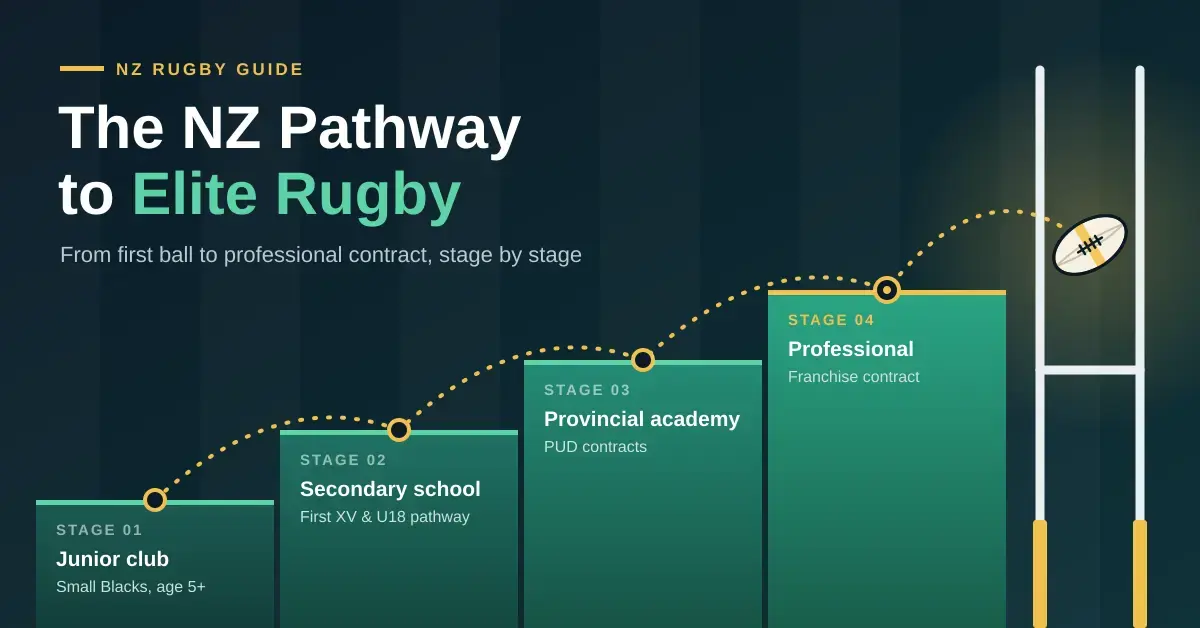
New Zealand produces elite rugby players with remarkable consistency, and it does so through a pathway that is unusually clear and well connected. A child who first picks up a ball at five can follow a series of defined steps — junior club rugby, secondary school teams, provincial academies and franchise training groups — all the way to a professional contract. This guide explains how that journey works stage by stage, who runs each level, and what changed for the 2026 season, so players, parents and coaches can see exactly where the road leads.
Key Points
- New Zealand’s rugby pathway is a connected series of stages that runs from age 5 to the professional game.
- It begins with the Small Blacks junior model, built on fun, ball skills and gradually introduced contact.
- Secondary school First XV rugby and the National U18 Pathways Programme are the main talent-spotting windows.
- Provincial union academies, using Provincial Union Development (PUD) contracts, bridge school and the professional ranks.
- For 2026, Super Rugby clubs added Wider Training Groups of up to 12 players, with a new development competition replacing the old Super Rugby U20 tournament.
- The New Zealand Under 20s and the NPC are the final steps before Super Rugby and the All Blacks or Black Ferns.
Where the pathway begins: Small Blacks and junior rugby

The foundation of the New Zealand system is the Small Blacks programme, New Zealand Rugby’s (NZR) official model for junior players aged roughly 5 to 13. Its guiding idea is simple: give children as many touches of the ball as possible, keep the game fun, and introduce difficulty only when they are ready. Rather than a shrunken version of the adult game, the youngest grades play small-sided matches on smaller fields so that everyone is involved.
Five-year-olds start with Rippa Rugby, a non-contact form in which players pull a velcro tag instead of tackling. Tackling is then added gradually and taught as a technique in its own right, and complex set-pieces such as scrums and lineouts are deliberately delayed until players are older and stronger. New Zealand Rugby describes rugby as a “late-development” sport, so the junior model is built around long-term skill and enjoyment rather than early results.
How the junior game grows with the child
Exact formats vary between provincial unions and clubs, but the progression follows a consistent shape, moving from non-contact play toward the full 15-a-side game.
| Age band | Typical focus | Contact level |
|---|---|---|
| School Years 1–2 (about 5–7) | Fun, ball handling and evasion | Non-contact (Rippa) |
| School Years 3–4 (about 7–9) | Learning safe tackle technique | Tackling introduced, controlled |
| School Years 5–6 (about 9–11) | Contested ball and breakdown basics | Full contact, limited set-piece |
| School Years 7–8 (about 11–13) | Positional play and set-piece basics | Graduated scrums and lineouts, 15-a-side |
Secondary school rugby and First XV culture
Secondary school rugby, and the First XV in particular, is one of the most visible and competitive stages of the pathway. Leading rugby schools run their top teams with professional-style support — strength and conditioning, video analysis and nutrition guidance — and marquee fixtures are broadcast and heavily followed. The National Top 4 tournament, which decides the country’s champion school team, is a major scouting window for provincial unions and Super Rugby clubs.
Because so much attention falls on schoolboy rugby, the environment tests character as much as talent. Selectors look for players who can handle pressure, large crowds and expectation, not simply those who are physically dominant against their peers.
The National U18 Pathways Programme
To make sure talent outside the traditional First XV schools is not missed, NZR runs a National U18 Pathways Programme. Around a third of eligible under-18 players have been based at clubs rather than school First XV teams, so the programme casts a wider net. Rather than a single national under-18 side, it is built around three New Zealand squads that assemble together each September:
- New Zealand Schools
- New Zealand Barbarians Under 18
- New Zealand Māori Under 18 (Ngā Whatukura)
These squads play a short block of matches against each other and international opponents such as Australia Under 18, giving the country’s best teenagers a first taste of high-performance rugby while they finish school.
Provincial academies: the bridge to the professional game

After school, the most direct route toward the professional ranks is a provincial union academy, such as those run by Auckland, Canterbury or Otago. Academies act as a finishing school: players are usually signed to Provincial Union Development (PUD) agreements that provide coaching, gym access and support while they study or work. A strong provincial programme feeds a high proportion of its players into the NPC and the women’s Farah Palmer Cup, and many go on to Super Rugby.
Quick Facts
| Governing body | New Zealand Rugby (NZR) |
| Entry point | Small Blacks / Rippa Rugby, from about age 5 |
| Key school stage | First XV and the National Top 4 |
| Post-school bridge | Provincial union academies (PUD contracts) |
| 2026 change | Super Rugby Wider Training Groups (up to 12 players per club) |
| Peak age-grade team | New Zealand Under 20s |
| Senior domestic competitions | Hilux NPC (formerly Bunnings NPC) and the Farah Palmer Cup |
What academies actually develop
Academy life extends well beyond the gym. Players are guided across a set of connected areas designed to prepare them for professional sport and for life afterwards. Most academies also expect players to be studying or working, so they always have a plan away from rugby.
- Technical skill: mastering position-specific roles such as lineout throwing for hookers or goal-kicking for first five-eighths.
- Tactical understanding: reading the game and executing complex phase play.
- Physical conditioning: building the aerobic capacity, speed and power developed through structured strength and conditioning programmes.
- Nutrition and recovery: learning to fuel training and repair the body.
- Mental skills: resilience and composure, including the well-known “red head / blue head” idea of staying calm under pressure.
- Life skills: managing money, study and professional conduct.
The 2026 Super Rugby contracting model
The biggest recent change to the pathway arrived with the 2026 season. New Zealand’s five Super Rugby franchises — the Blues, Chiefs, Hurricanes, Crusaders and Highlanders — can now each sign up to 12 additional players to a Wider Training Group (WTG). These players train full-time alongside the main squad all season, effectively a “shadow” group learning the professional environment from the inside.
WTG players cannot play Super Rugby Pacific matches unless injury opens a spot in their position, so they are protected from being rushed. Instead, they get competitive rugby in a new development competition between the New Zealand franchises. That competition replaces the former Super Rugby Under 20 tournament, shifting the emphasis from a single age-grade event toward season-long development. Most WTG players also hold NPC contracts, so they play meaningful rugby year-round.
New Zealand Under 20s and international age-grade rugby
For many players the New Zealand Under 20s, often called the Baby Blacks, is the final proving ground before a full professional career. Selection typically comes from the best academy and WTG players, and strong U20 form is one of the clearest signals for Super Rugby recruiters. The team plays two main international windows each year.
| Competition | Level | Notes |
|---|---|---|
| U20 Rugby Championship | Southern Hemisphere (SANZAAR) | Annual matches against Australia, South Africa and Argentina. |
| World Rugby U20 Championship | Global | Annual 16-team world championship; NZ finished third in 2026 (hosted in Georgia). |
| Franchise development competition | Domestic (NZ) | New for 2026; replaces the former Super Rugby U20 tournament. |
In 2026 the New Zealand Under 20s defended their U20 Rugby Championship title and finished third at the World Rugby U20 Championship in Georgia, underlining the depth the pathway continues to produce.
Club rugby and the NPC

Professional academies have not replaced club rugby, which remains the heartbeat of the game. Players who miss an academy place straight out of school can prove themselves in premier club grades, where provincial coaches regularly watch for late developers. A standout club season can earn a training-partner invitation with a provincial union and, eventually, a place in the NPC — New Zealand’s semi-professional provincial competition, which carries Toyota Hilux naming rights from 2026 after several years as the Bunnings NPC.
The NPC is the last major test before Super Rugby: it is where young players show they can cope with the physicality of senior men. The women’s equivalent, the Farah Palmer Cup, plays the same role on the pathway to the Black Ferns, while the Heartland Championship gives players in smaller rural unions a route to representative honours.
| Stage | Typical age | Main playing environment |
|---|---|---|
| School and club junior rep | 15–18 | First XV and U18 pathway squads |
| Provincial academy (PUD) | 18–21 | Premier club rugby, NPC, national U20s |
| Super Rugby Wider Training Group | About 19–23 | Franchise development competition and NPC |
| Full Super Rugby / Test | 20 and up | Super Rugby Pacific, All Blacks and Black Ferns |
How talent is identified
Recruitment in New Zealand blends the traditional “eye test” with data. Talent identification managers track physical, technical and behavioural markers to compare prospects fairly across the country, whatever school or region they come from.
- Physical profile: comparing a player’s physical maturity with their age to spot early and late developers.
- Work rate: GPS units measure distance covered and high-speed running during matches.
- Technical reliability: tackle completion, effective carries and position-specific actions such as lineout success.
- Discipline and composure: penalty and card counts as a guide to decision-making under pressure.
A widely used physical benchmark is the Bronco Test, a 1.2 km running drill made up of five continuous sets of 20 m, 40 m and 60 m shuttles. It has been part of All Blacks pre-season for well over a decade, and elite players such as Beauden Barrett have posted some of the quickest recorded times. As a rough guide, professional backs tend to finish in about 4:20–4:45 and forwards around 4:50–5:10, though targets vary by position and programme.
Player welfare and avoiding burnout
The journey is demanding, so welfare has become central to the model. Unions apply load-management limits that cap how much young players train and play across multiple teams, reducing overuse injuries. Mental health support is now built into academy programmes, recognising that expectation can weigh heavily on teenagers.
- Load management: monitoring training and match minutes, with enforced off-seasons for recovery.
- Concussion care: New Zealand’s community game uses a Blue Card system, removing a player with a suspected concussion and requiring a graduated return to play.
- Education and vocation: study or work requirements so players have a plan beyond rugby.
- Financial literacy: guidance on managing a first professional contract.
The underlying philosophy is often summed up as “a better person makes a better player”: athletes who are supported off the field tend to perform more freely on it.
Reference sources
- New Zealand Rugby — Small Blacks
- New Zealand Rugby — 2026 National U18 Men’s Pathways Squads
- Super Rugby — Wider Training Groups media release
- RugbyPass — NZR confirm new Super Rugby contracting model
- allblacks.com — New Zealand squad named for the 2026 Under 20 Rugby Championship
- Auckland Rugby — Development & Age Grade
- Coach — The All Blacks’ Bronco Test explained
Frequently Asked Questions
How do you get into a rugby academy in New Zealand?
Most players are identified through First XV, club and U18 representative rugby. Standing out in regional and national age-grade tournaments is the surest way to be noticed by a provincial union’s talent identification staff, who then offer academy or development agreements.
What is a PUD contract?
A Provincial Union Development contract is a developmental agreement for academy-level players. It typically provides coaching, strength and conditioning support and a modest allowance while the player continues to study or work.
At what age do New Zealand players turn professional?
Most sign their first professional or semi-professional terms between about 18 and 21, usually through a provincial academy, an NPC squad or a Super Rugby Wider Training Group, before earning a full Super Rugby contract.
Can you become an All Black without playing First XV rugby?
Yes. Plenty of players who did not attend a traditional rugby school, or who developed late physically, have used premier club rugby and the U18 club pathway to earn representative selection.
What is the Super Rugby Wider Training Group?
Introduced for 2026, the Wider Training Group lets each New Zealand franchise sign up to 12 extra players who train with the main squad and play in a new franchise development competition. They step up to Super Rugby Pacific mainly when injuries create an opening.
What is the Bronco Test?
The Bronco is a 1.2 km fitness test of five continuous rounds of 20 m, 40 m and 60 m shuttle runs, used to measure aerobic and repeated-sprint fitness. It is a standard benchmark in New Zealand’s high-performance environments.