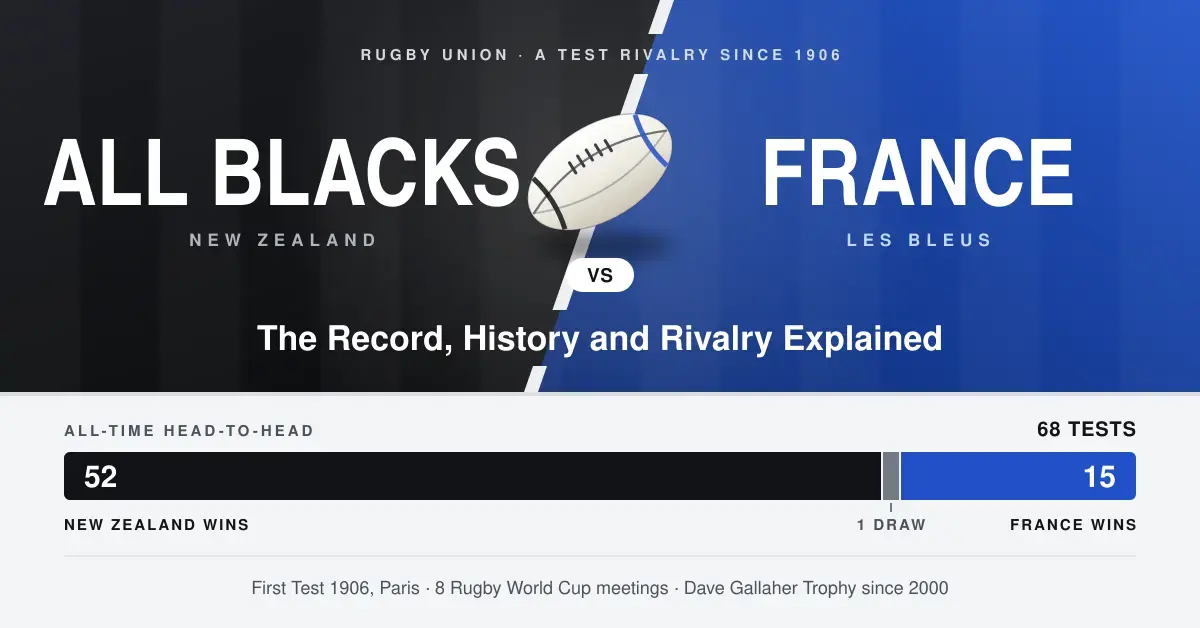
The contest between New Zealand’s All Blacks and France (nicknamed “Les Bleus”, French for “the Blues”) is one of international rugby union’s oldest and most unpredictable. New Zealand holds a heavy statistical lead, yet France is the side most likely to derail an All Blacks campaign on the biggest stage. This guide sets out the all-time record, the eight Rugby World Cup meetings the two nations have contested, the most recent results up to the 2026 Nations Championship, and how the two teams actually match up on the field — explained in plain terms for newcomers to the sport.
Key Facts
- All-time record: 68 Tests — New Zealand 52 wins, France 15 wins, 1 draw.
- First meeting: 1 January 1906 in Paris (New Zealand won 38–8).
- World Cup meetings: 8 — more than any other pair of nations (NZ 5 wins, France 3).
- Trophy at stake: the Dave Gallaher Trophy, contested since 2000.
- Most recent result: New Zealand 34–32 France, 4 July 2026, Christchurch.
- Top points scorer in the fixture: Dan Carter (New Zealand), 163 points.
A rivalry with a heavy New Zealand lead
The two nations first met on New Year’s Day 1906, when the touring “Original” All Blacks beat France 38–8 in Paris. Since then New Zealand has won the large majority of their meetings. Across 68 Test matches (a Test is a full international between two senior national teams), New Zealand has won 52, France has won 15, and one match was drawn — the 20–20 result in Paris in 2002. That gives the All Blacks a win rate of roughly 76 percent, one of the most lopsided long-running records they hold against a leading rugby nation. Even so, the raw numbers understate how competitive the fixture has become: France beat New Zealand three times in a row between 2021 and 2024 before the All Blacks reasserted themselves in 2025 and 2026.
The all-time head-to-head
The table below summarises the men’s Test record between the two sides. It reflects results up to and including the July 2026 Nations Championship meeting.
| Measure | Detail |
|---|---|
| First meeting | 1 January 1906, Paris — New Zealand 38–8 |
| Total Tests played | 68 |
| New Zealand wins | 52 |
| France wins | 15 |
| Draws | 1 (20–20, Paris, 2002) |
| New Zealand’s biggest win | 62–13 (2015 World Cup quarter-final) |
| France’s biggest win | 40–25 (2021, Paris) |
| Top points scorer in the fixture | Dan Carter (New Zealand) — 163 points |
Why France is called the All Blacks’ “bogey team”
A “bogey team” is an opponent that repeatedly causes a stronger side trouble against the odds. France earned that label for its habit of beating New Zealand when it matters most. France was the first Northern Hemisphere nation to win a Test series in New Zealand, doing so in 1994 with victories of 22–8 in Christchurch and 23–20 in Auckland. The second win was sealed by the celebrated “try from the end of the world”, finished by full-back Jean-Luc Sadourny after the ball travelled almost the length of the field through several pairs of hands. France then knocked New Zealand out of the World Cup in 1999 and again in 2007, cementing a reputation for producing an inspired 80 minutes that defies form. This unpredictability — often summed up by the phrase “French flair” — is the central theme of every preview. It sits in contrast to the more structured, high-tempo style that has long defined the way the All Blacks approach their other great rivalries.
Eight Rugby World Cup meetings
New Zealand and France have met eight times at the Rugby World Cup, more than any other pair of nations. New Zealand has won five of those matches and France three. The finals of 1987 and 2011 stand at the summit of the rivalry, but France’s semi-final win in 1999, its quarter-final upset in 2007 and its shock pool-stage win in 2023 are the results that give the fixture its edge. The complete match-by-match history is catalogued on Wikipedia.
Rugby World Cup Meetings
| Year | Stage | Winner | Score |
|---|---|---|---|
| 1987 | Final | New Zealand | 29–9 |
| 1999 | Semi-final | France | 43–31 |
| 2003 | Bronze final | New Zealand | 40–13 |
| 2007 | Quarter-final | France | 20–18 |
| 2011 | Pool stage | New Zealand | 37–17 |
| 2011 | Final | New Zealand | 8–7 |
| 2015 | Quarter-final | New Zealand | 62–13 |
| 2023 | Pool stage | France | 27–13 |
The 1987 and 2011 finals
Both World Cup finals between the sides were played at Eden Park in Auckland. In 1987, New Zealand won the inaugural tournament 29–9, with captain David Kirk lifting the first Webb Ellis Cup. The 2011 final could hardly have been more different: New Zealand edged France 8–7, the lowest-scoring final in the tournament’s history, remembered for France’s ferocious defence and captain Thierry Dusautoir’s man-of-the-match performance in defeat. A single Tony Woodcock try and a Stephen Donald penalty were enough for the hosts. Together the two finals capture the rivalry — one a display of New Zealand’s clinical edge, the other a test of nerve under relentless pressure.
| Final | Score | Venue | Notable figure |
|---|---|---|---|
| 1987 Final | New Zealand 29–9 France | Eden Park, Auckland | David Kirk (NZ captain) |
| 2011 Final | New Zealand 8–7 France | Eden Park, Auckland | Thierry Dusautoir (France captain) |
Recent form: 2021 to 2026
The 2020s have been the most competitive stretch in the rivalry’s history. France won three consecutive meetings — 40–25 in Paris in 2021, the 27–13 World Cup opener in 2023, and a 30–29 thriller in Paris in November 2024 that turned on the boot of fly-half Thomas Ramos. New Zealand answered emphatically in 2025 and 2026, first sweeping a home series and then winning the opening Test of the new Nations Championship. You can track the wider picture of New Zealand’s season through the site’s regularly updated All Blacks results and scoring guide.

The 2025 series in New Zealand
France toured New Zealand in July 2025 for a three-Test series. France’s head coach rested most of his first-choice players, and the All Blacks, under head coach Scott Robertson, won all three matches to retain the Dave Gallaher Trophy. The results underlined a familiar pattern: France can win a one-off Test in Paris, but sustaining that level across a three-week tour of New Zealand remains a tall order.
- First Test (Dunedin, 5 July): New Zealand 31–27 France — a tight opener decided late.
- Second Test (Wellington, 12 July): New Zealand 43–17 France — a first-half masterclass; the trophy was retained here.
- Third Test (Hamilton, 19 July): New Zealand 29–19 France — a physical finish to complete a 3–0 sweep.
The 2026 Nations Championship opener
The Nations Championship is a new global competition in which the six Rugby Championship nations and the six Six Nations nations play a full round-robin across the July and November windows, with the leading sides meeting in finals in London. Because the format pits each Southern Hemisphere side against each Northern Hemisphere side just once, New Zealand and France met only once in 2026: New Zealand won 34–32 on 4 July 2026 at the new One New Zealand Stadium (also known as Te Kaha) in Christchurch — among the first internationals staged at the city’s new roofed venue. New Zealand do not face France again in the November 2026 window, when the All Blacks instead play Scotland and Wales in the Northern Hemisphere.
How the two teams play
Tactically the fixture is often a collision of philosophies. The All Blacks traditionally favour a fast, multi-phase game built on quick ball, accurate passing and support running, aiming to stretch and tire the opposition. France increasingly leans on a powerful, heavy forward pack to dominate the set-piece platforms — the scrum and lineout — paired with explosive individual runners and one of the game’s finest halfbacks in Antoine Dupont.
The battles that decide the result
Three areas usually swing these matches:
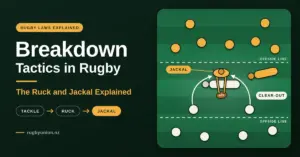
- The breakdown: the fight for the ball immediately after a tackle. France’s ability to slow or steal All Blacks ball through the “jackal” has been its key disruptor in recent wins — a contest explained in the site’s guide to the ruck and jackal.
- Set-piece: a dominant French scrum and maul can win penalties and territory; New Zealand’s lineout height is often a counter-weapon.
- Kicking: both sides use tactical kicking to control field position, and the accuracy of the goal-kickers frequently decides tight games, as the 8–7 and 30–29 results show.
The Dave Gallaher Trophy
Since 2000, New Zealand and France have played for the Dave Gallaher Trophy. It is named after Dave Gallaher, captain of the 1905 “Original” All Blacks, who was killed in 1917 at Passchendaele during the First World War while serving with the New Zealand forces in France. That shared history gives the fixture an added layer of respect: for France, winning in New Zealand is regarded as one of rugby’s hardest feats, while for New Zealand a home defeat to France is treated as a national setback. New Zealand has held the trophy for most of its history and retained it with the 2025 series win.
Players who have shaped the modern rivalry
Individual match-ups often decide these Tests. The table below lists players who have been central to recent meetings and the roles they fill; a fuller explanation of each shirt number is available in the guide to rugby positions.
| Position | New Zealand | France | Why the role matters |
|---|---|---|---|
| Halfback (No. 9) | Cam Roigard | Antoine Dupont | Speed and control at the base of the ruck. |
| First five-eighth (No. 10) | Beauden Barrett / Damian McKenzie | Romain Ntamack | Directing the kicking and attacking game. |
| Number 8 | Ardie Savea | Grégory Alldritt | Ball-carrying power at the back of the scrum. |
| Wing | Will Jordan | Damian Penaud | The main finishing threats out wide. |
How to follow the rivalry
Test matches between the sides are played in the July and November international windows and, when the draw allows, at the Rugby World Cup. New Zealand’s home Tests are typically shared between Eden Park, Wellington, Dunedin, Hamilton and now Christchurch’s roofed stadium, while French home Tests are usually staged at the Stade de France in Paris. For readers new to the sport, understanding the arc of the game — from the amateur era to today’s professional contest — helps explain why the styles differ; the site’s overview of the evolution of rugby union is a useful starting point.
Sources
- AllBlacks.com — All Blacks v France: a rivalry in numbers
- NZ Rugby Stats — France rivalry profile
- World Rugby — France beat New Zealand 27–13 (2023 World Cup opener)
- AllBlacks.com — All Blacks retain the Dave Gallaher Trophy (2025)
- AllBlacks.com — New Zealand v France, 4 July 2026 (Nations Championship)
- Rugby World — Every France v New Zealand World Cup meeting
- AllBlacks.com — Reliving the “try from the end of the world” (1994)
Frequently Asked Questions (FAQ)
Who has won more matches between New Zealand and France?
New Zealand leads clearly. Across 68 Tests the All Blacks have won 52, France has won 15, and one match was drawn (20–20 in Paris in 2002).
Why is France called the All Blacks’ “bogey team”?
Despite the lopsided overall record, France has repeatedly beaten New Zealand at the World Cup — in the 1999 semi-final and the 2007 quarter-final — and pushed them to the limit in the 2011 final. That knack for causing upsets on the biggest stage is why the label stuck.
What was the score of the 2011 Rugby World Cup final?
New Zealand won 8–7 at Eden Park in Auckland. It remains the lowest-scoring final in Rugby World Cup history.
What is the Dave Gallaher Trophy?
It is the trophy contested by New Zealand and France since 2000. It is named after Dave Gallaher, captain of the 1905 “Original” All Blacks, who was killed in the First World War in 1917.
When did the teams last play, and what happened?
They met in the 2026 Nations Championship on 4 July 2026 in Christchurch, where New Zealand won 34–32. Before that, New Zealand swept the 2025 home series 3–0.