Few announcements stir as much conversation across New Zealand as the naming of the All Blacks. When the selectors confirm a touring squad or a match-day team, the choices are dissected in workplaces, clubrooms and sports media from Northland to Southland, because the players picked carry the hopes of a rugby-obsessed country onto the test field.
This guide explains how the modern New Zealand national rugby union team is actually put together: the pathway players travel to earn a call-up, how the 2026 squad is structured position by position, why coaches load the forward bench, and how the international season is organised. It is grounded in the current squad named under head coach Dave Rennie, so the process is explained through real, verified selections rather than theory.
Key Points
- The All Blacks squad is the top of a pathway that runs through school and club rugby, the Bunnings NPC and Super Rugby Pacific.
- The 2026 squad has 34 players under head coach Dave Rennie, with Ardie Savea as captain.
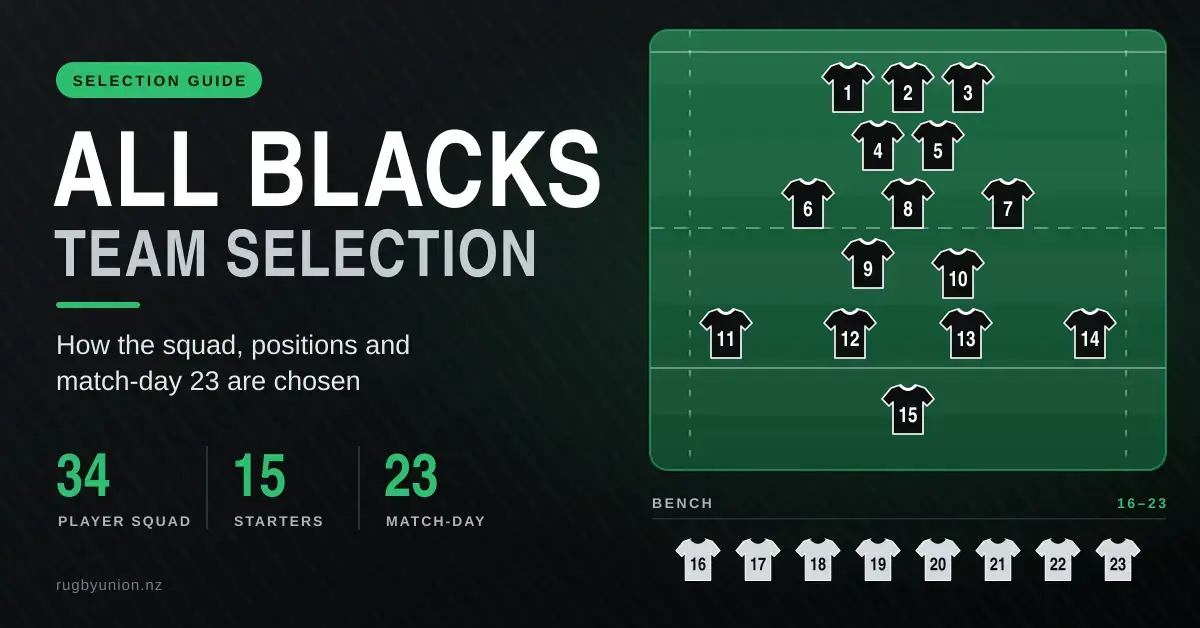
- Only 23 players — 15 starters and eight replacements — are named for each Test.
- Selectors balance every position group: tight five, loose forwards, halves, midfield and back three.
- A loaded 6-2 forward bench is often used to keep the pack fresh in the final quarter.
- In 2026 the team plays the new Nations Championship, plus the October Bledisloe Cup against Australia.
Why an All Blacks Selection Matters So Much
Selecting the national side is treated differently from most team announcements anywhere in world sport. For more than a century the silver-fern jersey has marked the top of the game in New Zealand, and the squad reflects the country’s provincial regions, its Maori and Pasifika playing heritage, and its long record in test rugby. New Zealand remains one of the most successful sides in the history of the international game, which is part of why every call-up and omission is examined so closely. You can trace the honours and milestones behind that record in the team’s full international history.
From Club and School Rugby to the Test Arena
The route to an All Blacks jersey is a structured system run by New Zealand Rugby alongside the five Super Rugby Pacific franchises and the provincial unions. Before a player is realistically considered, they usually prove themselves through school First XV rugby, a provincial academy and senior provincial matches. New Zealand’s player development pathway is designed so that by the time someone is capped, they already have the skills and physical conditioning to cope with tier-one test rugby. The Bunnings NPC, the country’s main provincial competition, is a key rung on that ladder: it gives fringe and returning players match time and lets selectors judge form and durability.
| Selection Phase | Main Focus | What It Delivers |
|---|---|---|
| Grassroots identification | Tracking standout First XV schoolboys and provincial club performers. | A wide, diverse pool of talent across both islands. |
| Provincial testing | Exposing academy graduates to the Bunnings NPC. | Evidence of durability and skill under real match pressure. |
| Franchise development | Building high-performance conditioning and combinations in Super Rugby Pacific. | Players ready for the speed and intensity of test rugby. |
| International assembly | Finalising the match-day 23 for a specific opponent and venue. | A cohesive test side selected to suit the game plan. |
How the All Blacks Squad Is Assembled
Naming a 34-strong test squad is only the visible part of a much larger operation. Once the selectors sign off the list, team management coordinates medical screening, player welfare, apparel, travel and camp logistics, often across international borders. The aim is simple: get every player into camp fit, informed and free of administrative distractions so the coaching group can focus on preparation.
Super Rugby Pacific Form and Regional Balance
The starting point for any squad is recent form in Super Rugby Pacific, drawing on the Blues, Chiefs, Hurricanes, Crusaders and Highlanders. Under Dave Rennie the 2026 squad rewarded strong club seasons: three of the four uncapped players — prop Xavier Numia and outside backs Josh Moorby and Fehi Fineanganofo — came from the title-winning Hurricanes, alongside Blues loose forward Anton Segner. Even so, form does not guarantee selection; the panel also weighs fitness, positional need and whether a player’s style fits the intended test approach.
- Medical screening: selected players are assessed for soft-tissue and joint issues before camp.
- Combinations: selectors favour players who already have franchise partnerships in the same positions.
- Provincial liaison: management works with clubs so unselected players still get game time.
- Player welfare: workload, travel and recovery are planned across a long international season.
Quick Facts
| Head coach | Dave Rennie |
|---|---|
| Selectors | Sir Graham Henry and Neil Barnes (senior assistant coach) |
| 2026 captain | Ardie Savea |
| Squad size (2026) | 34 players |
| Match-day squad | 23 (15 starters + 8 replacements) |
| 2026 debutants | Xavier Numia, Anton Segner, Josh Moorby, Fehi Fineanganofo |
| July home Tests | France, Italy, Ireland (Nations Championship) |
| October | Bledisloe Cup v Australia |
| Broadcast (NZ) | Sky Sport and Sky Sport Now |
The Tight Five: Front Row and Locks
In test rugby a team’s attack is only as good as the platform its tight five provides. The scrum, lineout and breakdown work of the props, hooker and locks set the base for everything else. If the front row cannot hold its own at scrum time, the backline is starved of clean ball and the side is forced into a conservative, kick-heavy game.

Balancing Set-Piece Power With Mobility
Modern props such as Ethan de Groot, Tyrel Lomax and Fletcher Newell are expected to do far more than scrummage. A loosehead or tighthead must anchor the scrum against heavy northern-hemisphere packs while also making tackles, clearing rucks and handling the ball in general play. At hooker, experienced operators like Codie Taylor add test-match maturity as the lineout thrower and organiser of the maul. Locks such as Tupou Vaa’i and Patrick Tuipulotu supply lineout height and calling, plus the collision work behind the scrum.
| Position | Key Selection Metrics | Tactical Output |
|---|---|---|
| Loosehead prop | Scrum stability, low body position, high work rate. | Winning the scrum battle to secure clean first-phase ball. |
| Hooker | Accurate lineout throwing, scrum power, breakdown awareness. | Securing set-piece possession and leading the forward pack. |
| Tighthead prop | Structural strength, resistance to scrum pressure, close-range tackling. | Anchoring the scrum so the pack holds under load. |
| Locks | Lineout height and intellect, high tackle counts, restart work. | Winning aerial ball and adding power behind the front row. |
The Loose Forwards: Numbers 6, 7 and 8
The loose-forward trio is often the most debated part of any All Blacks team sheet, because it shapes how the side approaches the collision and the breakdown. Selectors blend different profiles across the blindside flanker (6), openside flanker (7) and number eight (8) to combine speed, ball-carrying and turnover ability.
Blending Physicality and Breakdown Speed
With captain Ardie Savea a first-choice option at the back of the scrum, the 2026 trio prioritises mobility, carrying and quick work at the breakdown. Blindside options such as Peter Lakai add physical carrying and defence in tight channels, while openside specialists like Luke Jacobson bring high tackle counts and the reading skills needed to win turnovers. Wallace Sititi adds explosive carrying and versatility across the back row.
- Blindside (6): physical carrying and defence in the narrow channels, plus maul work.
- Openside (7): low breakdown entry to contest the ball immediately after the tackle.
- Number eight (8): carrying off the base of the scrum and linking forwards with backs.
- Bench cover: versatile loose forwards who can also cover lock late in a match.
The Inside Backs: Halfback and First Five-Eighth
The tempo and territory of the team rest largely with the halves. A well-drilled halfback and first five-eighth can neutralise an aggressive defence with clever kicking and quick, accurate passing, and can turn defensive pressure into attacking chances. If you are new to the numbering, our guide to rugby positions explains how each role and jersey number fits together.
Directing Territory and Tempo
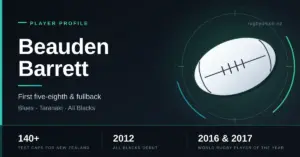
Rennie’s selections have leaned on quick ball delivery, with Hurricanes halfback Cam Roigard combining with playmakers such as Ruben Love at first five-eighth, backed by the experience of Beauden Barrett and Damian McKenzie. A fast pass away from the ruck stops defensive lines from setting, while an accurate goal-kicker and tactical kicker at 10 controls the scoreboard and field position.
| Role | Core Responsibilities | Effect on Attack |
|---|---|---|
| Halfback (9) | Quick ruck delivery, box kicking, communication with the forwards. | Sets the speed of attack and probes the blindside. |
| First five-eighth (10) | Controlling territory, tactical and goal kicking, organising the midfield. | Acts as the main decision-maker and releases the outside backs. |
Midfield Combinations at 12 and 13
The midfield is both the first line of defence and a key attacking channel, so it needs players who combine strength, footwork and handling under pressure. Opposition coaches often target the 12-13 channel with big inside centres running direct lines, so the pairing has to defend as well as it attacks.
Winning the Gain-Line and Organising the Defence
A balanced midfield usually pairs a strong ball-carrier at second five-eighth with a reader of the game at outside centre. Jordie Barrett offers size, distribution and a long kicking game at 12, while options such as Quinn Tupaea, Anton Lienert-Brown and Billy Proctor add carrying, experience and defensive organisation across 12 and 13.
- Inside centre (12): absorbs contact, wins gain-line metres and offers a second playmaking link.
- Outside centre (13): manages wide defence and reads overlaps before they form.
- Attacking variety: midfield runners disguise their lines to beat defensive drift.
- Turnover pressure: aggressive, legal tackling to shut down the offloading game.
The Back Three: Wings and Fullback
The back three — the two wings and the fullback — provide security under the high ball and the acceleration to turn kick returns into long-range attacks. Because opposition sides kick to isolate outside backs, this unit needs positioning, aerial skill and clear communication.
Handling the Aerial Game and Counter-Attacking
The 2026 back-three options blend power and finishing with aerial reliability: Caleb Clarke brings size on the wing, Will Jordan offers positional reading and finishing, and Damian McKenzie can operate as a creative fullback, with Leroy Carter, Josh Moorby and Fehi Fineanganofo adding pace. A fullback who reads the game well allows the side to run a second-playmaker system and launch counter-attacks when the opposition kicks poorly.
| Position | Key Attributes | Tactical Contribution |
|---|---|---|
| Left wing (11) | Power carrying, beaten-defender rate, physical presence. | Bending the edge and finishing chances near the touchline. |
| Right wing (14) | Positional tracking, support lines, clinical finishing. | Turning half-chances into tries in transition. |
| Fullback (15) | High-ball security, deep coverage, second-playmaker vision. | Sweeping in defence and launching attacks from deep. |
The Bench: Impact Reserves and the 6-2 Split
Test matches are frequently decided in the final quarter, so the eight replacements are selected as specialists who can change the game, not just cover injuries. How a coach splits the bench between forwards and backs is a deliberate tactical choice.
Refreshing the Pack Late in a Test
One increasingly common option is a 6-2 split — six forwards and two backs on the bench — using high-impact players such as hooker Asafo Aumua, prop Pasilio Tosi and loose forward Wallace Sititi to renew much of the pack in the second half. Fresh forwards help maintain scrum, lineout, carrying and defensive intensity against tiring opponents. The trade-off is thinner backline cover, so the two reserve backs usually have to cover several positions.
- Front-row refresh: replacing the front row to keep scrum pressure on.
- Utility backs: reserves such as Billy Proctor who can cover midfield and the wider channels.
- Breakdown impact: loose-forward replacements tasked with slowing opposition ball.
- Backline balance: a 5-3 split is the alternative when more back cover is needed.
The 2026 International Calendar
The season places heavy physical and travel demands on the squad, so player welfare and scheduling are managed carefully. A key change to understand for 2026 is that the traditional Rugby Championship does not run this year; the southern nations instead play the new global Nations Championship.
Nations Championship, Bledisloe Cup and the November Tour
The All Blacks’ 2026 programme has three clear blocks. In July they host three northern rivals at home in the Nations Championship: France in Christchurch (4 July), Italy in Wellington (11 July) and Ireland at Eden Park (18 July). In October they play the two-Test Bledisloe Cup against Australia — the first Test at Eden Park on 10 October and the second in Sydney on 17 October. In November they travel north to face Scotland, Wales and England, before the inaugural Nations Championship Finals Weekend in London on 27-29 November.
| Block | Main Fixtures | Context |
|---|---|---|
| July (home) | Nations Championship v France, Italy and Ireland. | Home Tests against northern-hemisphere opponents. |
| October | Bledisloe Cup v Australia (Auckland and Sydney). | The trans-Tasman series, held outside the Nations Championship. |
| November (away) | Tests v Scotland, Wales and England, then the Finals Weekend. | Northern tour and the Nations Championship play-offs in London. |
Following the All Blacks: Tickets and Broadcast
Home Tests sell quickly, so it helps to know the official channels. Tickets are sold through authorised outlets such as Ticketek and Ticketmaster, and members of official supporter programmes can receive pre-sale access. You can find more detail on buying All Blacks tickets safely and avoiding resale scams.
Where to Watch in New Zealand
Sky Sport is the main broadcaster of All Blacks Tests in New Zealand, with live coverage, replays and analysis. Fans who prefer streaming can use the Sky Sport Now service on phones, tablets, computers and smart TVs. Whether attending or watching, using official sources protects against invalid tickets and unreliable streams.
- Official ticketing: avoid unverified resale sites with inflated prices or invalid barcodes.
- Match-day transport: included with tickets in some host cities during set hours, but not everywhere — check the event page.
- Live broadcast: Sky Sport for full coverage on television.
- Streaming: Sky Sport Now for live and on-demand access on mobile devices.
Bringing It Together
Naming an All Blacks team is the end of a long process that reaches from school and club rugby through the Bunnings NPC and Super Rugby Pacific to the international camp. Every choice — from the balance of the tight five to the shape of the bench — reflects the game plan for a specific opponent and the demands of the season. Understanding that process, and following the team through official tickets and broadcasts, is part of how New Zealand supporters stay connected to their national side.
Sources
Frequently Asked Questions (FAQ)
How many players are named in an All Blacks squad?
There is no fixed number, but a campaign squad usually contains about 34 to 36 players. The 2026 Nations Championship squad has 34. For each individual Test, only 23 players are selected — 15 starters and eight replacements.
Who is the current head coach, and who is the 2026 captain?
Dave Rennie is the All Blacks head coach, working with co-selectors Sir Graham Henry and senior assistant coach Neil Barnes. Ardie Savea is the 2026 captain; he took over the role from lock Scott Barrett, who was unavailable through injury.
When is the match-day 23 usually announced before a Test?
The match-day 23 is normally named about 48 hours before kick-off, typically on the Thursday when the Test is on Saturday. It is a media convention rather than a fixed rule, and travel, tournament requirements or late medical assessments can change the timing.
What is a 6-2 bench split, and why is it used?
A 6-2 split names six forwards and two backs among the eight replacements. It lets a team refresh most of its pack for the closing stages to sustain scrum, lineout, carrying and defensive intensity. The trade-off is less backline cover, so the two reserve backs must be able to cover several positions.
How does Super Rugby Pacific form affect selection?
Super Rugby Pacific is the main weekly evidence base before the international season, so selectors weigh current form, fitness, combinations and whether a player suits the game plan. Strong club form helped several uncapped players into the 2026 squad, but it does not automatically guarantee a place.
What competitions do the All Blacks play in 2026?
In 2026 the All Blacks play the new Nations Championship rather than the Rugby Championship, hosting France, Italy and Ireland at home in July. They also contest a two-Test Bledisloe Cup against Australia in October, then tour north in November to face Scotland, Wales and England before the Nations Championship Finals Weekend in London.