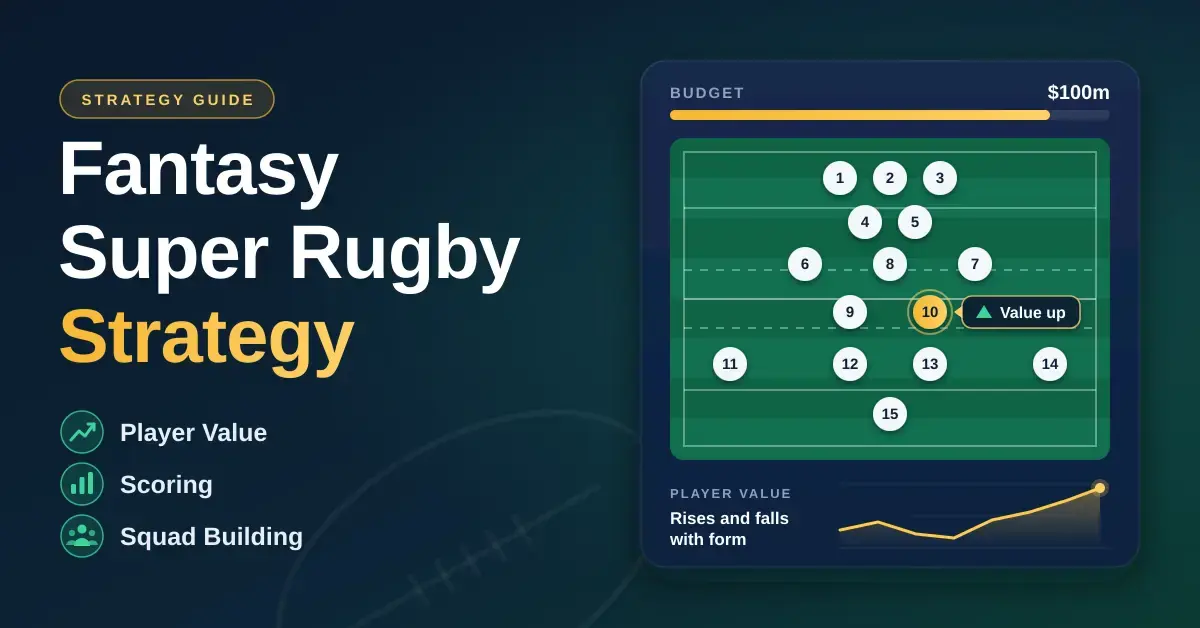
Fantasy Super Rugby lets fans across New Zealand and the wider region pick a virtual 15-player squad drawn from the real Super Rugby Pacific competition and earn points based on how those players perform each weekend. The official game is free to play, gives every manager a $100 million salary budget, and for the 2026 season introduced variable player pricing — a system where a player’s value rises or falls from round to round based on form. This guide focuses on the strategy side: how player value works, how to read the scoring, and how to build a balanced squad. For a full walkthrough of the rules and how to set up a team, see our companion guide to the official Super Rugby Fantasy game.
Quick Facts
| Game | Fantasy Super Rugby (official Super Rugby Pacific fantasy) |
|---|---|
| Operator | Super Rugby Pacific |
| Official site | playfantasyrugby.com |
| Cost | Free to play |
| Platforms | Web browser, plus iOS and Android apps |
| Starting budget | $100 million |
| Squad size | 15 players (no bench) |
| Max per club | 4 players |
| Transfers | Unlimited (locked players excepted) |
| New for 2026 | Variable player pricing (up to +/- $0.5m per round) |
How Fantasy Super Rugby Works
The concept is simple: you are a selector with a fixed budget, and you sign a squad of 15 players whose real match statistics convert into fantasy points. Understanding the boundaries of the game is the first step to competing.
- Budget: You start with $100 million to sign your full squad — a salary cap that forces trade-offs between premium stars and cheaper value picks.
- Squad shape: 15 players in fixed positions — 2 props, 1 hooker, 2 locks, 3 loose forwards, 1 halfback, 1 first five-eighth (fly-half), 2 midfielders and 3 in the back three.
- Club limit: No more than four players from any single Super Rugby Pacific franchise. With 11 clubs in the competition, this spreads your risk across teams.
- Transfers: Unlimited across the season, but a player locks once their team kicks off and cannot be moved until the round is complete.
- Captain: One nominated captain each round scores double points.
- No bench: All 15 of your players score every round — there are no reserves or automatic substitutions, so every selection matters.
The game is free to enter, with a global leaderboard and the option to build private leagues against friends. The overall global winner is advertised to receive a major prize of roughly USD $10,000 (about AUD $14,000). Because your squad spans the whole league, it helps to understand the wider Super Rugby Pacific format and teams before you draft, and to know exactly what each rugby position is expected to contribute.
The Fantasy Scoring System, Explained
Points are the currency of the game, and the scoring rewards a blend of eye-catching attack and unglamorous consistency. A try is the jackpot at 15 points, but a flanker quietly banking tackles and a turnover can out-score a try-less winger. The table below sets out the main actions and their values.
Fantasy Scoring
| Action | Points |
|---|---|
| Played 1–60 minutes | +1 |
| Played 61+ minutes | +2 |
| Try scored | +15 |
| Try assist | +9 |
| Line break | +7 |
| Line-break assist | +5 |
| Defender beaten | +2 |
| Offload | +2 |
| Metres gained | +1 per 10m |
| Turnover won | +4 |
| Interception | +5 |
| Tackle made / missed | +1 / -1 |
| Conversion / missed | +2 / -1 |
| Penalty goal / missed | +3 / -1 |
| Drop goal | +3 |
| Own lineout won | +1 |
| Lineout steal | +5 |
| Lineout error | -2 |
| Scrum won outright (front row) | +3 |
| Penalty / error conceded | -1 |
| Yellow card / red card | -5 / -10 |
| Captain | Double all points |
Two ideas matter most when you read this table. First, floor versus ceiling: high-ceiling attackers (wings, midfielders, fullbacks) can explode for a try and a line break, but they can also score almost nothing in a tight game. Grafters — locks, hookers and defensive loose forwards — offer a reliable floor through tackles, minutes and set-piece work. A good squad blends both.
Second, a common myth worth correcting: a 50:22 kick is not a scored fantasy action. The 50:22 is a law that wins a lineout deep in the opposition half; it does not award points on its own. What it does is create territory and attacking platforms, which can then lead to metres gained (worth a point per 10 metres), line breaks and tries. If you want to understand why that territory matters, our guide to why kicking wins field position explains the tactical picture.
Variable Player Pricing and How to Find Value
The headline change for 2026 is variable pricing. Every player’s value can move by up to $0.5 million each round: perform well relative to your price and you go up, disappoint and you drift down. Players who feature for under about 10 minutes see no change. Starting prices are set from the previous season’s form, so proven internationals and prolific goal-kickers begin as the most expensive assets.
Smart managers treat this like a market. The core tactic is buy low, sell high: identify an under-priced young player or an in-form squad rotation pick early, watch their value climb over a few rounds, and use the extra budget to upgrade elsewhere. Growing your total squad value gives you more spending power for the run-in, when you may want several premium players at once.
Where value hides
- Cheap enablers: Reliable starters at low prices who play 80 minutes and rack up tackles or metres are the backbone of a balanced budget.
- Form before reputation: A famous name resting or out of form is dead money; back players who are actually starting and firing.
- Differentials: A strong player owned by few managers can lift you up the leaderboard faster than the obvious captain picks everyone shares.
Building a Balanced 15-Player Squad
Because there is no bench, every pick has to earn its place. Most successful squads are built around two engines: a creative spine and a hard-working pack.
The spine: 9, 10 and 15
The halfback, first five-eighth and fullback dictate attacking flow and collect a large share of try assists (9 points) and line-break assists (5 points). The fly-half usually kicks goals too, so conversions (2 points) and penalties (3 points) add a dependable stream of points — though a poor kicking day carries small penalties for misses. Fullbacks who counter-attack rack up metres and clean breaks. Spending a meaningful chunk of your budget on this creative core is usually money well spent.
The forward pack
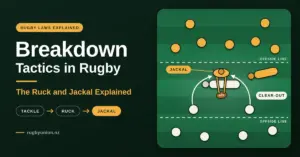
Forwards provide your floor. Fetching flankers who force turnovers (4 points each) and pile up tackles are consistent scorers regardless of the result, and 80-minute players earn the full time-on-field bonus. Set-piece specialists add value too: a lineout steal is worth 5 points and a dominant scrum rewards the front row. If you want to spot which players win these battles, our breakdowns of set-piece strategy and breakdown and jackal tactics are a useful primer.
Captaincy and the Three Boosters
Your captain scores double every round, so the armband should go to a player with a high, reliable ceiling in a favourable match-up — typically a first-choice goal-kicker or a prolific try-scorer facing a weaker defence. On top of that, you get three one-off boosters for the season:
- Triple Captain: your captain scores triple instead of double for one round — best saved for a premium player in a big match.
- Limitless: an unlimited budget for a single round, letting you field a dream XV of the most expensive players before your squad reverts.
- Co-Captains: nominate two captains who both score double for one round, spreading the risk if you are unsure which star will fire.
Boosters can each be used only once and cannot be combined in the same round, so timing is everything. Rounds where the whole league plays and star availability is high — such as Super Round — are natural windows to deploy them.
Managing Rotation, Rest and Super Round
New Zealand managers face a particular headache: the All Blacks and other internationals are rotated and rested for player welfare, so a marquee name can be listed as unavailable and score zero. With no bench to cover for you, the only tool is the transfer market — check the confirmed team lists each week and move rested players out before they lock. Prioritising genuine 80-minute starters over big names who are being managed is one of the simplest ways to avoid blank scores.
One date to circle is Super Round. In 2026 all five matches were played across a single weekend at the new One NZ Stadium in Christchurch (24–26 April), marking the venue’s grand opening. A full round of fixtures in one place means high player availability and, with a covered, dry surface, conditions that tend to favour attacking, high-scoring rugby — an ideal moment to consider a booster. Fantasy sport has become part of rugby’s broader entertainment culture, a shift documented widely in the media and on reference sites such as Wikipedia.
How the 2026 Law Changes Affect Fantasy Scoring
Super Rugby Pacific introduced several ‘faster footy’ law innovations for 2026 that indirectly shape fantasy output. Understanding them helps you predict which players benefit.
- Pass back before a 50:22: teams may now pass the ball back into their own half before kicking a 50:22, making the territory-winning kick easier and boosting kickers and fullbacks who gain metres.
- No joining a ruck after ‘use it’: once the referee calls ‘use it’, defenders cannot pile in, producing cleaner, quicker ball for halfbacks and more attacking chances.
- Referee discretion on penalty tries: a yellow or red card is no longer automatic when a penalty try is awarded, slightly reducing the card risk attached to aggressive defenders.
- Fewer unprompted TMO checks: the TMO now only steps in unasked for serious foul play or a clear and obvious infringement in the lead-up to a try, keeping the game flowing.
Common Mistakes to Avoid
- Loading up on one team’s stars — the four-per-club cap and injury risk make this fragile.
- Picking on reputation instead of confirmed selection and current form.
- Ignoring goal-kickers, who quietly bank points every week.
- Burning all three boosters early instead of saving them for high-ceiling rounds.
- Forgetting to transfer out rested or injured players before they lock.
Sources
- Super Rugby Pacific – Fantasy: How to Play, Scoring and Boosters
- Super Rugby Pacific Fantasy – Official Game Guidelines
- RugbyPass – Super Rugby Pacific Fantasy: Rules and Boosters explained
- Play Fantasy Rugby – official game portal
- Super Rugby Pacific – Confirms new law innovations for 2026
- Super Rugby Pacific – Super Round confirmed for Christchurch in 2026
- Ministry of Sport – Fantasy Super Rugby Pacific 2026 launches with variable pricing
Frequently Asked Questions
Is Fantasy Super Rugby free to play?
Yes. The official game is free to enter, with a global leaderboard and private leagues, and the overall global winner is advertised to receive a major prize of roughly USD $10,000 (about AUD $14,000).
How does variable player pricing work?
Each round a player’s value can rise or fall by up to $0.5 million, depending on how their fantasy return compares with their price. Players who feature for under about 10 minutes see no change, and starting prices are based on the previous season’s form.
How many players can I pick from one club?
A maximum of four players from any single Super Rugby Pacific franchise, which spreads your squad across the 11 competing teams.
What are the three boosters and can I combine them?
Triple Captain, Limitless and Co-Captains. Each can be used once during the season and only one may be active in any given round, so they cannot be stacked.
Is a 50:22 kick worth fantasy points?
No. The 50:22 is a law that wins a lineout in the opposition half; it does not score directly. It helps indirectly by creating territory that can lead to metres gained, line breaks and tries, which do score.