Following the Super Rugby standings is one of the simplest ways to see where every team sits as a season unfolds. The table is more than a list of wins and losses — it captures form, playoff hopes and the way bonus points can lift a side above a rival on the same number of victories. This guide explains how the standings are built, how the points and finals systems work, and where each team finished in the most recent seasons.
How the Standings Are Calculated
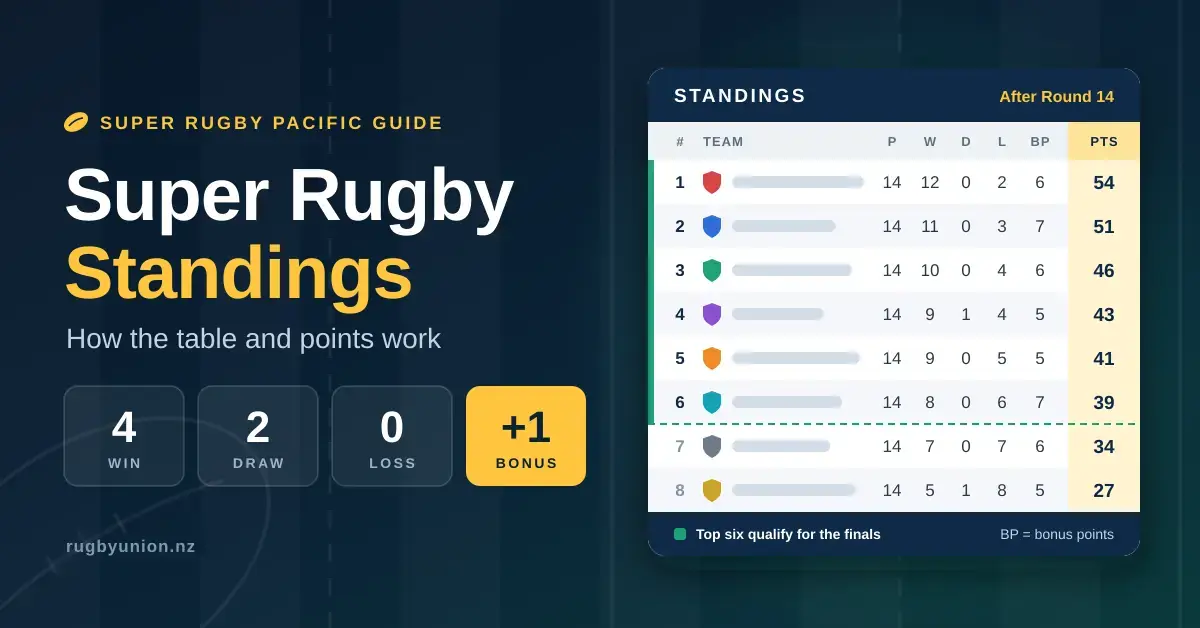
Super Rugby Pacific standings rank the competition’s 11 teams on total competition points earned across a 14-round regular season. Each side plays 14 matches — seven at home and seven away — with two byes spread through the schedule. Points are awarded for results, and extra bonus points reward attacking play and close finishes.
Here is the full scoring system:
- 4 points for a win
- 2 points for a draw
- 0 points for a loss
- 1 bonus point for scoring three or more tries than the opponent
- 1 bonus point for losing by seven points or fewer
Because a team can claim the attacking bonus point in a win, the maximum haul from a single match is five points. A side can also leave with something from a defeat: a losing bonus point keeps them within touch of the pack. This is where momentum swings — a late try that secures a bonus point can turn the tides of a tight playoff race and lift a team above a rival with an identical win column.
Key Points
- Teams are ranked on total competition points from a 14-round regular season.
- Win = 4 points, draw = 2 points, loss = 0 points.
- Two bonus points are available per match: one for scoring three or more tries than the opponent, one for losing by seven points or fewer.
- The top six teams qualify for the finals series (1v6, 2v5, 3v4).
- Ties are broken by wins first, then points difference, then tries scored.
Reading the Table
Most published Super Rugby tables use the same abbreviations. Knowing them makes the standings far easier to follow:
- P — matches played
- W / D / L — wins, draws and losses
- PF — points for (scored)
- PA — points against (conceded)
- PD — points difference (PF minus PA)
- B — bonus points earned
- Pts — total competition points, the figure teams are ranked on
When two teams finish level on total points, tiebreakers decide who ranks higher. Super Rugby Pacific applies them in order: most wins first, then points difference, then total tries scored. That is why a side with a poorer points difference can still sit higher if it has banked more victories.
2026 Final Standings
The Super Rugby Pacific regular season in 2026 was topped by the Hurricanes, who finished with 11 wins, a competition-best points difference of +264 and 55 competition points. The Chiefs matched the Hurricanes on 11 wins but trailed on bonus points and differential to take second. The Crusaders, Blues, Reds and Brumbies completed the top six and booked their place in the finals.
2026 Super Rugby Pacific Standings
| Pos | Team | P | W | D | L | PF | PA | PD | Pts |
|---|---|---|---|---|---|---|---|---|---|
| 1 | Hurricanes (Champions) | 14 | 11 | 0 | 3 | 562 | 298 | +264 | 55 |
| 2 | Chiefs (Runners-up) | 14 | 11 | 0 | 3 | 515 | 325 | +190 | 51 |
| 3 | Crusaders | 14 | 8 | 0 | 6 | 488 | 388 | +100 | 41 |
| 4 | Blues | 14 | 8 | 0 | 6 | 456 | 412 | +44 | 38 |
| 5 | Reds | 14 | 8 | 0 | 6 | 364 | 386 | -22 | 37 |
| 6 | Brumbies | 14 | 7 | 0 | 7 | 402 | 373 | +29 | 34 |
| 7 | Force | 14 | 7 | 0 | 7 | 358 | 383 | -25 | 30 |
| 8 | Waratahs | 14 | 5 | 0 | 9 | 353 | 402 | -49 | 28 |
| 9 | Highlanders | 14 | 5 | 0 | 9 | 327 | 424 | -97 | 24 |
| 10 | Fijian Drua | 14 | 5 | 0 | 9 | 330 | 473 | -143 | 21 |
| 11 | Moana Pasifika | 14 | 2 | 0 | 12 | 276 | 567 | -291 | 9 |
Pts is total competition points, including bonus points. The top six teams qualified for the finals; the Hurricanes went on to beat the Chiefs 60–5 in the Grand Final.
The season ended emphatically. The Hurricanes beat the Chiefs 60–5 in the Grand Final at Wellington Regional Stadium on 20 June 2026 — the biggest winning margin in a Super Rugby final and the club’s second title. Wings Fehi Fineanganofo and Josh Moorby each finished the campaign with 17 tries, a single-season record.
How the Finals Work
Since 2025, Super Rugby Pacific has used a six-team finals series rather than the eight-team format of earlier years. The top six teams after the final regular-season round qualify, and the position each finishes in shapes the whole bracket.
The first weekend features three qualifying finals: first plays sixth, second plays fifth and third plays fourth, with the higher-seeded side hosting each match. The three winners advance, and so does the best-performing losing team — though that side drops one seeding place as a penalty. Teams are then re-seeded for the semi-finals, and the higher seed again hosts, right through to the Grand Final.
The value of a high finish is obvious. In 2025 the Chiefs topped the regular season but lost their qualifying final to the sixth-placed Blues, which dropped them to a lower semi-final seed. The Crusaders, who had finished second, went on to win the Grand Final 16–12 over the Chiefs in Christchurch for their 13th title — proof that where you sit before the finals can matter as much as the finals themselves.
New Zealand Teams in the Standings
New Zealand fields five of the competition’s 11 franchises, and their form is often the headline of any Super Rugby table. In 2026 four of the five reached the finals: the Hurricanes and Chiefs led the way, while the Crusaders and the Blues also secured top-six places. Only the Highlanders missed out, finishing ninth.
The pattern was similar in 2025, when the Chiefs, Crusaders, Hurricanes and Blues all made the six-team cut and the Highlanders again fell short. That depth means the New Zealand derbies — Crusaders against Blues, or Chiefs against Hurricanes — frequently double as playoff-defining fixtures.
Long the benchmark of the competition, the Crusaders have won more titles than any other side and reached the final in both 2025 and 2026, winning the first of those. Their consistency is a reminder that the standings reward sustained performance across a long season, not just a strong finish.
Which Teams Dominate the Standings
Some franchises appear near the top of the table far more often than others. The Crusaders are the competition’s most decorated side and have spent much of Super Rugby’s history in the leading places. The Hurricanes, Chiefs and Blues have all enjoyed strong runs, while the Brumbies remain Australia’s most consistent presence. Fijian Drua and Moana Pasifika, the newest franchises, have shown flashes of quality but are still building toward regular top-six finishes.
Reading a single season’s standings alongside this longer history helps explain why a surprise result — a traditional powerhouse near the foot of the table, or a newcomer pushing for the finals — carries so much weight for fans.
Following Live and Round-by-Round Standings
During match weekends the table updates in real time. Live standings fold in the current score and any bonus points a team is on course to earn: a side leading by three or more tries is provisionally shown with an attacking bonus point, while a team trailing by seven or fewer carries a losing bonus point until the final whistle. Those projections can shuffle the order several times in an afternoon when multiple games kick off together.
Round-by-round tracking tells a richer story than the final table alone. A side can sit mid-pack early, string together wins and climb into the six, or drift out of contention with a run of narrow losses. Late in the season the middle of the table often tightens to the point where a single bonus point separates a home final from an early exit — which is why fans watch the live ladder as closely as the match itself.
Standings and Fantasy Rugby
The standings are also the backbone of prediction and fantasy games. Following the table closely helps when picking form players and fixtures in Super Rugby Fantasy, where a team on a winning run and racking up bonus points usually signals in-form individuals worth selecting. Understanding why a side sits where it does — schedule, differential and bonus points — turns a plain league table into a useful planning tool.
Sources
Frequently Asked Questions
Who won Super Rugby in 2026?
The Hurricanes won the 2026 Super Rugby Pacific title, beating the Chiefs 60–5 in the Grand Final in Wellington. It was the Hurricanes’ second championship and the largest winning margin recorded in a Super Rugby final.
What does B stand for in a rugby table?
B stands for bonus points. A team earns one for scoring three or more tries than its opponent and one for losing by seven points or fewer, so it is possible to collect two bonus points in a single match.
How many teams make the Super Rugby Pacific finals?
The top six teams on the regular-season table qualify for the finals. First plays sixth, second plays fifth and third plays fourth in the qualifying finals, with the higher-placed team hosting each match.
How many points is a win worth in Super Rugby?
A win is worth four competition points and a draw is worth two, while a loss earns none. Teams can add up to two bonus points per match on top of that, so a winning side can bank a maximum of five points from one game.
Have the Chiefs ever won Super Rugby?
Yes. The Chiefs won back-to-back titles in 2012 and 2013 under coach Dave Rennie, beating the Sharks and then the Brumbies in the finals. They have since remained regular contenders, reaching the Grand Final in both 2025 and 2026 without adding a third crown.