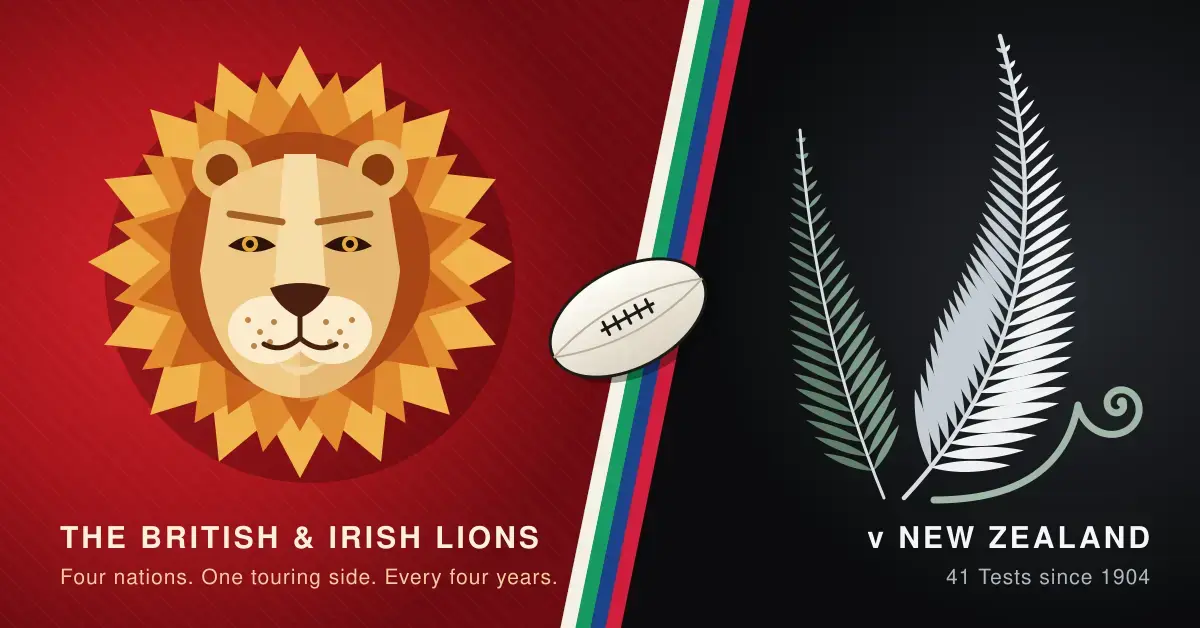
The British & Irish Lions are one of rugby union’s most unusual and celebrated teams. Instead of representing a single country, they bring together the best players from England, Ireland, Scotland and Wales for a tour that happens only once every four years. For New Zealand fans a Lions visit is a rare event — the All Blacks have faced the Lions only a handful of times in more than a century, and the two sides share one of the sport’s great rivalries. This guide explains who the Lions are, how their touring squads are chosen, the history of their famous tours, and, in detail, their Test record against New Zealand.
Key Facts
- What they are: a combined team of players from England, Ireland, Scotland and Wales
- First tour: 1888 (to Australia and New Zealand); first official home-unions tour in 1910
- Tour cycle: once every four years since 1989, rotating among Australia, New Zealand and South Africa
- Record v New Zealand: 41 Tests — New Zealand 30 wins, Lions 7, 4 drawn
- Only series win in NZ: 1971 (2–1, one Test drawn)
- Most recent tour: Australia 2025, won 2–1 (captain Maro Itoje, coach Andy Farrell)
- Next tour: New Zealand in 2029; first women’s Lions tour (also to NZ) in 2027
- Colours: red jersey, white shorts, blue socks, green turnovers
What are the British & Irish Lions?
The British & Irish Lions are a representative team selected from the four “home unions” of the British Isles: England, Ireland (which fields players from both the Republic of Ireland and Northern Ireland), Scotland and Wales. Any player eligible to represent one of those four national teams can be picked for the Lions, regardless of where they play their club rugby.
The team exists only to tour. Every few years the Lions assemble, play a short series of warm-up matches and then contest a Test series against one of the major southern-hemisphere nations. Between tours the Lions do not play, which is part of what makes a selection so prized — a player may get only one chance, or none at all, in an entire career.
The side is governed jointly by the four unions — the Rugby Football Union (England), the Irish Rugby Football Union, Scottish Rugby and the Welsh Rugby Union — rather than by a single country’s governing body. Players run out in a distinctive red jersey, which is why the Lions are sometimes simply called “the men in red”.
A short history of the Lions
The first touring team made up of players from the British Isles travelled to Australia and New Zealand in 1888, though that pioneering trip was a private venture and no Test matches were played. The first tour organised under the four home unions headed to South Africa in 1910. Since then the touring side has grown into one of the most storied institutions in the sport, playing against the so-called “big three” of the southern hemisphere.
The amateur era
For most of the twentieth century the Lions toured as amateurs, often spending months at sea and on the road. Tours were long, physically brutal and included many matches against provincial and club teams as well as the Test series. The standout result of this period was the 1971 tour to New Zealand — still the only time the Lions have won a Test series on New Zealand soil — followed by the 1974 tour of South Africa, when the Lions went through all 22 matches unbeaten.
The modern four-year cycle
Since 1989 the Lions have toured on a regular four-year cycle, rotating among Australia, New Zealand and South Africa. Recent destinations were Australia in 2013, New Zealand in 2017, South Africa in 2021 (a tour played behind closed doors during the pandemic) and Australia again in 2025. In the professional era tours have become shorter and more intense, typically squeezing a handful of warm-up games and a three-Test series into roughly six weeks. You can read more about the long history of rugby union and how the game turned professional.
How a Lions squad is picked
A single head coach is appointed to lead each tour, supported by assistant coaches drawn from across the four nations. For the 2025 tour that head coach was Andy Farrell. The coach and his selectors then choose a squad on merit, which means a strong nation in a given year can dominate the squad while another may have very few players — or, in theory, none at all.
A modern Lions squad is large by international standards. The 2025 group named 38 players, reflecting the need to cover a demanding schedule and the risk of injuries far from home. Key steps in building a tour include:
- Form and fitness: selectors watch the Six Nations and club form closely in the months before a tour.
- Balance: the squad must cover every position, including specialist cover in the front row and at scrum-half. If you are new to the game, our guide to rugby positions explains what each role does.
- Captaincy: one player is named tour captain, though the Test captain can change if there are injuries.
- Warm-up matches: players audition for a Test place in the early tour games against provincial and club sides.
- Replacements: because tours are far from home, injured players are often flown out and replaced mid-tour.
Blending players who are normally rivals into one team in a matter of weeks is one of the hardest jobs in rugby, and part of what gives a successful Lions tour its mystique.
The Lions and the All Blacks
No opponent tests the Lions quite like New Zealand. Across more than a century the All Blacks hold a commanding edge: the two sides have met 41 times in Tests, with New Zealand winning 30, the Lions winning 7 and 4 drawn. New Zealand first beat a British Isles team 9–3 in Wellington in 1904, and the All Blacks have won the majority of series since.
Lions Series in New Zealand
| Year | Series result | Test scores (NZ–Lions) |
|---|---|---|
| 1904 | New Zealand won 1–0 | 9–3 |
| 1930 | New Zealand won 3–1 | Lions 6–3, 13–10, 15–10, 22–8 |
| 1950 | New Zealand won 3–0 (1 draw) | 9–9, 8–0, 6–3, 11–8 |
| 1959 | New Zealand won 3–1 | 18–17, 11–8, 22–8, Lions 9–6 |
| 1966 | New Zealand won 4–0 | 20–3, 16–12, 19–6, 24–11 |
| 1971 | Lions won 2–1 (1 draw) | Lions 9–3, 22–12, Lions 13–3, 14–14 |
| 1977 | New Zealand won 3–1 | 16–12, Lions 13–9, 19–7, 10–9 |
| 1983 | New Zealand won 4–0 | 16–12, 9–0, 15–8, 38–6 |
| 1993 | New Zealand won 2–1 | 20–18, Lions 20–7, 30–13 |
| 2005 | New Zealand won 3–0 | 21–3, 48–18, 38–19 |
| 2017 | Series drawn 1–1 (1 draw) | 30–15, Lions 24–21, 15–15 |
1971: the one series win
The 1971 tour remains the high point of Lions history in New Zealand and the only series the tourists have ever won there. Captained by John Dawes and guided by coach Carwyn James, the Lions won the series 2–1 with one Test drawn. More than 50 years later, that result is still the benchmark every touring Lions side is measured against.
2005 and the drawn series of 2017
The 2005 tour went the other way: a powerful All Blacks team swept the series 3–0, winning the Tests 21–3, 48–18 and 38–19. The 2017 tour produced one of the most dramatic finishes in the rivalry’s history. New Zealand took the first Test 30–15, the Lions hit back to win the second 24–21, and the decisive third Test finished 15–15, leaving the series drawn 1–1 — a result widely regarded as a moral triumph for the tourists against the then world champions. On that tour the Lions also played a midweek fixture against the Māori All Blacks, a long-standing tour tradition. To understand how the modern New Zealand side is built, see our explainer on how the All Blacks squad is selected.
The Lions against Australia and South Africa
New Zealand is only one of the three nations the Lions visit. The tourists have enjoyed more success against Australia, while South Africa — like the All Blacks — has usually proved a tougher proposition. The modern (post-1989) series tell the story:
- 1989, Australia: Lions won 2–1.
- 1997, South Africa: Lions won 2–1 — one of the Lions’ most celebrated modern tours.
- 2001, Australia: Australia won 2–1.
- 2009, South Africa: South Africa won 2–1.
- 2013, Australia: Lions won 2–1, their first series win in 16 years.
- 2021, South Africa: South Africa won 2–1 in a series played behind closed doors.
- 2025, Australia: Lions won 2–1.
The pattern is clear: Australia has been the Lions’ most beatable modern opponent, while series against New Zealand and South Africa are won far less often. That is a large part of why a Lions tour to NZ carries such weight for fans on both sides.
The jersey, badge and traditions
The famous red shirt is more recent than many fans assume. Early tourists wore a variety of colours and hoops; the now-iconic combination of a red jersey, white shorts, dark blue socks and green turnovers was adopted in 1950 for the tour of Australia and New Zealand. The four colours are often read as a nod to the four unions — the red of Wales, white of England, blue of Scotland and green of Ireland.
The crest, which has appeared on the shirt in various forms since 1938, carries one emblem for each nation: the English rose, the Scottish thistle, the Irish shamrock and the Welsh feathers. Tour traditions — long trips, the test of blending four rivalries into one team, and the rarity of selection — all add to the sense that a Lions tour is something apart from the regular international calendar.
The 2025 tour to Australia
The most recent tour sent the Lions to Australia in 2025. Andy Farrell’s squad, announced at The O2 in London on 8 May 2025, contained 38 players — 15 from Ireland, 13 from England, eight from Scotland and two from Wales — with lock Maro Itoje named captain. Itoje became the first Englishman to captain the Lions since Martin Johnson.
The three-Test series against the Wallabies finished 2–1 to the Lions:
- First Test (Brisbane, 19 July): Lions won 27–19.
- Second Test (Melbourne, 26 July): Lions won 29–26 to clinch the series.
- Third Test (Sydney, 2 August): Australia won 22–12 in wet conditions to avoid a whitewash.
It was the Lions’ first series win of any kind since their 2013 tour of Australia, and a reminder of how finely balanced these contests can be even when a side takes an early 2–0 lead.
When is the next Lions tour?
The Lions are next scheduled to tour New Zealand in 2029. New Zealand Rugby has confirmed that planning for the men’s tour is well advanced, though exact dates and the full match schedule have not yet been published; based on past tours it is likely to run across the southern-hemisphere winter, roughly from late June to early August.
There is also a new chapter on the way: the first-ever women’s British & Irish Lions tour is planned for New Zealand in 2027, extending the Lions tradition to the women’s game for the first time. For New Zealand fans, that means two Lions visits in the space of a few years — a rare treat given how seldom the tourists come south. If you are planning ahead, keep an eye on the broader international calendar, including the Rugby World Cup 2027.
Sources
- British & Irish Lions — Official History
- World Rugby — The history of the British and Irish Lions
- British & Irish Lions — 2025 squad announcement
- Irish Rugby — Lions celebrate first series win in 12 years
- Sky Sports — Australia 19-27 British and Irish Lions (first Test)
- Global Rugby Results — Lions tours to New Zealand
- Rugby World — The history of the iconic red Lions jersey
- RugbyPass — New Zealand Rugby CEO offers 2029 Lions tour update
Frequently Asked Questions
What are the British & Irish Lions?
They are a combined rugby union team selected from players eligible for England, Ireland, Scotland and Wales. The side exists only to tour, assembling once every four years to play a Test series against Australia, New Zealand or South Africa before disbanding again.
How often do the Lions tour?
Since 1989 the Lions have toured on a four-year cycle, rotating among the three major southern-hemisphere nations. The 2025 tour went to Australia, and the next tour is scheduled for New Zealand in 2029.
Have the Lions ever beaten the All Blacks in a series?
Yes, but only once. The 1971 Lions won the series 2–1 with one Test drawn, which remains the only time they have won a series in New Zealand. The 2017 series finished drawn 1–1, while New Zealand has won every other series between the teams.
Who can be selected for the Lions?
Any player eligible to represent one of the four home unions — England, Ireland, Scotland or Wales — can be chosen, no matter which club or country they play in. The head coach and selectors pick the squad on merit, so the balance between the four nations changes from tour to tour.
Why do the Lions wear red?
The red jersey, worn with white shorts, blue socks and green turnovers, was adopted in 1950. The colours are commonly seen as representing all four unions together — red for Wales, white for England, blue for Scotland and green for Ireland — and the crest carries the rose, thistle, shamrock and feathers of the four nations.