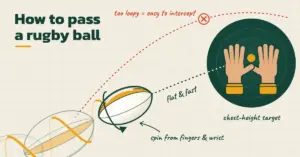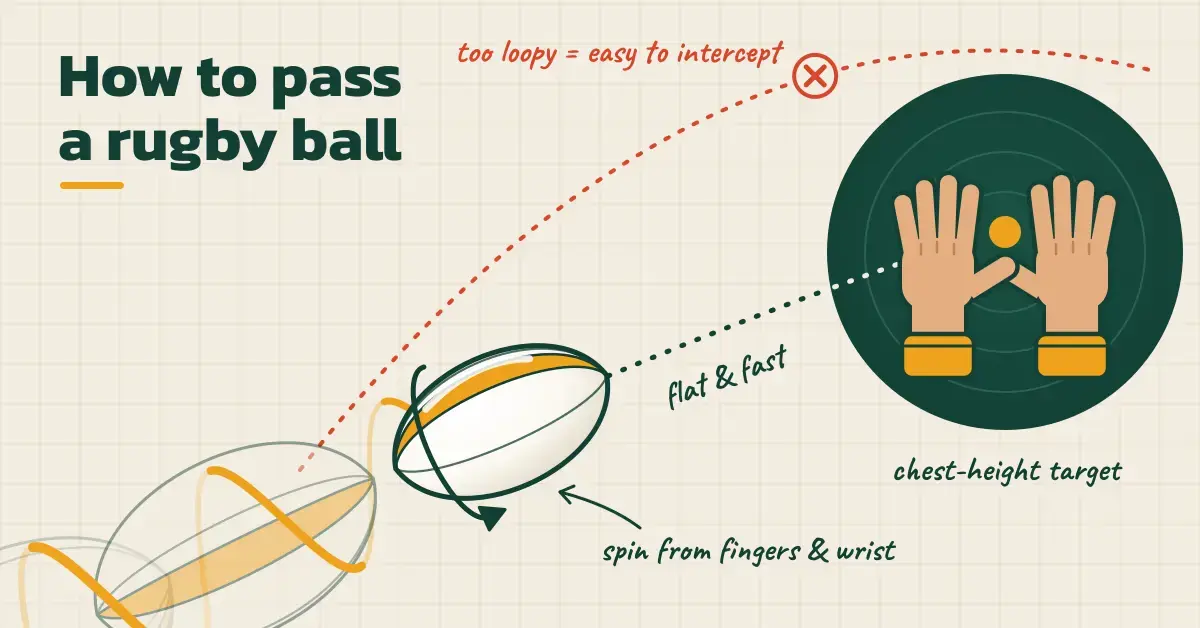
Passing is the skill that keeps rugby moving. A clean, accurate pass lets your team keep the ball alive, stretch the defence and put a teammate into space — and because the ball can only be passed sideways or backwards, good passing is something every player, from front-row forward to fullback, has to learn. To pass the ball, hold it in two hands at waist-to-chest height and turn side-on to face the receiver. Swing the ball across your body to a target at chest height just in front of them, then follow through with your fingers pointing at the target.
Pass Types Compared
| Pass | When it is used | Main power source | Difficulty |
|---|---|---|---|
| Lateral / push pass | Short, quick passes in midfield and near the ruck | Shoulders, wrists and a smooth push | Beginner |
| Spin / spiral pass | Longer passes and moving the ball wide fast | Power hand fingers and wrist rolling over the ball | Intermediate |
| Pop pass | Short soft release to a runner near contact | Light lift from both hands | Beginner |
| Scrum-half (clearing) pass | Passing straight off the ground at a ruck or scrum | Back hand drive from a low, stable base | Intermediate |
| Offload | In or just after a tackle to beat the defence | Free arms and a short flick | Advanced |
The grip: how to hold the ball
Everything starts with your hands. World Rugby’s first coaching cue for passing is simply to hold the ball in two hands — never tuck it under one arm until contact. From there:
- Spread your fingers. Place your hands on either side of the ball, roughly over the seams, with your fingers spread wide for control rather than a tight, white-knuckle squeeze.
- Know your two hands. One hand supplies the power and, for a spin pass, the spin; the other guides direction. We cover which hand does which job in each section below.
- Carry the ball ready. Hold it between waist and chest height in front of you so you can pass either way without a tell-tale wind-up.
The ball itself makes a difference. A ball that is too big, too worn or the wrong size for your hands is far harder to grip and spin, which is why age-grade rugby uses smaller balls. Our guide to choosing the right rugby ball explains the sizes and types.
The basic pass (lateral or push pass), step by step
The lateral pass — also called a push pass — is the first pass every beginner should master. It is accurate over short distances and easy to catch, so it is the default for quick hands close to a ruck or in midfield. Build it in order:
- Get your body side-on. Turn side-on to the defence so your chest faces the supporting receiver you are passing to — World Rugby’s cue for the position.
- Commit a defender. Where you can, draw a defender towards you first so the pass sends your teammate into the gap the defender has left.
- Pick your target. Aim for a spot in front of the receiver at chest height, not at the player, so they can run onto the ball at pace.
- Swing the ball across. Move the ball quickly across your body, using your chest, shoulders, elbows and wrists to control the speed and flight — a smooth push, not a slap.
- Follow through to the target. Finish with both hands extended in the direction of the pass and your fingers pointing at the target. Then keep supporting your teammate after the ball has gone.
Keep the ball between your waist and chest the whole time. A push pass that starts low tends to float and drop in front of the receiver.
The one rule that shapes every pass
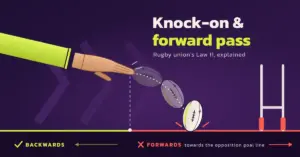
In rugby union you cannot throw the ball forward: under World Rugby’s Law 11, an intentional forward pass is penalised and an accidental one gives a scrum to the other team, so every pass must travel level with you or back towards your own goal line. See our guide to the knock-on and forward pass rules for the full detail, or our overview of the basic rules of rugby for the wider picture.
The spin pass (spiral pass): passing with distance
The spin pass — or spiral pass — makes the ball travel further and faster by spinning it around its long axis, like a thrown American football. It is the pass a halfback uses to fire the ball from a ruck to the first five-eighth, and the pass a backline uses to skip players and move the ball wide quickly. It is harder to throw and to catch than a push pass, so learn the basic pass first.
Power hand and guide hand
The two hands have clearly different jobs, and they swap depending on which way you are passing. According to World Rugby, when you pass to your right the left hand gives the power and imparts the spin, while the right hand provides stability and direction. When you pass to your left, you simply reverse it: the right hand powers and spins, the left hand guides. Put the power hand towards the back and lower half of the ball and the guide hand towards the front.
Creating the spiral
The spin comes from your fingers and wrist, not from swinging your whole body harder. As you release:
- Turn the ball so its long axis sits at roughly 30 degrees to the horizontal — World Rugby’s exact cue for the spiral pass.
- Let the power hand roll and snap up and over the top of the ball, so your fingers pull across it and set it spinning.
- Keep the guide hand light; its job is to steer, not to add force or spin. Fighting the power hand with the guide hand is what kills a spiral.
Follow-through and accuracy
Finish with your hands extended and your fingers pointing at your target, the same as a basic pass. The hand that was on top of the ball should finish towards the target; if it drops away early, the pass tends to fall short in front of the receiver. A spin pass travels further but is naturally less forgiving, so trade a little distance for accuracy until the technique is grooved. Elite first five-eighths such as Beauden Barrett make it look effortless precisely because the mechanics are automatic.
The scrum-half (clearing) pass from the ground
The halfback — called the scrum-half elsewhere — often has to pass straight off the ground at a ruck or scrum, which World Rugby calls the clearing pass. The technique is different because there is no time to pick the ball up first:
- Get low and stable. Approach the ball in a low, strong, stable position with your hips dropped and knees bent, head over the ball and eyes on it.
- Set your feet. Put the foot on your passing-hand side next to the ball — right foot for a right-handed pass, left foot for a left — and point your other foot in the direction you are passing.
- Sweep in one movement. Scoop the ball and release it in one quick motion rather than lifting it and then passing, which is slower and easier for defenders to read.
- Drive with the back hand. As with a spin pass, one hand steadies and the other drives; passing right, the right hand steadies and the left hand powers the ball away.
- Follow through. Finish with both hands extended towards the receiver.
Which players make which passes most often comes down to their role on the field — our guide to rugby positions explains the numbers and New Zealand names, from halfback and first five-eighth to the outside backs.
Other passes you will see
Once the basics are solid, these variations build on the same foundations:
- Pop pass: a short, soft, usually one- or two-handed pop up to a runner hitting the line close to you, often used just before contact.
- Offload: a pass made in or after a tackle, when you keep your arms free and release the ball to a supporting runner to beat the defensive line.
- Miss (cut-out) pass: a long spin pass that deliberately skips the nearest receiver to hit a player further out and swing the attack wide.
- Dive or flick pass: a quick, improvised release used when there is no time for a full technique, best kept for when nothing else is on.
Common mistakes and how to fix them
Most passing errors come back to a handful of faults. If your passes are missing, check these first:
- Passing with the arms only. A pass driven by the arms alone has little range. Turn your body side-on and use your shoulders and core so the arms finish the job rather than doing all of it.
- Aiming at the player, not in front. Throwing at your teammate forces them to slow down or stop. Target a spot in front of them at chest height so they run onto it.
- No follow-through. Stopping your hands at release makes the ball drop short or wobble. Finish with your fingers pointing at the target every time.
- The guide hand fighting the power hand. On a spin pass, if both hands push, the spiral dies and the ball floats. Let one hand power and spin while the other only steers.
- Telegraphing the pass. A big backswing tells the defence where the ball is going. Carry the ball in two hands in front of you and pass with a short, quick action.
- Drifting the ball forward. Releasing late while sprinting can send the ball forward relative to you. Pass level or slightly behind, and release a fraction earlier.
Simple drills to practise passing
You can groove passing almost anywhere with a partner or a wall:
- One-handed spins. Throw the ball one-handed to build the spin from the power hand, practising off both left and right. Add the guide hand only once the spiral is reliable.
- Static pairs. Stand a fixed distance apart and pass back and forth, focusing on grip, target and follow-through before you add movement.
- Step and pass. Take one step towards the target and pass, then build up to passing on the run so the skill holds at game pace.
- Target passing. Pass at a mark on a wall or a cone at chest height to sharpen accuracy over set distances.
Passing is one of the core handling skills, alongside catching, tackling and kicking — our guide to the rugby skills every player should master puts it in context.
Sources
Frequently Asked Questions
Can you pass the ball forward in rugby?
No — in rugby union the ball may only be passed sideways or backwards, as the forward-pass rule above explains.
What is the difference between a spin pass and a normal pass?
A normal pass (the lateral or push pass) pushes the ball to a nearby teammate without spin and is accurate over short distances. A spin or spiral pass puts rotation on the ball around its long axis so it travels further and faster, which is why it is used for longer passes and to move the ball quickly out wide. The spin pass is harder to throw and to catch, so beginners should master the push pass first.
Which hand provides the power in a spin pass?
The hand furthest from the direction you are passing. When you pass to your right, your left hand supplies the power and the spin while your right hand steadies and guides the ball; when you pass to your left, the roles swap. The power comes mainly from your fingers and wrist rolling over the ball, not from swinging your arms harder.
Why does my rugby pass keep wobbling or dropping short?
The usual causes are a weak grip, letting the guide hand fight the power hand so the spiral dies, and cutting the follow-through short. Spread your fingers for a firm grip, let one hand power and spin while the other only steers, and finish every pass with your hands extended and your fingers pointing at the target.
How can I practise passing on my own?
Use a wall. Mark a target at about chest height and pass at it from a set distance, working on both hands and on your follow-through, then step back to add range. One-handed spin throws against a wall are a good way to build the spiral before you add the guide hand.