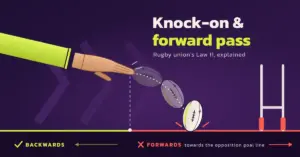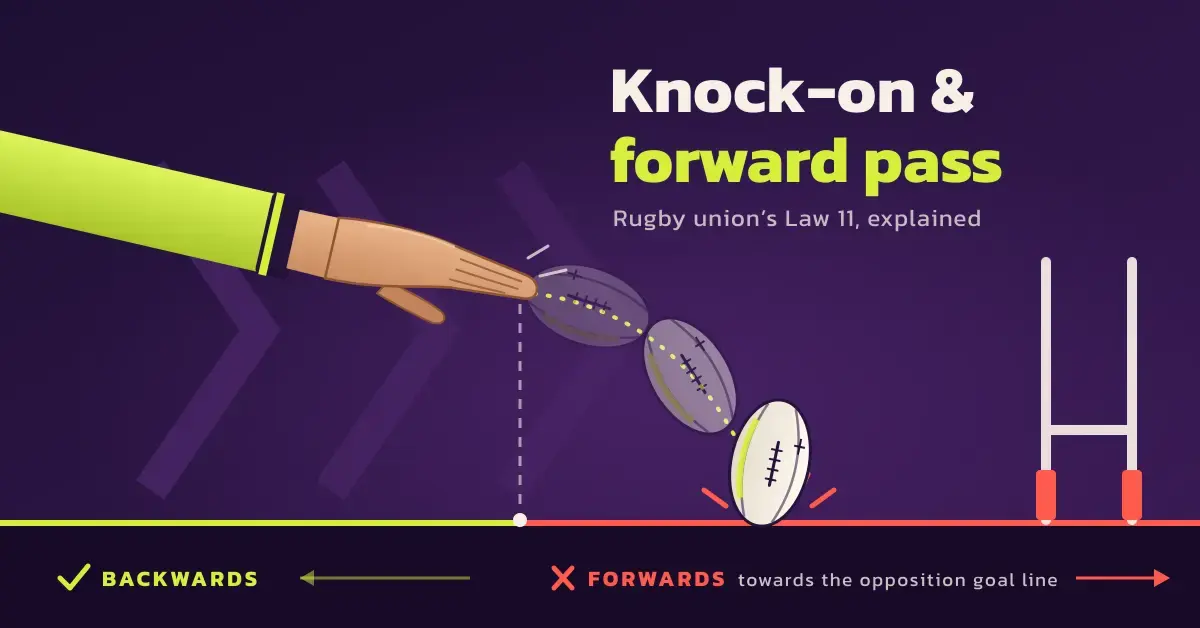
A knock-on and a forward pass are the two most common handling errors in rugby union, and both usually hand the ball straight to the other team. The knock-on rule in rugby sits inside World Rugby’s Law 11, which also covers the forward pass — officially called a “throw forward”. In plain terms, a knock-on is when you lose the ball forward off your hand or arm, and a forward pass is one that travels towards the opposition’s goal line. This guide explains both, the scrum or penalty that follows, and the handful of situations that look like an error but are perfectly legal. Knowing them is part of the basic rugby rules every player and supporter in Aotearoa New Zealand picks up early.
Key Points
- Knock-on: losing the ball forward off the hand or arm so it hits the ground or another player before you regather.
- Forward pass (throw forward): a pass whose direction is towards the opponents’ goal line.
- “Forward” means towards the opposition’s dead-ball line.
- Accidental error: scrum to the other team, who get the put-in.
- Deliberate error: penalty, plus a possible yellow card or penalty try if it stops a likely try.
- Not an offence: a charge-down, a ball ripped forward by an opponent, a backward knock, or a genuine catch you regather in time.
What counts as a knock-on?
World Rugby now calls a knock-on a “knock forward”, but the meaning is unchanged. Under the laws it happens in three ways:
- You lose possession of the ball and it goes forward.
- You hit the ball forward with your hand or arm.
- The ball strikes your hand or arm and goes forward.
In every case it is only a knock-on if the ball then touches the ground or another player before you can catch it again. If you knock the ball up, then regather it cleanly before it lands, there is no offence. The word “forward” has a precise meaning here: towards the opposition’s dead-ball line, the line at the very back of their in-goal area.
The body part matters too. The knock-on law is built around the hand or arm (or losing possession). A ball that bounces off a player’s leg, foot, knee or chest and goes forward — without the player ever holding it — is normally not a knock-on, and play carries on. A knock-on may occur anywhere in the field of play, including when a player is trying to make a tackle and the ball comes off them forward.
A typical example: a player reaches for a pass, the ball bounces off their fingertips and lands in front of them. Because it came off the hand, went forward and hit the ground, the referee signals a knock-on.
What counts as a forward pass?
A throw forward — what most fans call a forward pass — is when a player throws or passes the ball forward. The laws define this by the passer’s arms: it is a throw forward if the arms of the player passing the ball move forward. A forward pass can happen anywhere on the field.
This is one of the most argued calls in the game. A pass can leave the hands travelling backwards yet still drift forward through the air because the passer is running at speed. Officials judge the pass on the direction the hands and arms send the ball, not purely on where it eventually lands, which is why a pass from a sprinting player can be legal even when it looks forward to the crowd. Assistant referees and the Television Match Official (TMO), the off-field official who reviews video, often help decide the tight ones.
Knock-On vs Forward Pass
| Aspect | Knock-on | Forward pass (throw forward) |
|---|---|---|
| What it is | Losing the ball forward off the hand or arm | Passing or throwing the ball forward |
| Key test | Ball goes forward and touches the ground or another player | The passer’s arms move the ball towards the opponents’ line |
| Accidental sanction | Scrum to the opposition | Scrum to the opposition |
| Deliberate sanction | Penalty (card or penalty try if it stops a try) | Penalty (card or penalty try if it stops a try) |
| Common example | Dropping a high ball forward off the hands | A looping pass that drifts ahead of a runner |
What happens after a knock-on or forward pass?
For an accidental knock-on or forward pass, the sanction is a scrum to the team that did not make the error, and that team gets the put-in (they feed the ball into the scrum). Before stopping play, the referee will usually apply the advantage rule, letting play run on if the non-offending side gains territory or possession anyway; only if no advantage comes does play return for the scrum.
If the knocked-on ball goes into touch (over the sideline), the non-offending team can choose instead to take a quick throw-in or a lineout rather than the scrum. In short, an accidental error costs you possession; a deliberate one costs you far more.
When it is not a knock-on
Several moments look like a knock-on but carry no sanction — play simply continues:
- A charge-down. If you block an opponent’s kick and the ball comes off your hands or arms and goes forward, that is not a knock-on.
- A ball ripped or knocked out by an opponent. If a tackler or jackler rips or knocks the ball forward out of the ball-carrier’s hands, the carrier is not penalised for the ball going forward.
- A genuine catching attempt. It is not an intentional knock-on if, while trying to catch the ball, a player knocks it on, provided there was a reasonable expectation of gaining possession.
- Knocking the ball backwards. A “knock-back”, where the ball comes off your hand towards your own line, is legal and either team can play it.
- Off the body, not the hand. A ball that deflects forward off a leg, foot or chest, with no possession lost, is usually not a knock-on.
Deliberate knock-on or forward pass
Knocking the ball forward on purpose — slapping down a pass, for instance — is treated far more seriously than an accident. The sanction is a penalty to the other team. If the deliberate knock-on or forward pass stops a try that would probably otherwise have been scored, the referee awards a penalty try and the offending player is shown a yellow card (a 10-minute spell in the sin-bin) or, in the most serious cases, a red card. Whether a card follows comes down to the referee’s judgement of how clear the scoring chance was; there is no fixed formula. For the full detail on sanctions, see our guide to the yellow and red card rules.
Knock-ons near the try line and in-goal
Close to the line, where the ball ends up can change the restart. A knock-on in open play brings a scrum at the place of the error. But if the ball is knocked on and then made dead in the in-goal area, the in-goal law decides the restart: depending on how the ball got there, play comes back with either a goal-line drop-out or a five-metre scrum. Defences under pressure on their own line have to manage this carefully, along with the offside rule.
Is the knock-on the same in rugby league?
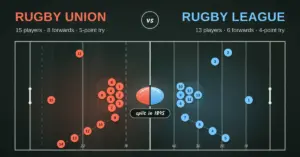
The knock-on exists in both codes, and in each one an accidental knock-on hands possession to the opposition. The difference is in the restart: rugby union brings a contested scrum, while rugby league uses its own uncontested scrum and possession rules. For a wider comparison of how the two games differ, see our breakdown of rugby union vs rugby league.
Sources
Frequently Asked Questions
Is it a knock-on if the ball comes off a player’s leg or foot?
Usually not. The knock-on law applies to the ball going forward off the hand or arm, or to losing possession forward. A ball that strikes a player’s leg, foot, knee or chest and bounces forward — without the player having held it — is normally not a knock-on, and play continues.
Can the ball go backwards off a player’s hands without a penalty?
Yes. Only a ball that goes forward counts. If the ball comes off your hand towards your own goal line — a “knock-back” — there is no offence, and either team can play the ball.
Why is a pass sometimes ruled forward when it looked backward?
Because officials judge the throw on the direction the passer’s arms send the ball, not only on where it lands. A player running at speed can release the ball backwards out of the hands and still see it drift forward through the air. If the hands pushed it forward it is a forward pass; if they sent it back it is legal, even if the player’s momentum carries it on.
Does a knock-on always stop play straight away?
No. The referee can play advantage first, allowing the non-offending team to keep going if they gain ground or possession. Play only returns for the scrum if no advantage is gained.