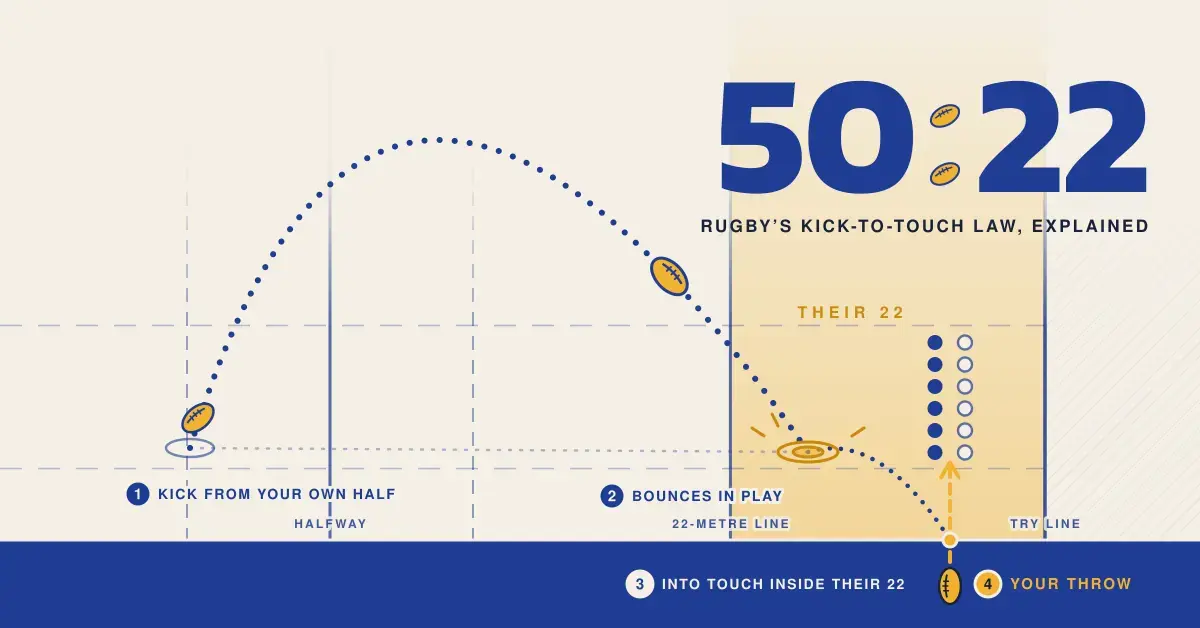
The 50:22 is one of the newest laws in rugby union, and it quietly changes where players stand all over the field. In short, if a team kicks the ball from inside its own half and the ball bounces into touch inside the opposition’s 22-metre area, the kicking team is rewarded with the throw at the resulting lineout. That is a big prize: instead of handing possession to the other side, the kicking team keeps the ball deep in attacking territory. Below is exactly how a 50:22 works, what does not count, and why World Rugby brought it in.
Key Points
- What it is: a kick from your own half that bounces into touch inside the opposition’s 22-metre area.
- The reward: the kicking team throws into the resulting lineout instead of conceding possession.
- Must bounce: the ball has to bounce in the field of play first — a kick straight out on the full does not count.
- Open play only: it cannot be gained from a kick-off or any restart kick.
- Where it lives: Law 18 of World Rugby’s Laws of the Game.
- Since when: trialled globally from 2021, full law from 1 July 2022.
What is the 50:22 rule?
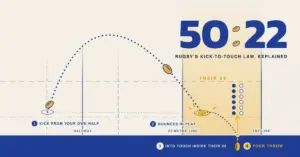
The 50:22 is a lineout law set out in Law 18 of World Rugby’s Laws of the Game. The name is a shorthand: the kicker starts inside their own half (behind the halfway, or “50”, line) and the ball ends up in touch inside the opponents’ 22-metre zone (the “22”).
Normally, when you kick the ball out, the other team gets to throw into the lineout. The 50:22 flips that reward. If your kick meets all of the law’s conditions, your team throws in instead. In practice it lets a side gain up to 50-plus metres of ground and still keep possession, which is why coaches and players value it so highly.
How a 50:22 works, step by step
For a kick to count as a successful 50:22, every one of these conditions must be true:
- The kicker is in their own half. The player must be in their own half when they kick.
- The ball finds touch inside the opposition 22. It must go into touch (out of play over the sideline) inside the opponents’ 22-metre area — not short of it, and not over the dead-ball line.
- The ball bounces first. The law requires the kick to go “indirectly” into touch, meaning it must bounce in the field of play before crossing the line. A kick that sails straight out on the full does not earn a 50:22.
- It happens in open play. The kick cannot be a kick-off or any kind of restart kick.
When all of that is satisfied, the referee awards the lineout throw to the kicking team at the point where the ball crossed the touchline. Knowing where the lines sit on the pitch helps here, so it is worth being clear on a rugby field’s markings and where the 22-metre line falls.
The “carried back into your own half” condition
There is one extra rule that often trips people up. If a team carries or passes the ball back into its own half and then kicks, the 50:22 only counts if one of these has happened first:
- the team never took the ball into their own half before kicking, or
- a tackle, ruck or maul took place within their half, or
- an opponent touched the ball within their half.
This stops teams from simply shovelling the ball backwards to set up an easy long-range kick. There has to be a genuine passage of play first.
What does not count as a 50:22
Because the conditions are strict, plenty of long kicks look like a 50:22 but are not. This table sums up the difference.
| Situation | 50:22 awarded? |
|---|---|
| Kick from own half, bounces, then into touch inside the opposition 22 | Yes — kicking team throws in |
| Kick from own half straight out on the full inside the 22 (no bounce) | No — opposition throws in |
| Kick that goes into touch short of the 22 | No — normal lineout rules |
| Kick taken from inside the opposition half | No — kicker must be in their own half |
| Kick-off or a restart kick that finds touch in the 22 | No — the law excludes restarts |
| Ball carried back into own half and kicked with no tackle, ruck, maul or opponent touch first | No |
Getting these details right is part of reading the game well, alongside staples such as the offside rules in rugby union and the advantage rule.
Why the 50:22 rule was introduced
The 50:22 began as one of several law trials World Rugby announced in 2021, part of a welfare-driven plan to make the game safer as well as more open. It was trialled globally from 2021, then made permanent full law from 1 July 2022, after the World Rugby Council approved it alongside the goal-line drop-out and three other changes.
The reasoning has two sides:
- Player welfare. World Rugby framed the trials as welfare-based, part of its stated aim of a safer, more sustainable game.
- Creating space. Because the kick is so costly to concede, defending teams have to keep players back to patrol the backfield and guard the touchlines. Pulling those defenders deep leaves fewer bodies in the front-line defence, which opens gaps for the attacking team to run and pass into.
In other words, a team does not even have to execute a 50:22 to benefit from it — the mere threat of one changes how the opposition sets up.
How the 50:22 changes tactics
The law has made accurate long kicking a prized skill, especially for halfbacks, first and second five-eighths and fullbacks. Teams now drill kicks that are weighted to bounce and sit up inside the 22 rather than skid dead. On defence, sides position a deep back three to cover the kick, which is exactly the trade-off the law is designed to force.
For attacking teams, the 50:22 sits inside a wider battle for control of territory. It is one more reason why kicking matters so much in rugby: a single well-judged kick can move the game 50 metres and keep the ball at the same time.
Sources
Frequently Asked Questions
What is the rule for a 50:22 kick in rugby?
A 50:22 is a kick taken in open play from inside your own half that bounces and then goes into touch inside the opposition’s 22-metre area. When that happens, your team is rewarded with the throw at the resulting lineout, keeping possession deep in attacking territory.
Does the ball have to bounce for a 50:22?
Yes. The law requires the kick to go “indirectly” into touch, so the ball must bounce in the field of play before crossing the sideline. A kick that goes straight out on the full does not count, and the throw goes to the opposition instead.
Can you get a 50:22 from a kick-off or restart?
No. Law 18 states the variation does not apply at a kick-off or any type of restart kick. A 50:22 can only come from a kick in open play.
When was the 50:22 introduced?
World Rugby trialled it globally from 2021 and made it permanent full law from 1 July 2022. It was part of a package of welfare-driven law changes that also included the goal-line drop-out.
What is the difference between a 50:22 and a mark?
They are separate laws. A mark (Law 17) is when a defender catches an opponent’s kick cleanly while on or behind their own 22-metre line and shouts “Mark!”, earning a free kick. The 50:22 (Law 18) is an attacking reward for kicking the ball into touch inside the opposition 22 — the two do not overlap.