Fantasy Super Rugby Pacific turns every round of the southern hemisphere’s flagship club competition into a personal contest of selection, timing and nerve. The official game is free to play, runs at playfantasyrugby.com and hands every manager a virtual budget to build a 15-player team that scores points from real on-field performances. This guide explains exactly how the game works — budget, scoring, captaincy and boosters — and then walks through the practical strategy you need to draft smartly, captain effectively and climb the global leaderboard.
What Is Fantasy Super Rugby Pacific?
Fantasy Super Rugby Pacific is the official fantasy game tied to the Super Rugby Pacific season. It is free to enter, and managers compete for a grand prize pool advertised at A$10,000 as well as bragging rights in private mini-leagues. You build a squad, earn points based on how your chosen players actually perform each weekend, and rise or fall against every other manager in the world.
The 2026 competition featured 11 teams — the Blues, Chiefs, Crusaders, Highlanders, Hurricanes, Moana Pasifika, Fijian Drua, Brumbies, Queensland Reds, NSW Waratahs and Western Force — playing 14 matches each across 16 rounds (with two byes), from February to June. The headline change for 2026 was the introduction of variable player pricing, meaning a player’s cost rises and falls through the season based on demand and form.
Quick Facts
| Game | Fantasy Super Rugby Pacific (official) |
| Official site | playfantasyrugby.com |
| Cost | Free to play |
| Grand prize | Advertised at A$10,000 |
| Budget | $100 million (virtual) |
| Squad | 15 players, max 4 from any one club |
| Captain | Scores double points each round |
| Transfers | Unlimited (players not yet played) |
| Boosters | Triple Captain, Co-Captains, Limitless |
| New for 2026 | Variable player pricing |
| Platform | Web browser, global leaderboard |
How the Game Works: Budget, Squad and Transfers
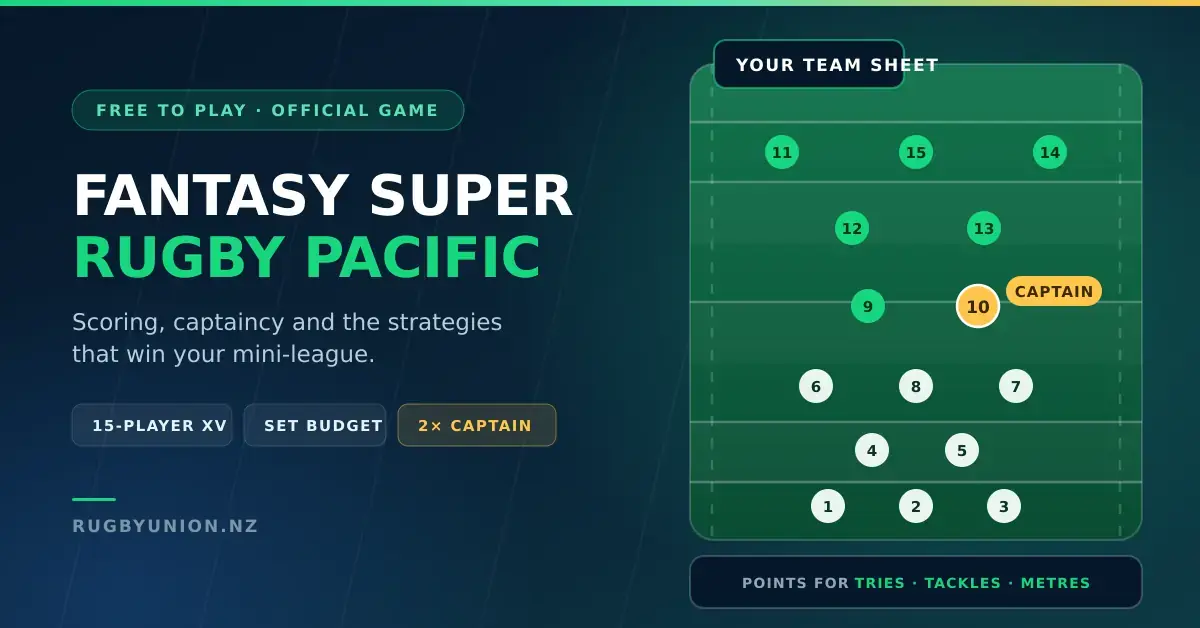
Every manager starts with a virtual budget of $100 million to assemble a 15-player squad. There is one important balance rule: you may pick a maximum of four players from any single franchise, which forces you to spread your selections across the competition rather than simply cloning one dominant team.
- Captain: Each round you nominate one captain who scores double points. You can change your captain as many times as you like right up until that player’s match kicks off.
- Transfers: Transfers are unlimited across the season, but you can only move a player in or out if they have not yet played in the current round. The game locks players progressively — a “rolling lockout” — as their matches begin.
- Variable pricing: Because prices shift week to week, buying a form player early (before their value climbs) is itself a way to build budget headroom for later signings.
Boosters Explained
You are given three one-off boosters to deploy at the moment of your choosing across the season. Each can be used only once, and only one can be active in a given round:
- Triple Captain: Your nominated captain scores triple points for that round instead of double.
- Co-Captains: You name two captains for one round, both earning double points.
- Limitless: You get an unlimited budget for a single round, letting you field a dream team without price constraints.
Saving boosters for a round where a heavy favourite hosts a struggling side — or where several of your premium players face weak defences at once — is usually more valuable than playing them early.
How Fantasy Points Are Scored
Points reward positive contributions and penalise mistakes. Attacking plays score the most: a try is worth the single biggest reward, followed by line breaks and try assists. Defensive graft — tackles made and turnovers won — provides a steady points floor, which is why hard-working forwards are so reliable. Discipline matters too: cards, missed tackles and handling errors all cost you points.
A few terms worth knowing if you are new to rugby: a turnover is winning the ball back from the opposition; an offload is a pass made while being tackled; a line break is bursting cleanly through the defensive line. All three are scored generously because they create attacking momentum.
Different positions accumulate points in different ways, which shapes who is worth their price:
| Position Group | Primary Scoring Drivers | Fantasy Value |
|---|---|---|
| Loose forwards (6, 7, 8) | Tackles, turnovers, carries, offloads | High and consistent |
| Fly-halves (10) | Goalkicking, try assists, line breaks | Premium captain material |
| Outside backs (11, 14, 15) | Tries, defenders beaten, metres gained | High ceiling, more volatile |
| Hookers (2) | Lineout work, tries from mauls, tackles | Good value for budget |
For a fuller breakdown of what each number does on the field, see our guide to rugby positions.
Fantasy Points Guide
| Action | Points |
|---|---|
| Try | +15 |
| Try assist | +9 |
| Line break | +7 |
| Line break assist / interception / lineout steal | +5 |
| Turnover won | +4 |
| Penalty goal / drop goal | +3 |
| Defender beaten / offload / conversion | +2 |
| Tackle made / metres gained (per 10m) | +1 |
| Game time: 1-60 min / 61+ min | +1 / +2 |
| Missed tackle / handling error / penalty conceded | -1 |
| Yellow card | -5 |
| Red card | -10 |
Building a Competitive Squad
Long-term success starts with intelligent squad construction rather than a scattergun of famous names. Evaluate current form, upcoming fixtures, injury history and how many minutes a player is likely to get, then spend accordingly.
Balancing Budget and Value
A common beginner trap is spending almost the entire budget on two or three superstars and filling the rest of the squad with cheap players who barely feature.
- The core spine: Invest in high-involvement roles — dynamic loose forwards, a goalkicking fly-half and a busy hooker — who bank points through tackles, carries and set-piece work every week.
- Squad depth: Make sure your cheaper picks are genuine starters, not bench-warmers, so rotation and late withdrawals do not leave you with players scoring zero.
- Value selections: Hunt for underpriced players who have locked down a starting jersey through injury or a positional switch, freeing budget for a premium try-scoring outside back.
Because prices move with form, tracking match statistics closely pays off; you can also learn more at sports-betting.nz to stay across form and market movements. Keep an eye on versatile players who cover several positions, too — they give you flexibility when injuries force a reshuffle.
Picking a Captain
The captain choice is the single most influential decision each round, because that player’s score is doubled. It is rarely about the biggest name and almost always about high, reliable involvement in a favourable matchup.
Goalkicking fly-halves and fullbacks are natural captains: they touch the ball constantly and rack up points through kicks, line breaks and metres gained. In 2026, players such as Beauden Barrett at the Blues and Damian McKenzie at the Chiefs offered exactly that blend of goalkicking and playmaking. Just as valuable are high-work-rate loose forwards who quietly bank tackles and turnovers even on a quiet attacking day. Where possible, captain a player who is at home against a side with a leaky defence.
Reading the Fixtures and Matchups
Studying the draw is as important as studying players. Identifying mismatches — based on form, home advantage, travel and head-to-head records — is how you find weekly points.
Home Advantage and Travel Fatigue
Cross-border travel across New Zealand, Australia and the Pacific takes a physical toll, and touring sides often fade defensively late in matches. Historically strong home teams like the Crusaders and Chiefs make their core starters dependable assets at their own grounds, while a visiting side with a poor away defensive record is a signal to load up on their opponents’ outside backs and goalkickers.
Plan a round or two ahead using the Super Rugby fixtures, and confirm your line-ups against the latest news for late team changes. If a favourite is riding a run of soft fixtures, consider stacking their key players; if your picks are heading into a brutal away stretch, transfer toward managers with kinder draws. Following the Super Rugby ladder also helps you spot which teams are peaking.
Common Mistakes to Avoid
- Chasing reputations: A famous name out of form scores no better than an unknown. Weigh recent performances and matchups, not past achievements.
- Over-stacking one team: Loading up on a single franchise leaves you exposed to their bad week, an injury cluster or a hard patch of fixtures. A balanced spread reduces that risk (and the four-per-club cap enforces it).
- Ignoring price movement: With variable pricing, sitting on a rising star too long means paying a premium; sitting on a falling one erodes your budget.
- Forgetting byes and rest: Track team announcements so you are not fielding a rested or benched player. For broader tactical reading and alternative angles, read alternative articles.
Getting Started
Signing up takes only a few minutes, and the game is designed to be accessible to casual fans as well as die-hards:
- Register a free account at the official game site, playfantasyrugby.com.
- Spend your $100 million on a 15-player squad, respecting the four-per-club limit.
- Nominate your captain for the opening round.
- Join or create a private league to play against friends, then track your rank on the global leaderboard.
If you enjoy the format, our companion article on fantasy Super Rugby offers additional weekly tactics to complement this guide.
Disclaimer
Fantasy Super Rugby Pacific is a free game of skill and is not gambling. This article is general information about how the game and competition work, not betting or financial advice. Any sports-betting services referenced are separate, are restricted to those aged 18 and over, and should be approached responsibly. If gambling is affecting you or someone you know in New Zealand, free confidential support is available from the Gambling Helpline New Zealand on 0800 654 655.
Sources
- Super Rugby Pacific — Fantasy Super Rugby Pacific 2026 launched
- Super Rugby Pacific — Fantasy game goes live (prize, budget, boosters)
- RugbyPass — Super Rugby Pacific Fantasy: rules and boosters explained
- Play Fantasy Rugby — official Super Rugby Pacific Fantasy game
- 2026 Super Rugby Pacific season — format and teams
- All Blacks — Beauden Barrett returns to Super Rugby Pacific
Frequently Asked Questions
Is Fantasy Super Rugby Pacific free to play?
Yes. The official game at playfantasyrugby.com is free to enter, with an advertised grand prize pool of A$10,000 plus private mini-leagues you can set up with friends.
How do I pick the best captain?
Choose a high-involvement player — usually a goalkicking fly-half or fullback, or a busy loose forward — playing at home against a weaker defensive side. Captains score double points, so consistency of involvement matters more than reputation.
Are forwards or backs better for fantasy points?
Both matter. Forwards provide a steady floor through tackles, turnovers and carries, while backs offer explosive upside via tries, line breaks and metres gained. A balanced mix protects you against quiet weeks.
How do transfers and player prices work?
Transfers are unlimited, but you can only move players who have not yet played that round. Prices fluctuate through the season based on demand and form, so buying in early on a rising player can save budget later.
What are the boosters?
There are three single-use boosters: Triple Captain (your captain scores triple), Co-Captains (two captains score double for one round) and Limitless (an unlimited budget for one round). Save them for high-ceiling rounds.