Speed separates good rugby players from match-winners. In New Zealand’s fast, physical game, the ability to accelerate from a standstill, change direction under pressure and still sprint hard in the final minutes decides tight contests. This guide breaks down how modern speed and agility work is actually built — the mechanics of the first few steps, footwork and reactive decision-making, plyometric power, safe deceleration, positional differences and the fitness tests coaches use to measure it. It is written for players, parents and grassroots coaches who want practical, evidence-based detail rather than gym clichés. Read more NZ articles.
Key Points
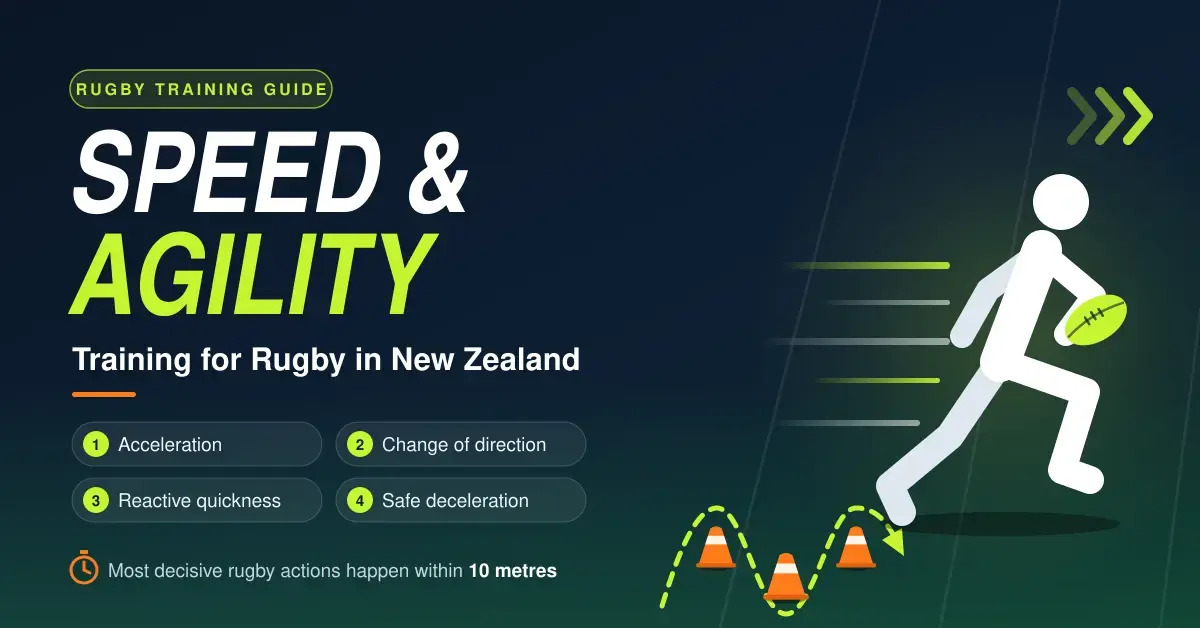
- Speed and agility training develops four qualities: acceleration, change of direction, reactive quickness and safe deceleration.
- Most decisive rugby actions happen over less than 10 metres, so the first few steps matter more than 100m top speed.
- Agility has two halves: the physical skill of changing direction and the cognitive skill of reacting to the game.
- Plyometrics build the elastic spring that turns gym strength into on-field speed.
- Deceleration training improves footwork and reduces knee and ankle injury risk.
- The Bronco test is New Zealand’s benchmark for repeat-sprint fitness.
What Speed and Agility Really Mean in Rugby

Coaches often group this work under the label SAQ — Speed, Agility and Quickness. It is useful to separate the three, because they are trained differently. Speed is how fast you can move in a straight line. Agility is how well you change direction. Quickness is how fast you react and get your first movement away. Raw track speed helps, but rugby rewards what is often called functional velocity: accelerating off the mark, decelerating to avoid a tackle, and turning sharply without losing momentum. Because most decisive actions happen over less than ten metres, the first few steps matter more than a fast 100-metre time.
- Linear acceleration — the hard, driving leg action needed to burst onto the ball and beat a defensive line.
- Change of direction (COD) — the physical skill of planting, braking and cutting to a new line.
- Reactive quickness — reading a teammate’s run or an opponent’s step and responding in real time.
- Deceleration — controlled braking so you can turn sharply and reduce the risk of knee and ankle injuries.
Good programmes develop these alongside, not instead of, a structured strength training for rugby base. Force built in the gym is the raw material that speed and agility work converts into on-field pace.
| Pillar of SAQ | Technical focus | On-field outcome |
|---|---|---|
| Acceleration | Low shin angles and high ground force | Breaking the gain line from a stationary ruck |
| Agility | Managing your centre of mass through a cut | Beating a defender one on one |
| Quickness | Reaction time and first-step speed | Getting to the breakdown or a loose ball first |
Linear Acceleration: Winning the First Ten Metres
Linear speed is the foundation. In rugby the priority is rarely the flat-out sprint but the ten-metre burst. Strong acceleration comes from the drive phase: a forward body lean of roughly 45 degrees, aggressive piston-like leg action and powerful arm drive, all aimed at putting maximum force into the ground in the shortest time. For forwards this is the difference in sniping from the base of a ruck; for backs it is how you exploit a gap before the defence closes.
Resisted Sprints and Force Production
A common tool is the weighted sled or resistance band. Adding a light load (a rough guide is around 10-15% of body weight, kept light enough that mechanics do not collapse) forces the athlete to drive through the hips and hold a low, powerful position — the same posture that breaks a tackle.
- Shin angle — keep it acute to the ground in the first steps to drive the body forward, not upward.
- Triple extension — extend ankle, knee and hip together for peak power.
- Arm action — drive the hands roughly hip to shoulder to balance the legs.
- Foot strike — land on the ball of the foot to keep ground-contact time short.
| Drill | Objective | What good looks like |
|---|---|---|
| Sled sprints | Horizontal force | Posture holds; stride does not shorten under load |
| Wall drives | Technical posture | Clean 45-degree body line with high knee drive |
| Falling starts | Weight transfer | Instant switch from lean into an explosive first step |
Change of Direction and Agility

Speed is a straight line; agility is the turn. Rugby is a lateral, unpredictable game, so change of direction has to be trained as much as forward speed. It splits into two parts: COD speed, the physical ability to plant and turn, and reactive agility, the decision about when to turn. Elite players can step off either foot, which is effectively a requirement for outside backs facing organised defences.
The Mechanics of the Sidestep
A sharp sidestep starts by lowering the centre of mass and planting the outside foot wide of the body. That wide plant creates the leverage to push the body laterally into the new direction. Strong quads and glutes are needed to absorb the braking force before re-accelerating.
- Hip drop — lower the hips before the turn to stay balanced and powerful.
- Eyes up — scan the defence while the feet work, rather than watching the ground.
- Knee alignment — keep the knee tracking over the toes on the plant to protect the joint.
- Transition speed — minimise the time between braking and the new acceleration.
| Phase of the cut | Movement detail | Why it matters |
|---|---|---|
| Deceleration | Short, choppy stutter steps | Prepares the body for a sudden change of line |
| The plant | Wide, high-force outside-foot strike | Creates the leverage to beat the defender’s shoulder |
| Re-acceleration | Explosive first step on the new path | Leaves the defender stuck in their drift |
Reactive Agility and Game Speed
The most advanced layer is reactive agility. Coaches increasingly move away from pre-set cone patterns towards drills with a live stimulus — a call, a light, a coach’s movement or an opponent’s step. A player who only rehearses fixed patterns can look sharp in training yet freeze in a match. Reactive quickness also depends on peripheral scanning: seeing the edge of the defensive line while sprinting. A player who is fast but not reading the picture is often shepherded into touch; a player with game speed adjusts their line to find the gap. These are also among the core rugby skills every player should master.
Mirror and Reaction Drills
Mirror drills are a simple staple. Two players face each other; one leads with lateral movements and the other shadows them as closely as possible. This builds the reaction and footwork needed to track a stepping opponent in a one-on-one.
- Cognitive load — force the brain to process information while the body is under stress.
- Reaction time — shorten the delay between seeing a cue and moving.
- Decision density — increase the number of real choices in each session.
- Communication — tie footwork to the team’s defensive calls and structure.
Plyometrics: Training Elastic Strength

To be genuinely fast and agile a player needs elasticity. Strength provides force; plyometrics — explosive jumping and bounding — provide the speed of that force. They train the stretch-shortening cycle, the muscle-tendon unit’s ability to act like a spring: it stretches under load, then snaps back to release energy. That is what makes a player feel light on their feet late in a game. Forwards often bias vertical work (box jumps) to help lineout lift and aerial contests; backs bias horizontal work (bounds and broad jumps) to build stride length and tackle-breaking power.
- Ground-contact time — keep foot contacts short and stiff to maximise the spring effect.
- Landing mechanics — learn to absorb force safely before adding intensity.
- Single-leg power — hops on each leg to even out the pop used for stepping.
- Progression — build from low-level hops to depth jumps only once landings are controlled.
| Plyometric | Main focus | Rugby benefit |
|---|---|---|
| Box jumps | Vertical power | Height for lineouts and high-ball contests |
| Bounds | Horizontal power | Longer stride at top-end sprinting |
| Depth jumps | Tendon stiffness | Faster change of direction (advanced only) |
Deceleration and Injury Prevention
Deceleration is the most neglected quality, yet many non-contact knee injuries happen during braking, not sprinting. Learning to stop under control from full pace — into a low, balanced athletic stance — makes a player both a sharper attacker and a safer athlete. A player who can stop in three steps rather than five is harder to defend and easier on their joints. This is a central theme in modern injury prevention for rugby players.
- Stutter stops — short, rapid contacts to dissipate force before a turn.
- Hip drop — lower the centre of mass to stay stable through the stop.
- Core bracing — keep the trunk controlled so you do not topple forward.
- Eccentric strength — train the quads to act as brakes through controlled lowering under load.
Positional Speed Profiles
Speed work is not one size fits all. Forwards need short-area quickness and repeated power over two to five metres before contact; outside backs need top-end speed and open-field evasion over twenty to forty metres. A prop does not need a winger’s flat-out pace, but does need to be just as sharp over the first couple of metres to win a ruck or a pick-and-go. Tailoring drills to the demands of each role — and to the rugby positions a player covers — is how professional squads programme their conditioning.
Positional Speed Profiles
| Position group | Typical sprint distance | Primary quality | Example focus drill |
|---|---|---|---|
| Front row and hooker | 0-5m | Short-area burst and reload | Ruck-exit sprints; get-up-and-go |
| Locks | 2-10m | Power off the mark | Sled drives; vertical plyometrics |
| Loose forwards | 5-20m | Tracking and chase speed | Lateral pursuit; reactive gates |
| Halfback (9) | 2-15m | First-step quickness | Reaction starts around the breakdown |
| First five and midfield | 10-25m | Lateral agility and stepping | Mirror drills; cut-step footwork |
| Outside backs | 20-40m | Top-end speed and evasion | Flying sprints; open-field agility |
Speed Endurance and the Bronco Test

Rugby is a game of repeated sprints, so speed has to be backed by speed endurance — the ability to keep producing high-intensity efforts with little recovery. This is usually trained with short sprints and brief rest periods so the body learns to clear fatigue and re-fuel its fast-energy system quickly. A player who is quick in the first minute but slow in the seventy-fifth is a liability, which is why recovery quality between sessions matters as much as the sessions themselves; sound recovery techniques protect the speed you build.
New Zealand’s benchmark for this is the Bronco test, introduced to the All Blacks by strength and conditioning coach Nic Gill. Players run continuous shuttles — 20m, 40m and 60m out and back — repeated five times for a total of 1.2km, with no rest. It rewards both aerobic capacity and the constant decelerate-turn-accelerate cycle that defines the sport. Elite backs typically finish around 4:20 to 4:25, and the fastest recorded All Blacks times sit near 4:12; forwards are generally slower given their size. A strong Bronco score means a player can still chase a kick or make a covering tackle in the closing minutes.
- Repeat-sprint ability — holding sprint quality across many efforts.
- Fatigued agility — keeping footwork clean after a hard conditioning block.
- Active recovery — easy movement between efforts to help clear fatigue.
- Fuelling — enough carbohydrate to support high-intensity bursts.
How Law Changes Are Shaping Game Speed
World Rugby’s recent law programme is built around speed, space and contest, and it filters straight into how players train. A 60-second shot clock now applies to conversions as well as penalty kicks, and lineouts have a 30-second setup, all of which cut dead time and raise the average tempo of a match. The 20-minute red card — where a sent-off player can be replaced after 20 minutes for non-deliberate foul play, while deliberate or dangerous acts still draw a permanent red — is running as a global law trial across elite competitions, with a decision on permanent adoption due in 2026.
The 50:22 kick, in law since 2021 rather than a new rule, continues to stretch defences and reward accurate kicking. Separately, a lower legal tackle height — waist or base of the sternum, chosen by each union — enters community-game law from 1 July 2026 and is being trialled at elite level for the first time at the 2026 World Rugby U20 Championship; Super Rugby itself is unchanged for now. In trials covering more than 150,000 tackles, tackle-related concussions fell by roughly 37% in adult men and 63% in adult women. For attackers, lower tackles reward elusive, low footwork; for everyone, a faster game rewards repeat-sprint fitness.
Building a Weekly Speed Programme
Most club and academy players get results from two to three focused speed and agility sessions a week, placed early in a session when the nervous system is fresh, with quality prioritised over volume. Fit the work into a wider plan alongside strength, skills and conditioning — the kind of balance covered in this rugby training and fitness guide. The most common mistakes are easy to avoid:
- Chasing flat-out top speed while neglecting the 0-10m acceleration that decides most rugby plays.
- Only ever running pre-set cone patterns, never reacting to a live stimulus.
- Skipping deceleration work, then finding that turns feel unstable and niggles appear.
- Doing speed sessions when already tired — quality speed needs a fresh nervous system.
- Neglecting strength, leaving little force to convert into on-field pace.
Trained consistently and progressed sensibly, these qualities compound. The player who masters the first-step burst, the reactive cut and the late-game reload is the one who keeps finding — and making — the difference.
Sources
- World Rugby — 20-minute red card moves to global law trial
- World Rugby — Lower legal tackle height in the community game
- World Rugby — Law amendments promoting speed, space and contest
- World Rugby — Explainer: what is a 50:22?
- Coach — Nic Gill on the All Blacks Bronco test
- Topend Sports — The 1.2km Bronco shuttle test
Frequently Asked Questions (FAQ)
How can I get faster for rugby?
Prioritise acceleration over the first ten metres using resisted sprints, sound sprint mechanics and plyometrics, and build the strength that produces force. Top-end speed helps, but the burst off the mark wins more rugby moments.
What is the difference between speed and agility?
Speed is how fast you move in a straight line. Agility is how effectively you change direction, and it has two parts: the physical skill of planting and cutting, and the reactive skill of deciding when to turn in response to the game.
What is the Bronco test?
It is New Zealand’s standard repeat-sprint fitness test: continuous 20m, 40m and 60m shuttles run five times for 1.2km with no rest. It measures the speed endurance a player needs to keep performing late in a match.
How often should I train speed and agility?
Two to three dedicated sessions a week suits most players, ideally early in training when fresh. Keep the efforts high quality with full recovery between reps rather than turning them into conditioning.
Does deceleration training really prevent injuries?
Learning to brake under control improves both performance and safety, because many non-contact knee and ankle injuries occur during the braking and cutting phase. Better deceleration means sharper turns and lower risk.