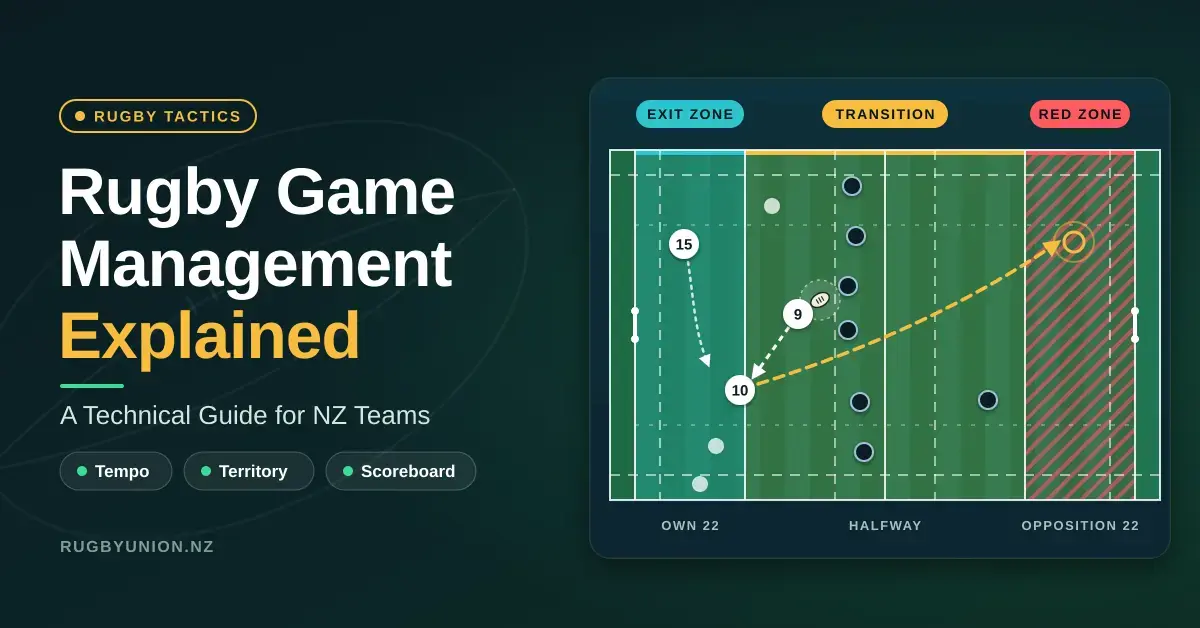
Game management is the part of rugby that rarely shows up on a highlights reel yet decides most tight matches. It is the running set of decisions a team makes about tempo, field position and the scoreboard so that its physical effort turns into points. In New Zealand’s fast, high-contact version of the game, those calls are usually driven by the team’s “spine” — the players down the middle who touch the ball most — and by a captain who reads the referee. This guide explains, in plain terms, how Kiwi teams control a game: how the pitch is split into zones, why the halfback sets the rhythm, when to take points instead of chasing a try, and how the current laws shape every one of those choices.
Quick Facts
| What it is | Decision-making about tempo, territory and the scoreboard to control a match |
| Key players | Scrum-half (9), fly-half (10), fullback (15) and the captain |
| The three zones | Exit (own 22), transition (halfway), red zone (opposition 22) |
| Shot clock | About 60 seconds for a kick at goal (penalties and conversions), in force since 2024 |
| “Use it” call | Five seconds to play the ball once the referee calls it at a ruck |
| 50/22 | Kick from your own half into touch inside the opposition 22 wins your lineout throw |
What game management means in New Zealand rugby

At its simplest, game management is decision-making under fatigue. A team can be fitter and more skilful than its opponent and still lose if it plays the wrong rugby in the wrong part of the field. Managing a match means constantly weighing three things against each other: keeping the ball, where on the field the next contest happens, and the risk attached to each play. Get the balance right and pressure builds on the opposition until they make a mistake.
Because ball-in-play time in Super Rugby Pacific and international rugby keeps climbing, the ability to deliberately speed a game up or slow it down is now as valuable as any individual skill. The four everyday levers look like this:
- Tempo — choosing when to play fast “quick ball” and when to slow the ruck to let tired forwards recover.
- Territory — often prioritising field position over possession so mistakes happen in the opponent’s half, not yours. Our guide to controlling territory covers this in depth.
- Risk — only attempting high-risk plays such as long passes or offloads in the safe parts of the pitch.
- Scoreboard — understanding what the current margin means in terms of “scores”, not just points.
The three-zone map of the pitch
Most New Zealand coaches teach players to see the field as three zones, each with a different job. Because rugby is played on a fixed field — roughly 100 metres between the try lines, as our explainer on rugby field dimensions sets out — the 22-metre lines are the natural boundaries between those zones.

The exit zone (inside your own 22)
Here the only goal is to escape safely. New Zealand teams are known for low-risk exits: a clearing kick to touch or a high, contestable box kick, never a loose offload. The 50/22 law makes this zone more dangerous than it used to be, because a poor kick can hand the opposition an attacking lineout inside your 22. Options a game manager weighs in the exit zone include finding touch to earn a lineout, calling a “mark” after catching a high ball to win a free kick, and forming a wall of forwards to protect the kicker from a charge-down.
The transition zone (around halfway)
In the middle third the aim shifts to manipulation. Teams use forward “pods” (small groups of three or four) to drag defenders out of position, probe for a mismatch, or set up a 50/22 kick. This is the zone where a side decides whether it is building an attack or simply squeezing the opponent back toward their own line.
The red zone (inside the opposition 22)
Once a team reaches the opponent’s 22 the margin for error disappears and play becomes clinical. Common weapons are the rolling maul from a lineout, short pick-and-go carries close to the ruck, and pre-planned strike plays out wide. If the defence holds, the manager’s job is to keep points on the table — a shot at goal or a drop goal — rather than force a low-percentage offload.
| Zone | Primary goal | Typical NZ choice |
|---|---|---|
| Exit (own 0–22m) | Clear safely | Contestable box kick or deep clearance to touch |
| Transition (around halfway) | Manipulate the defence | Forward pods, kick-pass or a 50/22 attempt |
| Red zone (opposition 22m) | Score | Rolling maul, pick-and-go or a set strike play |
Tempo and the halfback’s role
The scrum-half (number 9) is the metronome of a team. They decide how quickly the ball leaves each ruck, and that single choice shapes the whole game. If the forwards are blowing hard, the 9 will delay the pass a beat to let them recover. If the defence is scrambling, the 9 fires the ball away instantly to attack before the defensive line can reset. A well-timed snipe from the base of the ruck can also break the gain line and swing momentum. Understanding how the 9, the fly-half (10) and the fullback (15) share these duties is easier once you know what each rugby position does.
The “use it” five-second call
Once the ball is clearly won and available at the back of a ruck, the referee can call “use it”, after which the team has five seconds to play it away or concede a scrum. This is a long-standing law rather than a new rule, but managing it well matters: a sharp 9 uses those seconds to let attacking pods get set before launching, instead of being caught reacting.
| Tempo | Halfback action | Tactical benefit |
|---|---|---|
| Fast | Instant quick ball | Attacks a retreating, disorganised defence |
| Slow | Delayed pick-up | Lets the tight forwards catch their breath |
| Variable | Box kick or kick-pass | Forces the back three to keep turning and retreating |
Points or territory: the captain’s call
When a penalty is awarded in the opposition half, the captain chooses between kicking at goal for three points, kicking to touch for an attacking lineout, or taking a quick tap. In New Zealand the decision is usually framed around the “seven-point” gap — the value of a converted try. If a side leads by four, kicking the three moves it to seven ahead, meaning the opponent now needs two scores rather than one. If a side trails by eight, three points does not change how many scores it needs, so it will often go for the try instead.
The 60-second shot clock
Under the law package in force since 2024, a kicker has about 60 seconds to take a shot at goal — measured from when the referee is told a team is kicking for a penalty, and the same window now applies to conversions. Overstepping it costs the penalty kick (play restarts with a scrum to the other side) or the conversion. That is why captains are coached to commit to the decision the instant the penalty is blown rather than debating it and rushing the kicker.
| Scenario | Common decision | Reasoning |
|---|---|---|
| Early in the match | Take the three | Build an early lead and reward defensive pressure |
| Trailing by five | Kick to the corner | One converted try puts the team in front |
| Leading by four | Take the three | Stretches the gap to seven, a full converted try |
Kicking as a control tool: the 50/22 and the box kick
Kicking is the fastest way to relocate a game, moving play tens of metres downfield in a single action — the reason coaches stress why kicking matters so much. The 50/22 law is the clearest example. If a player kicks from inside their own half and the ball bounces in the field of play before rolling into touch inside the opposition 22, the kicking team throws into the resulting lineout. The threat alone forces defending wings to drop deeper, thinning the front-line defence and creating space for a running game.
The box kick, taken by the 9 from the base of a ruck, is best understood as a contest rather than a clearance. With enough hang time the chasers can arrive as the ball lands and either win it back or pressure an isolated catcher into a penalty. Other tools include the grubber kick along the ground to beat a rushing defence, the cross-field kick to a wing, and the deep territorial punt to pin an opponent in their exit zone.
| Kick type | Intent | Desired result |
|---|---|---|
| 50/22 | Swing territory | An attacking lineout inside the opposition 22 |
| Box kick | Contest possession | A turnover or a penalty from an isolated catcher |
| Long punt | Force an exit | Field position gained on the return |
Defence, discipline and the referee

A team also manages the game without the ball. A fast, connected defensive line dictates where the attack can go and can push opponents back toward their own line until they are trapped in the exit zone — territorial control achieved through defence rather than kicking. Coordinated defensive systems such as the rush, the drift and a swinging backfield of the two wings and the fullback all serve that aim, each trading a different risk for a different reward.
Lower tackle height and the breakdown
Defensive management has adjusted to the lowered tackle height now used across New Zealand community grades, where the first tackler must make contact below the sternum. After two seasons of trials worldwide, World Rugby adopted the lower height into community law from 1 July 2026. In practice defenders favour a low, dominant tackle that gets the carrier to ground quickly so a specialist openside can attack the ball, which speeds up the turnover contest at the breakdown.
Managing the referee and the sin bin
Discipline is a management tool in its own right. Captains are coached to be respectful but inquisitive — asking a referee for clarity on the offside line, for example, rather than arguing — because a team that keeps its penalty count low is far easier to control territorially. When a player is sent to the sin bin for ten minutes, the plan shifts to damage control: keeping the ball, taking time at set pieces and protecting the widest channels until the team is back to fifteen. Knowing the yellow and red card rules is part of managing that risk before it happens.
Key Points
- Territory often beats possession: play in the opponent’s half so their mistakes, not yours, are punished.
- The scrum-half sets tempo — fast ball attacks a scrambling defence, slow ball lets forwards recover.
- Read the margin in “scores”, not points: moving a lead to seven forces the opponent to score twice.
- Keep the penalty count low; a disciplined side is far easier to manage territorially.
- Adapt to the weather — kick more in the rain and wind, keep it tight when playing into a gale.
- Use “finishers” off the bench to win the final quarter, especially through a fresh front row.
Bench and conditions: finishers and the weather
Game management runs through to the coaching box. Modern New Zealand squads call their replacements “finishers” because they are picked to influence the final quarter, not simply to cover injuries. A fresh front row introduced around the hour mark can dominate a tiring scrum and win late penalties; a quick replacement halfback can expose a fatigued defence. Some sides go further with a heavily forward-loaded bench to reset their physical edge late in the game.
Wet and windy conditions
New Zealand’s climate demands its own plan. In heavy rain, possession becomes a liability because handling errors are more likely, so teams kick more and rely on the opposition dropping a slippery ball. Wind matters just as much: with a strong wind at your back at a ground like Wellington’s Sky Stadium, the plan is to kick long, pin the opponent and bank every kickable penalty; playing into the wind, sides keep it tight with short passes and forward carries to avoid a ball being caught by the gale.
| Conditions | Primary tactic | Main risk |
|---|---|---|
| Heavy rain | Territorial kicking | Dropped ball under a high kick |
| Wind at your back | Long kicking, bank penalties | Ball going dead in-goal |
| Wind in your face | Forward carries, keep it tight | Fatigue and turnovers at the ruck |
Bringing it together on match day
Good game management is not one grand plan but a chain of small, correct decisions repeated for eighty minutes: the right kick from the exit zone, the right tempo at the ruck, the right choice between points and territory, and the discipline to keep the referee onside. As the laws continue to reward speed, safety and continuity, the thinking side of rugby only grows in importance — which is why the best New Zealand teams treat every phase as a chance to control the game rather than simply react to it.
Sources
- World Rugby – Fan-focused law changes confirmed (shot clock and set-piece timing)
- World Rugby Passport – Law 15: Ruck (“use it” five-second call)
- World Rugby – Lower tackle height in community rugby
- New Zealand Rugby – Community game innovations (tackle height)
- New Zealand Rugby – Hilux domestic rugby partnership (NPC naming)
Frequently Asked Questions
What is rugby game management?
It is the ongoing tactical decision-making around tempo, field position and the scoreboard that a team uses to control a match and turn effort into points.
Who runs game management on the field?
Mostly the team’s “spine” — the hooker, number 8, scrum-half, fly-half and fullback — with the captain leading the decisions on penalties and communication with the referee.
What is the 50/22 rule?
If a player kicks from inside their own half and the ball bounces in the field of play before going into touch inside the opposition 22, the kicking team throws into the lineout, rewarding accurate kicking with attacking field position.
Why do teams sometimes kick a penalty instead of going for a try?
To keep scoreboard pressure and manage the margin in terms of scores. Moving a lead to seven points, for example, forces the opponent to score twice rather than once.
What happens if an attacker is held up over the try line?
The defending team is awarded a goal-line drop-out, restarting play from their own goal line. It denies the attack a five-metre scrum but only gives the defence limited territory, so it is a valuable relief rather than a big gain.