Few laws shape the rhythm of a rugby match as much as advantage. It is the reason a referee can spot a knock-on or an offside yet keep an arm out and let play run on, rewarding the team that did nothing wrong instead of stopping the game for every mistake. For New Zealand fans raised on fast, ball-in-hand rugby, understanding advantage is the key to reading why a whistle sometimes comes late — or not at all. This guide explains what the advantage rule actually says under World Rugby Law 7, the difference between tactical and territorial gain, how scrum and penalty advantage differ, when the period ends, and how players and coaches turn it into a free shot at points.
Key Points
- What it is: World Rugby Law 7 — the referee lets play continue after an infringement if the non-offending team can gain a benefit.
- Two types: territorial (ground gained) and tactical (clean ball and space); it may be both.
- Must be “clear and real”: a mere opportunity is not enough.
- Signal: one arm extended toward the non-offending team, held out until the referee decides.
- Two levels: scrum advantage (minor errors, ends fast) and penalty advantage (serious offences, lasts longer).
- The referee decides: there is no fixed time or distance — the official is the sole judge.
What the Advantage Law Actually Says
Advantage is set out in World Rugby Law 7. The principle is simple: if a team gains an advantage after the opposition infringes, the referee may allow play to continue in an effort to keep the game flowing. Rather than blowing up immediately for a minor error or a penalty offence, the official lets the non-offending team see whether playing on leaves them better off than the scrum or penalty they would otherwise be given.

The law makes the referee the sole judge of whether an advantage has been gained. There is no fixed time and no fixed distance — the referee decides, based on what is happening in front of them, when a real benefit has been earned. Crucially, the law states that the advantage must be “clear and real”; the mere opportunity to gain an advantage is not enough. A half-chance that comes to nothing is not an advantage, and play will be brought back.
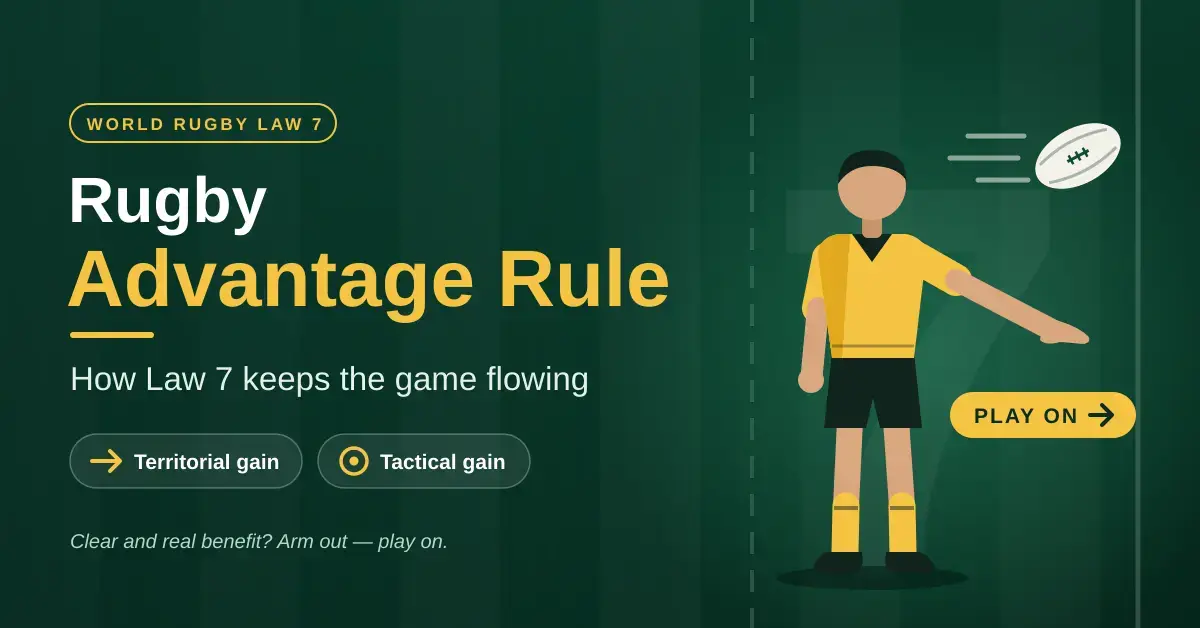
The signal is easy to spot. The referee extends one arm horizontally toward the non-offending team and will often call “advantage” out loud, keeping the arm out until they decide the advantage is over or the play is brought back. In a fluid game like New Zealand’s — whether that is Super Rugby Pacific, the Bunnings NPC or a Saturday club match — that outstretched arm is a green light to keep attacking.
Tactical vs Territorial Advantage
Law 7 recognises two kinds of benefit, and referees look for either one (or both).
- Territorial advantage means play has moved toward the offending team’s goal line. The non-offending team has physically gained ground compared with where the infringement happened.
- Tactical advantage means the non-offending team is free to play the ball as they wish. They may not have travelled far, but they have clean possession and a genuine chance to launch an attack — for example, a halfback with quick ball and options outside them.
- A combination of the two is common: a line break that carries the ball forward and leaves the attack with space to keep going.
Judging “Clear and Real” Gain
There is no metre marking in the law book, so referees rely on feel and context. Ground gained, the quality of possession and where it happens on the field all matter. A team pinned inside its own 22-metre line clearing to halfway has clearly gained; a side already deep in the opposition 22 may not, because a penalty there is worth far more than a couple of metres. Understanding how sides read the pitch is part of wider rugby game management, where tempo and field position drive most decisions.
Scrum Advantage vs Penalty Advantage
The referee’s arm looks the same either way, but the two types of advantage carry very different weight. The key is what the team would fall back on if the advantage fails.
Scrum vs Penalty Advantage
| Feature | Scrum Advantage | Penalty Advantage |
|---|---|---|
| Triggered by | Minor error (knock-on, forward pass) | Serious offence (offside, breakdown, foul) |
| Fallback if it fails | Scrum to the non-offending team | Penalty kick (points or kick to touch) |
| Referee patience | Low — called over quickly | High — may run several phases |
| Value | Minor tactical bonus | Major momentum shift |
| Can it upgrade? | Only if a further, more serious foul occurs | Captain may choose the best sanction after a second foul |
Scrum Advantage
A scrum advantage follows a minor, non-penalty error — most often a knock-on or a forward pass. Because the fallback is only a scrum, the bar for calling “advantage over” is low. If the non-offending team makes a small gain or wins fast, usable ball, the referee will quickly call the advantage complete and play carries on. If they fumble or are tackled immediately with nothing gained, the whistle goes and the game returns to the mark for the scrum. To understand what they would be going back to, it helps to know how a scrum works.
Penalty Advantage
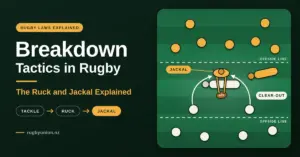
A penalty advantage follows a more serious offence — offside, a deliberate infringement, or an illegal act at the breakdown. Because the fallback is a full penalty (three points on offer, or a big territorial kick to touch), the referee is far more patient and may let several phases play out to see whether a try or major break results. Many of these offences happen at the contact area, so recognising them ties in closely with breakdown tactics like the ruck and jackal, and with the offside rules that trigger so many of them.
How and When Advantage Ends
This is the part beginners find hardest to read live. Under Law 7, the referee can end advantage in one of four ways:
- The non-offending team gains a clear advantage, so the referee calls “advantage over” and play simply continues.
- The non-offending team is unlikely to gain any advantage, so the referee stops play and applies the original sanction (the scrum or penalty).
- The non-offending team commits its own infringement before gaining an advantage, so the referee stops play and applies the first sanction — the original offence still stands.
- The offending team infringes again with no advantage gained, so the referee stops play and lets the non-offending captain choose the most advantageous option.
This is why coaches drill players to “play to the whistle.” Until the referee confirms the advantage is over, the team is effectively getting a free play: if the move breaks down, they return to the original mark.
Kicks, Touch and the Dead Ball
Advantage cannot continue once the ball is dead — for example, if it goes into touch, into in-goal and is grounded, or play otherwise stops. Kicking during advantage is a gamble: the referee waits to see the outcome, and if the kick is poor or is fielded comfortably by the opposition, the advantage is usually judged to have failed and play returns for the original offence. A well-weighted kick that regains territory or possession, on the other hand, can be the advantage itself — which is why kicking sits at the heart of winning field position.
Advantage Near the Try Line
Close to the goal line the calculation changes. A penalty advantage five metres out is enormously valuable, so referees tend to be patient and let attacking teams take repeated pick-and-go carries, knowing that if the attack stalls they can still return for the penalty. That safety net encourages relentless pressure. If the defending side infringes again in a clear try-scoring situation, the referee can award a penalty try. Modern try-line calls are increasingly settled by replay, which is where goal-line technology and the TMO come in.
Advantage, Foul Play and Player Safety
Advantage never overrides safety. If an infringement involves dangerous foul play — a high tackle to the head, a tip tackle or anything that risks injury — the referee will often stop play immediately to deal with it and check on any injured player. Head contact in particular is treated as a red line in the modern game.
In professional competitions such as Super Rugby Pacific, the Foul Play Review process (often called the “bunker”) lets officials keep the game moving. When an incident at least meets the yellow-card threshold but may warrant a red, the referee issues a yellow card and crosses their arms to refer it to a dedicated Foul Play Review Officer, who has up to eight minutes to review the footage and either uphold the yellow or upgrade it to a red. For a full breakdown of sanctions, see the guide to yellow and red card rules.
What Changed for 2026
Contrary to some claims online, World Rugby did not rewrite the advantage law for 2026. What did change are broader pace-of-play measures. Super Rugby Pacific’s 2026 law variations — free kicks (rather than scrums) for accidental offside and certain ruck offences, an expanded 50:22, more flexible quick taps, and the returning 20-minute red card — are aimed at cutting dead time and keeping the ball in play. They shape the environment in which advantage is played, but the core of Law 7 is unchanged.
How Teams Turn Advantage Into Points
Because a failed play simply returns to the mark, attacking teams treat advantage as a low-risk chance to try something ambitious. The first five-eighth (fly-half) usually dictates what happens: a cross-field kick to a winger, a long miss-pass to the edge, or an inside ball to exploit a defender who is out of position after conceding the penalty. Defenders, meanwhile, often hesitate for fear of giving away a second penalty — and sharp attacks lift the tempo to punish that hesitation.
- Communicate: players call “advantage” so teammates know they can take risks.
- Target the offender: attack the space around the player who just infringed, as they may be out of the defensive line.
- Go wide: move the ball to the edges where defenders are stretched.
- Back the kick: use the free play for a high-reward kick that could not be justified in normal play.
Common Mistakes and Who This Helps
The most frequent error in community rugby is stopping when players see the referee’s arm out, assuming the whistle is coming — the arm out is the opposite, a signal to play faster. Another is “milking” the advantage, looking for a second foul instead of simply trying to score. Captains help by managing the referee, checking whether the advantage is still live and, occasionally, preferring an early whistle when a shot at goal from the original penalty is the better option. Whether you are a new fan, a junior player or a coach, reading advantage well turns a confusing pause into one of rugby’s most rewarding moments.
Sources
Frequently Asked Questions
What is the advantage rule in rugby?
Advantage (World Rugby Law 7) lets the referee allow play to continue after an infringement if the non-offending team can gain a clear and real benefit, rather than stopping for the scrum or penalty straight away. The referee is the sole judge of whether that benefit has been gained.
What is the difference between scrum and penalty advantage?
Scrum advantage follows a minor error such as a knock-on, so the fallback is only a scrum and the referee calls it over quickly. Penalty advantage follows a serious offence, so the fallback is a full penalty and the referee is far more patient, often letting several phases play out.
Can you score a try while playing advantage?
Yes. If the non-offending team scores while advantage is being played, the try stands and the advantage is over. Scoring is the maximum benefit possible, so there is no reason to bring play back.
What happens if you knock the ball on during an advantage?
If the team playing under advantage makes its own error before gaining an advantage, the referee stops play and applies the original sanction — you go back to the first offence rather than being punished for the knock-on.
Does a kick end the advantage?
Not automatically. The referee waits to see the result. If the kick is poor or the opposition fields it comfortably, the advantage is usually judged to have failed and play returns for the original offence; a kick that regains ground or possession can count as the advantage itself.