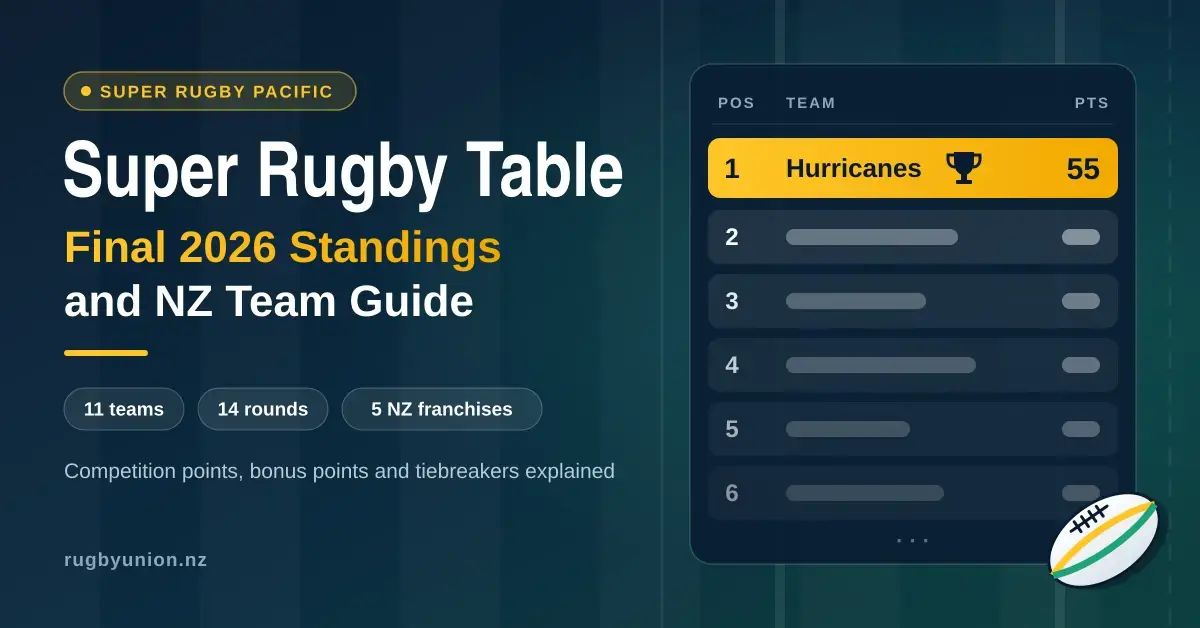
The Super Rugby table is the league ladder that ranks the eleven Super Rugby Pacific franchises across a 14-round regular season, and the 2026 edition finished as one of the most one-sided in the competition’s recent history. This guide explains exactly how the table is built — the competition points, the bonus points and the tiebreakers that separate level teams — and then walks through the completed 2026 standings, how all five New Zealand franchises fared, and how the finals series played out. Whether you are new to rugby union or a long-time follower checking where your side ended up, you will find the verified 2026 numbers alongside plain-English explanations of what every column means.
Key Points
- Champions: the Hurricanes won their 2nd Super Rugby title, beating the Chiefs 60–5 in the Wellington grand final — the biggest winning margin in a Super Rugby decider.
- Minor premiers: the Hurricanes also topped the 14-round table with 55 competition points and a league-best points difference of +264.
- New Zealand dominance: Kiwi franchises filled the top four — Hurricanes, Chiefs, Crusaders and Blues.
- Finals cut-off: the top six qualified; the Highlanders (9th) narrowly missed out and Moana Pasifika finished last on 9 points.
How the Super Rugby table works
Super Rugby Pacific is contested by eleven teams: the five New Zealand franchises (Blues, Chiefs, Crusaders, Highlanders and Hurricanes), four Australian sides (Brumbies, Force, Reds and Waratahs), Fiji’s Drua and the Pacific-Islands side Moana Pasifika. Because eleven teams cannot all play each other home and away, each side plays a fixed 14-match schedule, and the ladder simply ranks them by the competition points they bank over those rounds.
Points are awarded per match rather than per tournament. A win is worth four competition points, a draw two, and a loss none. On top of that, teams can collect two kinds of bonus point — a single extra point that rewards attacking, close-fought rugby even in defeat:
- Try bonus: awarded to any team that scores at least three more tries than its opponent in a match, win or lose.
- Losing bonus: awarded to a team that loses by seven points or fewer.
When two teams finish level on total competition points, the higher ladder position generally goes to the side with more match wins, and if they are still tied, to the team with the better points difference (points scored minus points conceded). Those small margins matter: they decide who hosts a home final and who has to travel. If you want the mechanics in more depth, our guide to how the Super Rugby ladder works breaks the scoring and tiebreakers down step by step.
Reading the columns
Most published Super Rugby tables use the same shorthand headings. Here is what each one means:
- P (or Pld): matches played.
- W / D / L: wins, draws and losses.
- PF: points for — the total points the team has scored.
- PA: points against — the total conceded.
- PD (or +/−): points difference, PF minus PA.
- BP: bonus points, the try and losing bonuses combined.
- Pts: total competition points, which set the ladder order.
Final 2026 Super Rugby Pacific standings
After 14 rounds, the Hurricanes finished as minor premiers — the team that tops the regular-season table — with 55 points and a competition-best points difference of +264. The top six qualified for the finals. The full 2026 ladder is below; it doubles as a quick reference for how each franchise’s season broke down.
| Pos | Team | P | W | L | PF | PA | +/− | BP | Pts |
|---|---|---|---|---|---|---|---|---|---|
| 1 | Hurricanes | 14 | 11 | 3 | 562 | 298 | +264 | 11 | 55 |
| 2 | Chiefs | 14 | 11 | 3 | 515 | 325 | +190 | 7 | 51 |
| 3 | Crusaders | 14 | 8 | 6 | 488 | 388 | +100 | 9 | 41 |
| 4 | Blues | 14 | 8 | 6 | 456 | 412 | +44 | 6 | 38 |
| 5 | Reds | 14 | 8 | 6 | 364 | 386 | −22 | 5 | 37 |
| 6 | Brumbies | 14 | 7 | 7 | 402 | 373 | +29 | 6 | 34 |
| 7 | Force | 14 | 7 | 7 | 358 | 383 | −25 | 2 | 30 |
| 8 | Waratahs | 14 | 5 | 9 | 353 | 402 | −49 | 8 | 28 |
| 9 | Highlanders | 14 | 5 | 9 | 327 | 424 | −97 | 4 | 24 |
| 10 | Drua | 14 | 5 | 9 | 330 | 473 | −143 | 1 | 21 |
| 11 | Moana Pasifika | 14 | 2 | 12 | 276 | 567 | −291 | 1 | 9 |
The table shows how tight the middle of the ladder was: the Crusaders, Blues and Reds all won eight matches, and only four competition points separated third from fifth. At the other end, Moana Pasifika finished bottom on nine points after a difficult campaign that saw them concede 567 points across the season.
Season Snapshot
| Competition | Super Rugby Pacific 2026 |
|---|---|
| Teams | 11 (5 NZ, 4 Australia, Fijian Drua, Moana Pasifika) |
| Regular season | 14 rounds, February–May 2026 |
| Minor premiers | Hurricanes (55 points) |
| Champions | Hurricanes (2nd title) |
| Runners-up | Chiefs |
| Grand final | Hurricanes 60–5 Chiefs, Wellington, 20 June 2026 |
| Top points scorer | Ruben Love (Hurricanes), 138 |
| Top try scorers | Fehi Fineanganofo & Josh Moorby (Hurricanes), 17 each |
The five New Zealand franchises in 2026
New Zealand teams dominated the top of the 2026 table, taking the first four places. For a fuller picture of where each side landed and how the ladder settled, the site’s Super Rugby standings page tracks the same season, while the Super Rugby Pacific format guide covers the competition’s structure and history.
Hurricanes and Chiefs set the pace
The Hurricanes were the outstanding side of the season. Eleven wins from fourteen, a +264 points difference and a league-high eleven bonus points gave them 55 competition points and top seeding. The Chiefs shadowed them all year, also winning eleven matches and finishing on 51 points, their slimmer bonus-point haul the main gap between the two. Those two seeds proved decisive once the finals arrived.
Crusaders, Blues, Reds and the chasing pack
The Crusaders, reigning champions after their 2025 title, could not repeat their table-topping form but still finished third on 41 points and reached the semi-finals. The Blues took fourth on 38 points, edging the Reds — the highest-placed Australian side going into the final rounds — who ended fifth on 37. The Brumbies claimed the last qualifying spot in sixth. Among the New Zealand sides, only the Highlanders missed the cut, finishing ninth on 24 points after a season in which their defence conceded 424 points.
How the 2026 finals played out
The top six teams advanced to a three-week finals series. The 2026 season used a format built around a “highest-ranked loser” safety net: the three qualifying finals were seeded 1v6, 2v5 and 3v4, and the three winners plus the best-placed losing team went through to the semi-finals, with the higher seeds hosting throughout.

In the qualifying finals, the Hurricanes overwhelmed the Brumbies, the Chiefs saw off the Reds, and the Crusaders beat the Blues. That left the Blues as the highest-ranked loser, so they progressed as the fourth semi-finalist and travelled to Wellington. The Hurricanes then beat the Blues again, and the Chiefs accounted for the Crusaders, setting up an all-New Zealand decider.
| Stage | Match | Result |
|---|---|---|
| Qualifying final | Hurricanes v Brumbies | 66–12 |
| Qualifying final | Chiefs v Reds | 46–24 |
| Qualifying final | Crusaders v Blues | 52–31 |
| Semi-final | Hurricanes v Blues | 57–21 |
| Semi-final | Chiefs v Crusaders | 49–12 |
| Grand final | Hurricanes v Chiefs | 60–5 |
The grand final, played in Wellington on 20 June 2026, was the most lopsided decider in Super Rugby history. The Hurricanes led 29–0 at half-time and ran out 60–5 winners over the Chiefs to claim their second Super Rugby title, surpassing the previous record margin for a final. It was the ninth all-New Zealand championship match in the competition’s history.
Why bonus points shaped the 2026 table
Bonus points are the quiet mover of any Super Rugby ladder, and 2026 was a clear example. The Hurricanes banked eleven of them — more than any other side — which is why they finished four points clear of the Chiefs despite both winning eleven matches. Attacking, high-tempo rugby that regularly clears the three-try margin turns narrow ladder gaps into decisive ones over a 14-round season.
The trend cut the other way lower down. The Force matched the Brumbies on seven wins but finished below them because they collected only two bonus points to the Brumbies’ six. The Drua and Moana Pasifika managed just one bonus point each all season. Much of that high-scoring, offload-heavy style traces back to the competition’s law settings — our explainer on the 2026 breakdown law changes shows how quicker ruck ball has pushed try counts up.
The Australian teams and the bottom of the table
While New Zealand sides monopolised the top four, the 2026 table also shows how finely the Australian conference was balanced. The Reds, Brumbies and Force all played their part in the finals race: the Reds and Brumbies both reached the top six, and the Force missed out by a single place despite matching the Brumbies on seven wins. The Waratahs, by contrast, collected eight bonus points — a healthy total — but only five wins, leaving them eighth and short of a finals berth. It is a good illustration of why wins, not bonus points, form the backbone of any ladder: bonus points refine positions, but they rarely rescue a season on their own.
At the foot of the table, the Drua and Moana Pasifika endured the toughest campaigns. The Drua’s home form in Fiji kept several results competitive, but heavy away defeats left them with a −143 difference in tenth. Moana Pasifika finished last on nine points, winning just twice and conceding 567 points across the season — the clearest defensive gap in the competition. For both Pacific franchises, closing that points-against column is the single biggest lever for climbing the 2026-style ladder in future seasons.
Leading scorers and records of 2026
Individual performances mirrored the table. The Hurricanes supplied the season’s leading point scorer, fly-half Ruben Love, who amassed 138 points, and shared the try-scoring lead too: Fehi Fineanganofo and Josh Moorby finished level on 17 tries each. Love added 25 points in the grand final itself, capping a campaign in which the Wellington side’s scoreboard pressure was central to their run to the title. External season archives such as Wikipedia catalogue the wider round-by-round record.
How 2026 compared with 2025
The 2026 table marked a clear change of guard at the top. Twelve months earlier the Crusaders had won the 2025 crown, beating the Chiefs 16–12 in a tight Christchurch final; you can revisit that campaign in our Super Rugby 2025 recap and the report on the 2025 Super Rugby final. In 2026 the Hurricanes replaced them as both minor premiers and champions, and the margin of their finals wins — 66–12, 57–21 and 60–5 — stood in sharp contrast to the low-scoring 2025 decider. For fans, the takeaway is how quickly the ladder can turn: a side that lifts the trophy one year is far from guaranteed the following season.
Final thoughts
The completed 2026 Super Rugby table tells a simple story — New Zealand franchises filled the top four places, the Hurricanes were a cut above from the opening rounds to the final whistle, and bonus points quietly decided several key positions. Reading a Super Rugby ladder well means looking past the points column to the wins, the points difference and the bonus points that sit behind it, because those are the numbers that ultimately shape who hosts finals and who lifts the trophy. With the 2026 season now settled, the table stands as a full record of one of the most dominant title runs the competition has seen.
Reference sources
Frequently Asked Questions
Who won the 2026 Super Rugby Pacific title?
The Hurricanes won the 2026 title, beating the Chiefs 60–5 in the grand final in Wellington on 20 June 2026. It was the Hurricanes’ second Super Rugby championship and the largest winning margin ever recorded in a Super Rugby decider.
How is the Super Rugby table decided?
Teams earn four competition points for a win and two for a draw, plus a bonus point for scoring three or more tries than their opponent and a bonus point for losing by seven points or fewer. The ladder ranks teams by total competition points, using wins and then points difference to separate any that finish level.
Where did the New Zealand teams finish in 2026?
New Zealand sides took the top four places: the Hurricanes finished first, the Chiefs second, the Crusaders third and the Blues fourth. The Highlanders were the only Kiwi franchise to miss the finals, ending the regular season ninth.
How many teams make the Super Rugby finals?
The top six teams on the regular-season table qualify for the finals series. In 2026 the qualifying finals were seeded 1v6, 2v5 and 3v4, with the three winners and the highest-ranked losing team advancing to the semi-finals.
What is a bonus point in Super Rugby?
A bonus point is a single extra competition point a team can earn in a match. One is awarded for scoring at least three more tries than the opposition, and one for losing by a margin of seven points or fewer. Over a season these points can lift a team several places up the table.