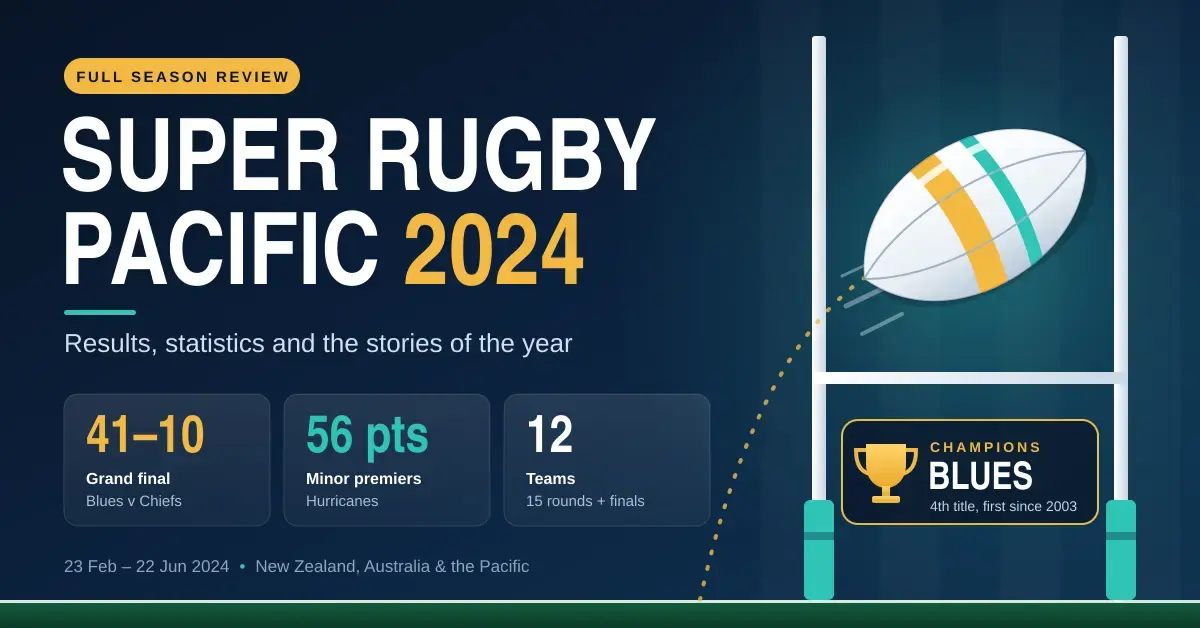
The 2024 Super Rugby Pacific season ended with the Blues finally lifting the trophy again after more than two decades of near-misses. Running from 23 February to 22 June 2024, it packed 12 teams from New Zealand, Australia and the Pacific into a 15-round regular season before an eight-team knockout finals. This guide walks through what happened and why it mattered: the Blues’ drought-breaking championship, the Hurricanes’ regular-season dominance, the shock collapse of the Crusaders, the players who topped the charts, and the law changes that shaped how the year was played. If you are new to the competition, our overview of how Super Rugby Pacific is structured is a useful companion.
Quick Facts
| Champions | Blues (4th title, ending a drought since 2003) |
| Grand final | Blues 41–10 Chiefs, Eden Park, 22 June 2024 |
| Minor premiers (top of ladder) | Hurricanes – 56 points |
| Runners-up | Chiefs |
| Top points scorer | Damian McKenzie (Chiefs) – 177 |
| Top try scorers | Sevu Reece (Crusaders) & Hoskins Sotutu (Blues) – 12 each |
| Teams | 12 (5 New Zealand, 4 Australia, Fijian Drua, Moana Pasifika) |
| Format | 15-round regular season, top 8 into the finals |
| Tries | 663 in 91 matches (7.29 per match) |
Key Points
- The Blues won their fourth title and first since 2003, beating the Chiefs 41-10 at Eden Park.
- The Hurricanes topped the regular-season ladder with 56 points, one clear of the Blues.
- The seven-time champion Crusaders collapsed to ninth and missed the finals for the first time in years.
- Damian McKenzie led the scoring (177 points); Sevu Reece and Hoskins Sotutu shared the try lead (12).
- The Fijian Drua reached a second straight quarter-final, and the Melbourne Rebels made their first finals.
The Blues End a 21-Year Title Drought
The story of the 2024 season is the resurgence of the Blues under head coach Vern Cotter. The Auckland franchise had not won a Super Rugby title since 2003, the longest championship drought in the competition’s history. In 2024 they built their campaign on a settled forward pack, the fewest points conceded in the league, and a home ground that opponents simply could not crack. Their reward was a home final at Eden Park, where a dominant scrum and a hat-trick from wing Caleb Clarke delivered a one-sided 41-10 win over the Chiefs in front of a crowd of more than 44,000. Lock and skipper Patrick Tuipulotu was named player of the match.
It was the fourth title in Blues history and a genuine shift in the balance of New Zealand rugby, which had been dominated by the Crusaders for the best part of a decade. Playmakers such as Beauden Barrett gave the backline control, while the pack provided the platform that had been missing in previous seasons.
How the Blues’ finals run played out
The Blues qualified second on the ladder and then won all three knockout matches at Eden Park, never really looking troubled once the playoffs began.
| Stage | Result | Venue |
|---|---|---|
| Regular season | 12 wins, 2 losses (2nd, 55 points) | — |
| Quarter-final | Blues 36–5 Fijian Drua | Eden Park |
| Semi-final | Blues 34–20 Brumbies | Eden Park |
| Grand final | Blues 41–10 Chiefs | Eden Park |
The Hurricanes and the Minor Premiership
While the Blues took the silverware, the Hurricanes were the most consistent side across the regular season. The Wellington franchise finished first on the ladder with 56 competition points, one clear of the Blues on 55, to claim the minor premiership. They played an expansive, high-tempo game built on the speed of their outside backs and a mobile loose-forward trio, and they were regularly able to punish turnovers with long-range tries.
Veteran halfback TJ Perenara took on a leadership role after first-choice number nine Cam Roigard suffered a season-ending knee injury, steadying the side through the run-in. Their year still ended in disappointment: the Hurricanes were beaten 30-19 by the Chiefs in a home semi-final, proving that finishing top of the table guarantees nothing once the knockout rounds begin. If the points and bonus-point system is new to you, see our explainer on how the Super Rugby ladder works.
Why the regular season and the title went to different teams
- The ladder rewards consistency across 14 matches, including bonus points for scoring four or more tries or losing by seven or fewer.
- The finals reward form on the day, home advantage and set-piece control in single-elimination rugby.
- In 2024 the Hurricanes won the first race and the Blues won the second, a reminder that the two prizes are decided very differently.
The Surprising Fall of the Crusaders
The biggest shock of the season was the defending champion Crusaders failing to reach the playoffs at all. After a remarkable run of seven straight titles (including the two Super Rugby Aotearoa seasons played during the pandemic), the Christchurch side finished ninth with just four wins from 14 matches. A coaching transition, a heavy injury toll among their All Blacks and uncharacteristic errors turned tight games into losses.
| Season | Ladder finish | Outcome |
|---|---|---|
| 2022 | Top of the table | Champions |
| 2023 | Finals qualifier | Champions (seventh straight title) |
| 2024 | 9th | Missed the finals |
There were still bright spots in red and black: wing Sevu Reece finished as a joint-leading try-scorer for the competition despite his team’s struggles. The collapse underlined how much parity there now is in the competition, where even a dynasty can slip out of the top eight in a single season. The Crusaders would recover quickly, bouncing back to win the title in the 2025 Super Rugby Pacific season.
Individual Statistical Leaders
Individual brilliance was on show throughout 2024. Chiefs first five-eighth Damian McKenzie confirmed his status as the region’s premier playmaker, finishing as the leading points scorer with 177 points from tries, conversions and penalties, and steering his side to a second straight grand final. Among the forwards, Blues number eight Hoskins Sotutu redefined what a loose forward can produce in the scoring zones.
- Top points scorer: Damian McKenzie (Chiefs) – 177 points.
- Top try scorers: Sevu Reece (Crusaders) and Hoskins Sotutu (Blues) – 12 tries each.
- Grand final player of the match: Patrick Tuipulotu (Blues).
- Attacking headline: 663 tries across 91 matches, an average of 7.29 per game.
Law Variations: Golden Point, 50:22 and Faster Rugby
Super Rugby Pacific has long used a set of trial law variations aimed at keeping the ball in play and creating dramatic finishes, and 2024 was no exception. The most talked-about is the Golden Point rule, which decides drawn regular-season matches, but several other tweaks also shaped tactics. Understanding these helps explain the season’s high-scoring, high-tempo style; our guide to rugby game management covers how coaches respond to them.
| Law variation | What it does |
|---|---|
| Golden Point | If scores are level after 80 minutes, up to 10 minutes of sudden-death extra time is played; the first team to score any points (try, penalty try, penalty goal or drop goal) wins, otherwise the match is a draw. |
| 50:22 kick | A kick from a team’s own half that bounces into touch inside the opposition 22 hands that team the lineout throw, rewarding accurate territorial kicking. |
| 20-minute red card | A player shown a red card is permanently removed, but the team may replace them after 20 minutes rather than playing a man short for the rest of the match. |
| Goal-line drop-out | When an attacker is held up over the line or knocks on in in-goal, play restarts with a drop-out rather than an attacking scrum, speeding the game up. |
Together with shot clocks that limit the time allowed for conversions and set-piece resets, these variations pushed ball-in-play time up and helped produce one of the most entertaining seasons on record.
Home Advantage and the Eden Park Fortress
A defining feature of 2024 was the return of home advantage as a decisive factor. The Blues were unbeaten at Eden Park all year, and traveling to New Zealand remained the hardest task in the competition for Australian and Pacific sides. Part of that is set-piece stability in front of a home crowd, and part of it is simply the toll of travel: a competition that stretches from Perth in the west to Suva in the north makes distance and scheduling a genuine, almost geographic constraint on results, a theme explored in books such as Prisoners of Geography. In 2024 the New Zealand franchises again protected their home venues far more reliably than they won on the road.

The Rise of Moana Pasifika and the Fijian Drua
The competition’s two Pacific franchises continued to grow. The Fijian Drua reached the quarter-finals for a second consecutive year, confirming that their fast, offloading game is a match for anyone, especially in the heat of a home fixture. Moana Pasifika also improved, winning four matches and climbing off the bottom of the table, with a notable upset among their results. Their competitiveness matters for the long-term health of a genuinely trans-Pacific competition.
| Franchise | 2024 ladder finish | Wins | Best result |
|---|---|---|---|
| Fijian Drua | 7th | 6 | Quarter-finalists (second year running) |
| Moana Pasifika | 11th | 4 | Climbed off the foot of the table |
The Race for the Top Eight and Final Standings
Twelve teams played 14 matches each, and the top eight advanced to the finals. The race for the lower playoff places went to the wire: the Highlanders sneaked in sixth, and the Melbourne Rebels qualified for their first-ever finals series in what proved to be the club’s final season. The full regular-season table is below.
| Pos | Team | Wins | Losses | Points |
|---|---|---|---|---|
| 1 | Hurricanes | 12 | 2 | 56 |
| 2 | Blues | 12 | 2 | 55 |
| 3 | Brumbies | 12 | 2 | 52 |
| 4 | Chiefs | 9 | 5 | 43 |
| 5 | Reds | 8 | 6 | 40 |
| 6 | Highlanders | 6 | 8 | 28 |
| 7 | Fijian Drua | 6 | 8 | 26 |
| 8 | Melbourne Rebels | 5 | 9 | 26 |
| 9 | Crusaders | 4 | 10 | 24 |
| 10 | Western Force | 4 | 10 | 20 |
| 11 | Moana Pasifika | 4 | 10 | 18 |
| 12 | Waratahs | 2 | 12 | 13 |
How the finals unfolded
- Quarter-finals: Chiefs 43–21 Reds; Hurricanes 47–20 Rebels; Blues 36–5 Fijian Drua; Brumbies 32–16 Highlanders.
- Semi-finals: Blues 34–20 Brumbies (Auckland); Chiefs 30–19 Hurricanes (Wellington).
- Grand final: Blues 41–10 Chiefs at Eden Park on 22 June 2024.
What the 2024 Season Meant
The 2024 campaign will be remembered as the year Auckland rugby reclaimed its throne and the Crusaders dynasty finally cracked. It blended high-scoring entertainment with fierce physical contests, the Pacific franchises kept closing the gap, and a new generation of players pushed their All Blacks claims. For a look at how the balance of power shifted again the following year, the 2025 final saw the Crusaders return to the top of the competition, showing just how quickly fortunes can turn in the modern Super Rugby era.
Reference sources
- 2024 Super Rugby Pacific season – season summary and final standings
- 2024 Super Rugby Pacific final – match details
- RNZ – Blues cruise to title with 41-10 win over Chiefs at Eden Park
- RugbyPass – Blues outmuscle Chiefs to be crowned 2024 champions
- Super Rugby Pacific – 2024 official fixtures and results archive
- Rugby.com.au – Super Rugby Pacific law variations
Frequently Asked Questions
Who won Super Rugby Pacific 2024?
The Blues won the 2024 title, beating the Chiefs 41-10 in the grand final at Eden Park on 22 June 2024. It was their fourth championship and ended a title drought that stretched back to 2003.
Which team finished top of the 2024 regular-season ladder?
The Hurricanes finished first on the ladder with 56 competition points, just one point ahead of the Blues on 55, to claim the minor premiership before the finals.
Who were the leading scorers in the 2024 season?
Damian McKenzie of the Chiefs was the top points scorer with 177, while Sevu Reece of the Crusaders and Hoskins Sotutu of the Blues shared the most tries with 12 each.
Why did the Crusaders miss the 2024 finals?
The defending champions finished ninth with only four wins from 14 matches, ending a run of seven straight titles. A coaching change, injuries and unusually high error counts all played a part.
What is the Golden Point rule in Super Rugby Pacific?
If a regular-season match is level after 80 minutes, up to 10 minutes of sudden-death extra time is played. The first team to score any points wins; if no one scores, the match is recorded as a draw.